Could Recovery Reinforce Power in Venezuela?
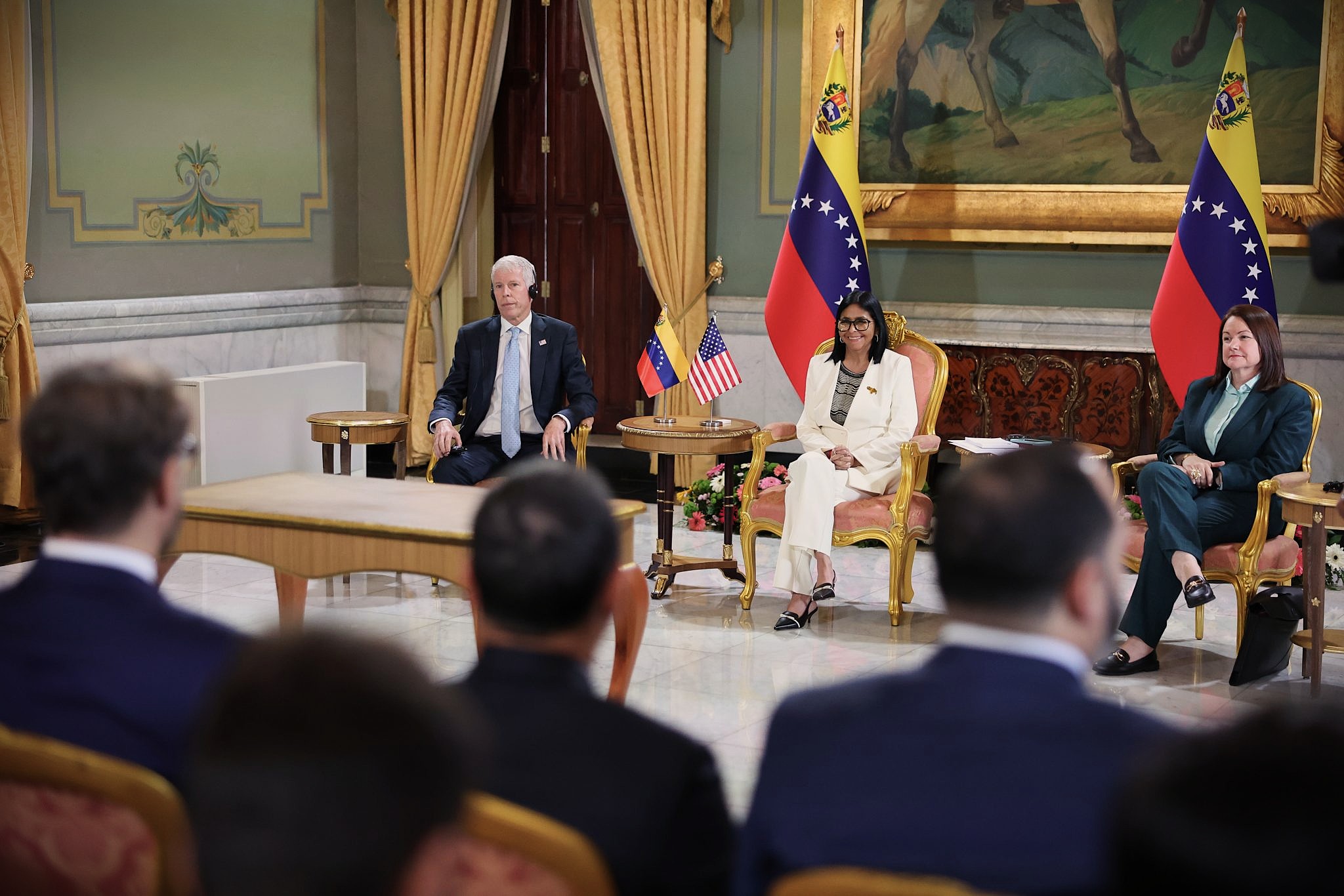
September 2: Chris Wright, Delcy Rodríguez and Paula Henao at the contract-signing ceremony for new deals with Chevron, Eni, and GE Vernova.
The lights could come back on in Maracaibo without Venezuelans gaining the capacity to change their government. More unsettlingly, restoring power to their homes could help keep those governing them in place.
This is the possibility taking shape in Venezuela. Chavismo’s relationship with Washington has changed under the pressure of American intervention; new investment could improve services while giving both the government and its foreign partners a growing interest in preserving the arrangement that delivers those improvements.
The issue goes beyond whether chavismo has abandoned its ideology: the infrastructure sustaining its power is being rebuilt around different relationships. Democratic demands now confront a governing system whose continuity may serve interests extending well beyond Venezuela.
A different foundation for continuity
Maduro remained after July 28, 2024, but maintaining control of the State could not repair the gap between holding office and having a credible electoral mandate. When US forces captured him in January 2026, that legitimacy deficit shaped the international response. Although there were international condemnations of the operation, opposing the use of force and defending Maduro’s right to govern were different positions. Some governments rejected his claim to the presidency while still questioning the intervention.
Nevertheless, Maduro’s removal left much of the chavista governing apparatus in place. Under Delcy Rodríguez, that apparatus faces a powerful external actor that can influence its room to manoeuvre. Pragmatism is therefore more than an ideological preference: cooperation with Washington has become a condition of political survival.
Tension arises when immediate commercial stability becomes tied to particular officeholders and agreements whose terms a democratic government might review.
For Washington, the authorities in Caracas can authorize contracts and implement agreements. For those authorities, cooperation offers resources and international acceptance. Their interests are different, but they can converge around continuity.
That convergence is acquiring a material basis. On October 17, Rodríguez announced expectations of almost $76 billion in oil investment over five years. These are anticipated investments, rather than money already spent. As contracts, payments and operations develop, however, businesses may become increasingly dependent on the officials and arrangements enabling them.
This does not make democracy incompatible with American investment. Accountable institutions could offer stronger guarantees over time. Tension arises when immediate commercial stability becomes tied to particular officeholders and agreements whose terms a democratic government might review. Political change can then appear as a risk to be postponed.
What changes behind the light switch
In my earlier article on infrastructure after the earthquakes, I argued that relationships, trust and coordination are as necessary to a response as machinery. Electricity works the same way. A power station depends on engineers, maintenance routines, payments and decisions about where resources go.
In my sociotechnical research, a cultural infrastructure framework helps distinguish three connected levels. The first is what people experience. The second is how work is organized to provide it. The third concerns who has authority, whose expertise counts and what makes their decisions acceptable or open to challenge.
During Maduro’s presidency, the drought of 2016 and the blackouts of 2019 exposed failures across all three. Households lost electricity. Behind the outages were maintenance problems, fuel shortages and the loss of experienced staff. An assessment by the Inter-American Development Bank also identified weak planning and the absence of independent regulation. Repairing machinery could not, by itself, correct the arrangements allowing the system to deteriorate.
Venezuelans may receive better electricity without gaining a meaningful say in how the system operates.
Under Delcy, the third level has changed profoundly. Washington now helps shape the conditions for reconstruction, and international suppliers offer access to equipment and expertise. The US Department of Energy describes an agreement with GE Vernova to modernize the grid and expand generation over several years.
That shift could enable changes in the second level, from procurement and contractor payments to maintenance and staffing. Those changes could eventually improve the first level, with fewer outages and more reliable services. However, Reuters reported in May that suppliers still faced uncertainty over payments, project priorities and authorizations. Announcements do not remove accumulated failures.
The important distinction is that changing who authorizes recovery does not necessarily give citizens more authority over it. The third level can be extensively reorganized between governments and companies while remaining closed to the people who depend on the service.
Whose stability, and for how long?
Electricity makes the resulting tension concrete. An oil producer needs reliable power. A household needs it too. Investment serving production could benefit both, but shared need does not ensure equal influence over which installations are repaired first or which communities wait.
If those priorities are negotiated mainly between officials and investors, Venezuelans may receive better electricity without gaining a meaningful say in how the system operates. Successful repairs could strengthen the government’s public standing while making commercial partners more invested in its continuity.
The different timescales matter. As I argued in “Venezuela Isn’t Transitioning. It’s Operating,” daily life follows immediate needs while political change moves on another timetable. A repaired installation may reduce outages before the wider network has dependable maintenance. Sustaining improvements requires organizational capacity. Establishing public accountability requires political decisions that neither repairs nor foreign investment can make automatically.
Venezuelans should not have to choose between functioning services and political rights. Nor should investors have to depend on indefinite chavista rule for contracts to be secure.
Meanwhile, every contract and operational dependency can make the emerging arrangement harder to alter. A process presented as temporary stabilization could acquire beneficiaries with reasons to prolong it. Recovery would then help rebuild the foundations of chavista power before the question of democratic authority is settled.
That is why an electoral timetable matters alongside investment commitments. US-backed talks involving Dinorah Figuera continue while María Corina Machado remains outside the process and no firm election date has been established. The practical question is whether citizens acquire enforceable rights to scrutinize and replace their government while economic arrangements are being consolidated.
Reliable electricity would be a real improvement, but Venezuelans should not have to choose between functioning services and political rights. Nor should investors have to depend on indefinite chavista rule for contracts to be secure.
Chavismo’s pragmatism is rebuilding the relationships through which it can survive. Whether that reconstruction also serves democracy depends on who can challenge its terms. The lights coming back on may show that the system works better; the decisive political test is whether Venezuelans can change the people running it.