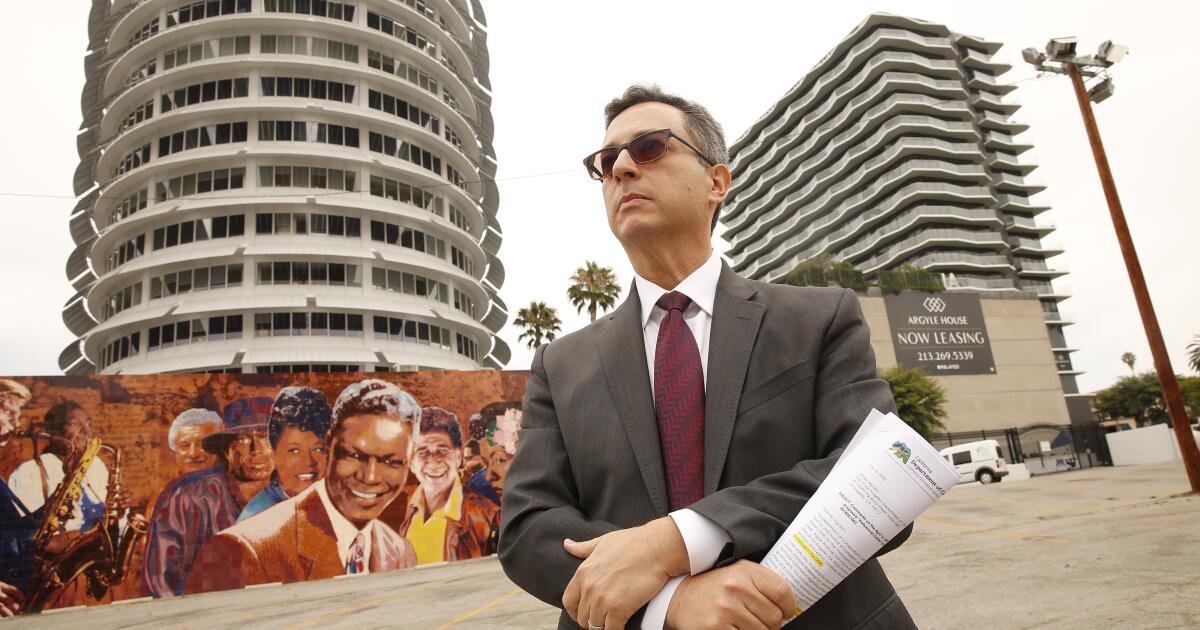
Robert Silverstein, who fought City Hall over Hollywood development and won, dies at 57
For more than two decades, attorney Robert Silverstein struck fear — and in some cases, loathing — in Hollywood’s real estate establishment.
During one legal battle, Silverstein convinced a judge to halt construction of a Target on Sunset Boulevard, even though work on the three-story structure was well under way. In another, he secured a ruling overturning the city’s approval of the Millennium project, a pair of 39- and 35-story skyscrapers that had been planned next to the Capitol Records building.
In yet another case, Silverstein, working as part of a larger legal team, helped persuade a judge to strike down the City Council’s approval of the Hollywood Community Plan update, which called for taller, denser development along transit corridors. The city’s planning department spent nearly a decade rewriting the plan.
Silverstein died Nov. 13 at the age of 57, according to a family member. He is survived by a wife and three children, his mother and two brothers. The cause of his death was not disclosed.
Several of Silverstein’s former clients praised him for his keen attention to detail — and for taking on cases against larger, wealthier adversaries.
“He always said he was trying to stick up for the little guy against the government,” said Doug Haines, a Hollywood resident who worked with Silverstein on more than a dozen lawsuits. “That was his whole focus, and he meant it.”
The son of a rabbi, Silverstein handled cases across Southern California, zeroing in on what he viewed as violations of zoning plans, public records laws, historic preservation rules, eminent domain procedures and the state’s environmental law, known by its acronym CEQA, or see-quah. Silverstein represented clients in Baldwin Park, Culver City, Glendora, Palmdale, Pasadena, Santa Ana and other communities.
Still, nowhere did he have as big an impact as in Hollywood, where he racked up a string of victories during the tenure of two mayors — Antonio Villaraigosa and Eric Garcetti.
In 2012, Silverstein won a ruling overturning the approval of a 20-story condominium tower at Hollywood Boulevard and Gower Street. A judge concluded that the city had violated CEQA by failing to make a parking analysis available for review until a day after the City Council’s planning committee had endorsed the project.
Two years later, Silverstein persuaded a judge to invalidate the building permits for a 299-unit high-rise on Sunset Boulevard. In that case, the judge found that the developer was required by the city to preserve a 1924 restaurant building, but failed to do so. (The company had built a replica instead, saying the original structure was too deteriorated.)
Silverstein’s aggressive advocacy spurred real estate companies and the city’s planning department to become more exacting about the paperwork they filed, said Jerry Neuman, a land use attorney who represented developers in several Silverstein cases. But the high-stakes legal environment also had a chilling effect on economic development in Hollywood, he said, with national real estate companies pursuing projects elsewhere.
“It helped drive investment away,” he said.
Some of Silverstein’s critics accused him of using frivolous lawsuits as a delaying tactic, forcing real estate developers to capitulate or risk huge financial losses.
Fran Offenhauser, a co-founder of the historic preservation group Hollywood Heritage, said those portrayals were not accurate.
“He didn’t take a case unless the case had merit,” said Offenhauser, who worked with Silverstein on multiple cases. “He would say, ‘I’m not going to take it unless you get me a specific instance of a violation of a specific law.’”
Silverstein was born Oct. 24, 1968. He earned a bachelor’s degree in English from UCLA in 1990 and a law degree from UC Hastings, now known as UC Law San Francisco, six years later.
Silverstein opened his own law office in 2005, taking on clients who were challenging eminent domain, the process used by government agencies to acquire private property from owners who are unwilling to sell.
Haines credited Silverstein with defeating the Los Angeles Unified School District’s plan to acquire and demolish scores of homes near the 101 Freeway to make way for a new middle school in Hollywood. The district ultimately abandoned the proposal, he said.
“He saved the community from losing all this housing, and people from being displaced,” Haines said.
Silverstein also represented Robert Blue, whose luggage store had become a target of eminent domain proceedings by the city’s redevelopment agency.
City officials wanted the site for the Hollywood and Vine project, which included a 300-room W Hotel and hundreds of residential units.
Silverstein challenged the legality of the redevelopment agency’s vote, arguing that the property and the surrounding area were not “blighted.” In the end, redevelopment officials reached an agreement with Blue to have the project constructed around his luggage business, which his family had owned since 1946.
Silverstein also represented Molly’s Burgers on Vine Street, which was sought by the city’s redevelopment agency so the site could be turned into an eight-story office building.
The Times reported in 2010 that the agency initially planned to spend $120,000 to relocate the burger stand. After Silverstein challenged the proceedings, the redevelopment agency and the developer agreed to provide the owner a combined $1.1 million.
“Robert was an old-school lawyer,” said attorney Bill Delvac, who represented the developer in the burger stand case. “If his client wanted to fight, he would fight. If his client wanted to settle, he would settle.”
In the Target lawsuit, Silverstein succeeded in showing that the city had permitted the construction of a 74-foot structure on a site where the zoning limited such projects to 35 feet. Real estate projects on that section of Sunset Boulevard could only go taller if they included housing.
Target went through a new approval process, and the project was eventually completed and opened.
While working on the challenge to Hollywood’s community plan, Silverstein took aim at the population figures the city used to justify its push for taller, denser residential development. The city, in its plan for accommodating growth in Hollywood, relied on estimates generated in 2004 by the Southern California Assn. of Governments.
Silverstein argued that the city’s environmental analysis should have incorporated 2010 U.S. Census data, which showed that Hollywood’s population had decreased over the prior decade. A judge ultimately agreed, striking down the plan.
“Robert’s dedication ensured that community concerns about environmental and demographic accuracy were taken seriously, and his work set a higher standard for how the city approaches its urban planning,” said Mike Eveloff, a co-founder of Fix the City, one of three groups that challenged the Hollywood plan.
Eveloff said Silverstein’s legal victories forced city officials to be more careful about complying with laws that govern access to public meetings, the release of public documents and development overall.
“When they knew he was going to be involved, they did have to pay more attention,” he said. “They knew they had to do it right.”
Silverstein continued to fight City Hall following the election of Mayor Karen Bass, representing Eveloff’s group as it challenged her order declaring a state of emergency on homelessness. The group called the declaration a “vast and illegal expansion of mayoral power,” one that improperly eliminated competitive bidding and leasing processes.
A Superior Court judge disagreed, concluding that the declaration did not conflict with city or state laws, and Fix the City later filed an appeal. Bass rescinded her order last month.