‘Quid pro quo’: How Indian firms fund parties whose governments help them | Politics
When India’s top court banned a controversial scheme in February 2024 that allowed individuals and corporates to make anonymous donations to political parties through opaque electoral bonds, many transparency activists hailed the judgement as a win for democracy.
Between 2018, when Prime Minister Narendra Modi’s government introduced the electoral bonds, and when they were scrapped in 2024, secret donors funnelled nearly $2bn to parties.
More than half of that went to Modi’s Hindu majoritarian Bharatiya Janata Party (BJP), which has held India’s central government since 2014, and also governs at least 20 Indian states and federally controlled territories, either directly or in coalition with allies.
In striking down the scheme, the Supreme Court said that “political contributions give a seat at the table to the contributor” and that “this access also translates into influence over policymaking”.
But two years later, data shows that big business continues to pump in millions of dollars in funding to political parties, with the BJP retaining its position as the biggest beneficiary, frequently raising serious concerns over a quid pro quo with donors.
The donors have returned to an older funding mechanism: electoral trusts. Introduced in 2013 by the Manmohan Singh government led by the Congress party that preceded Modi, the trusts, unlike bonds, require the donors to disclose their identities and the amount of money being given.
But that relative transparency is not dissuading companies from major mega-donations to parties directly positioned to benefit them through policies and contracts, an analysis of recent political funding by Al Jazeera reveals.

‘Money determines access’
In 2024-25, nine electoral trusts donated a total of $459.2m to political parties, with the BJP receiving $378.6 million — 83 percent of it. The main opposition Congress party got about $36m (8 percent), while other parties received the remaining amount.
This data is sourced from disclosures made during the first full year after the Supreme Court ban on bonds.
Two major corporations stood out, due to their significant financial scale and policy influence: The Tata Group, founded in 1868 by Jamsetji Nusserwanji Tata, is a global conglomerate with more than 30 companies spanning steel, IT, automobiles, aviation, and more. Its aggregate revenue for FY 2024-25 exceeded $180bn. The Murugappa Group, founded in 1900 by A M Murugappa Chettiar as a money-lending business in Burma (now Myanmar), is a prominent Indian conglomerate with 29 businesses in engineering, agriculture, financial services and beyond. Its turnover stood at $8.53bn in 2024-25.
Documents submitted to the Election Commission of India in 2024-2025 show that the Progressive Electoral Trust, backed by 15 companies belonging to the Tata Group conglomerate, distributed approximately $110.2m to 10 political parties in the run-up to the 2024 general election.
The BJP received about $91.3m – again roughly 83 percent of the total fund – while the Congress got $9.31m, with smaller sums going to several regional parties. Tata made its contribution on April 2, 2024, while Murugappa did so on March 26, 2024.
India’s general elections began on April 19 and concluded on June 1, 2024.
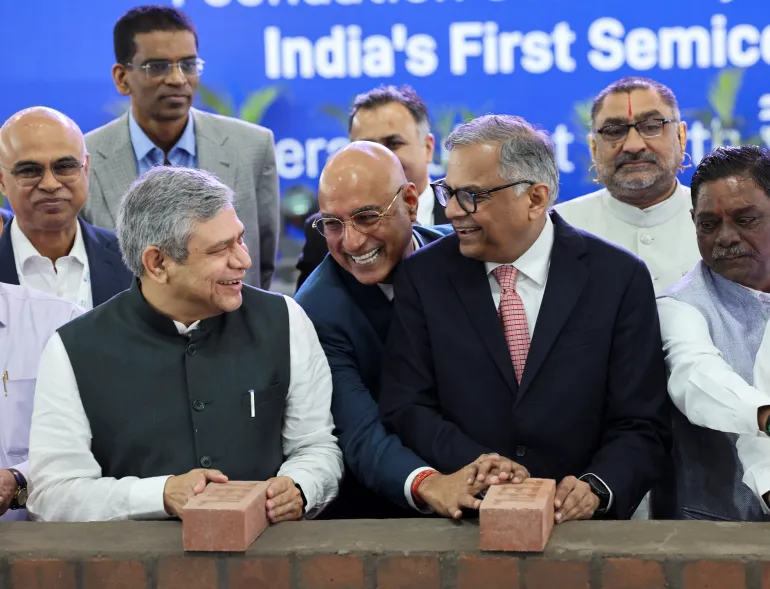
The timing and scale of these donations are significant, say experts. Tata’s donations came within weeks of the government approving two semiconductor projects worth more than $15.2bn announced by the Tata Group in Gujarat and Assam – both BJP-ruled states.
The Modi government also provided additional support of about $5.3bn under India’s plans to promote semiconductor development.
Meanwhile, in February 2024, the Indian government approved a semiconductor assembly and testing facility proposed by CG Power and Industrial Solutions Ltd, a Murugappa Group company. The project, to be set up in Sanand, Gujarat, with an investment of approximately $870m, also received central and state government incentives.
In the same financial year, disclosures showed that yet another trust called Triumph Electoral Trust received $15.06m from Tube Investments of India Ltd, another Murugappa Group company. The entire money went to the BJP, with no contribution by Triumph to other parties.The scale of these donations surprised observers as the Murugappa Group had been a modest political donor over the previous decade.
“Electoral trusts may be legal, but they normalise a system where money determines access, policy, and electoral success,” Parayil Sreerag, a political strategist, told Al Jazeera. Sreerag argued that such a mechanism “favours the ruling party, marginalises smaller movements, and erodes democratic competition and public trust”.
To be sure, corporate funding in India has a long history.
The Birla group of companies was a major financier of Mahatma Gandhi in the years leading up to independence in 1947. Since then, other companies and parties have continued the practice.
“Business houses have traditionally supported ruling political parties,” G Gopa Kumar, former vice chancellor of the Central University of Kerala and a political strategist, told Al Jazeera.
India’s legal framework governing corporate donations to political parties has evolved alongside political shifts. The Companies Act, 1956, first regulated such contributions, barring government companies and young firms, while mandating disclosure of donations. Corporate funding was later banned in 1969 under Prime Minister Indira Gandhi. The ban was lifted in 1985.
A major overhaul came in 2013 with the introduction of Electoral Trusts and the Companies Act, 2013. The new law capped corporate donations at 7.5 percent of average net profits, required board approval, and mandated disclosure, marking a significant attempt at regulation and transparency.
But while the Modi-era electoral bonds between 2018 and 2024 drew the bulk of the criticism over electoral finance from transparency activists, the return to electoral trusts has coincided with what is, in effect, an increase in corporate funding for parties. Between 2018 and 2024, the electoral bonds led to an average of under $350m in total donations per year.
Trusts – to which corporates turned after the bonds were scrapped – donated more than $450m by contrast, in 2024-25.
“Left unchecked, it [soaring corporate funding] risks creating a duopoly between political power and corporate capital,” Sreerag said.
Al Jazeera reached out to the Tata Group, the Murugappa Group and the Election Commission of India for their responses to concerns over links between donations and influence, but it has not yet received any response.

Uncovering corruption in election funding
Transparency activists argue that the surge in corporate funding, especially for the ruling party, both reveals the access and influence enjoyed by major firms and sheds light on the disadvantages faced by smaller parties and independent candidates.
Shelly Mahajan, a researcher at the Association for Democratic Reforms (ADR), a prominent Indian election watchdog, said unequal access to private donations undermines political participation and electoral competition.
“Despite decades of reform proposals, the nexus between money and politics persists in India due to weak enforcement and inadequate regulation,” she told Al Jazeera.
To many, the electoral bonds scheme came to epitomise that dark and cosy “nexus”.
In December, Nature magazine published a study on alleged corruption under the scheme, authored by academics Devendra Poola and Vinitha Anna John.
The authors found that newly incorporated companies made unusually large donations soon after their formation, pointing to expectations of gains from the government. In several cases, firms accused of tax evasion or other financial crimes donated after raids by India’s enforcement and investigating agencies, raising concerns of coercive political pressure: 26 entities under investigation bought bonds worth $624.7m, including $223.3m after raids by investigating agencies.
Bond purchases peaked around election cycles. That timing – around elections and after raids – was “significant”, Poola told Al Jazeera. “That sequencing is analytically difficult to dismiss as coincidence.” While the data cannot establish legal intent, Poola stressed that the pattern points to an “institutionalised quid pro quo ecosystem enabled by opacity”.
Yet critics say transparency alone does not resolve the link between public policy and political funding – as the data since the ban on electoral bonds shows.

‘What kind of democracy is this?’
Mahajan, the ADR researcher, said that in its decision to strike down the electoral bonds, the Supreme Court invoked the 2013 law on electoral trusts to reimpose a 7.5 percent cap on corporate donations based on their net profits.
Companies were ordered to disclose both the amounts and the recipients, creating greater scope for public scrutiny and detailed analysis. But that is not happening. Abhilash MR, a Supreme Court lawyer, said large corporate donations raise serious concerns, particularly under Article 14 of the Constitution of India, which guarantees political equality and administrative fairness.
He said there is mounting evidence of generous government incentives followed by large corporate donations.“When policy decisions appear calibrated to facilitate corporate funding, the very idea of a welfare state is undermined,” he told Al Jazeera, adding that proving corruption in courts remains extremely difficult.
“Temporal proximity between policy benefits and donations rarely meets the evidentiary threshold needed to trigger an independent judicial inquiry,” he said. “In such situations, accountability shifts from courtrooms to the public domain.”
Mini S, a politician from the Socialist Unity Centre of India (Communist) party, had hoped for that shift among voters when she contested the 2024 national elections from Thiruvananthapuram, the capital of the southern Kerala state.
She couldn’t fund air-conditioned vehicles, so her campaign during India’s notorious summer moved through neighbourhoods on hired motorbikes and autorickshaws. She hoped to unseat Shashi Tharoor, a former UN diplomat and politician from the opposition Congress party, who had been representing Thiruvananthapuram in parliament since 2009. When the votes were counted, Mini secured just 1,109 votes, while Tharoor won by a landslide. She also forfeited her $275 security deposit.
But for Mini, the outcome was less a personal defeat than an indictment of how Indian elections are fought. Her entire campaign ran on $5,500, she said, an amount much lower than the $105,000 limit set by the Election Commission of India on expenditure by a parliamentary candidate.
“India likes to call itself the world’s largest democracy, but it’s not,” Mini told Al Jazeera. “When corporate money openly funds mainstream parties – through electoral bonds and trusts, often in clear quid pro quo arrangements – and the Election Commission stays silent, what kind of democracy is this?”
In such a scenario, Mini said, government policies “serve corporate interests, not the constitution”.
“Ordinary people are sidelined, and the marginalised are pushed further into the margins. With money of this scale in elections, anyone without corporate backing, like us, is effectively locked out of politics,” she said.