
oz

Orange County Museum of Art highlights uncredited Hollywood artists

p]:text-cms-story-body-color-text clearfix”>

A dull yellow light peeks through a brooding sky looming over rolling Southern California hills. The oil painting “Approaching Storm” captures the kind of picturesque scene that would get fine artist Paul Grimm work in early Hollywood. Known for his plein air landscapes and masterful depictions of clouds, he turned to studio work to make money during the Great Depression.

He is one of many artists on display at a new UC Irvine Langson Orange County Museum of Art exhibition about set painters whose work would go uncredited or overlooked.

  • Share via

“They weren’t making their living selling their paintings, but they were making their living working for the studios,” said museum director Kathryn Kanjo. “The artist would lose their individual credit and recognition, to be at the service of what was needed by the studio.”

Elsewhere in the “Staging California in Early Hollywood” exhibition, hangs an 18-by-25-foot painted backing for “The Sound of Music” (1965), a project led by the then-art director of 20th Century Pictures’ special effects department, Emil J. Kosa Jr. He’d be the only one to get credit at the time, not the five other contributing artists, including celebrated plein air artist Arthur Grover Rider, who are also noted in the museum description.

“In general, at the studios, they systematized the production design, so that it was fast,” Kanjo said, describing the rigid process as militaristic. “Five artists at a time work day after day to get these things done.”

It’s the museum’s first exhibition since UC Irvine acquired the Orange County Museum of Art last September, building a 9,000-piece collection dating back to the 19th century.

The exhibition, with about 50 pieces, is the first since Kanjo’s appointment in December. It’s a love letter to the film industry’s anonymous and little-known artists, whose works were vital to movies.

Two paintings, one of mountains and one of a field below a graying sky, hang on a white wall.

The exhibition opens with Paul Grimm’s Untitled, 1974, left, and “Approaching Storm,” 1974, right, which capture the essence of the Southern California landscape.

(Allen J. Schaben / Los Angeles Times)

Take two of the most prolific set artists of the mid-20th century: Warren Newcombe and George Gibson. Newcombe was a Massachusetts-born, well-educated artist who started working on sets as early as 1920. He’d eventually join the MGM art department, where he perfected a visual effect technique called “matte painting.” For a time, it was simply referred to as the “Newcombe shot.”

Gibson was also at MGM around the same time. When the studio first hired the Scottish artist, he’d routinely miss shifts to paint plein air in Southern California. He and Newcombe would help craft “The Wizard of Oz” (1939), but when the credits rolled, both their names were missing.

Newcombe and Gibson would go on to be recognized and celebrated for their work. About a decade after “The Wizard of Oz,” Newcombe won two Oscars for special effects, for “Thirty Seconds Over Tokyo” (1944) and “Green Dolphin Street” (1947).

“He was really instrumental in the professionalization of artists at MGM,” assistant curator Michaëla Mohrmann said of Gibson. “His insistence on color saturation is something that really informs his work for ‘The Wizard of Oz,’ and it’s really that movie that cements his reputation as one of the masters of scenic art.”

Meanwhile, artists like Arthur Beaumont hardly got their due. Raised by a military family in England, the California transplant was particularly captivated by naval vessels. By 1933, he had painted maritime art for most of the U.S. Naval fleet. As a result of his work, he was commissioned as a lieutenant in the U.S. Navy and recognized as its fleet’s official artist.

He also began producing promotional materials and storyboards for Paramount Studios’ naval films as early as 1935, first for a movie titled “Mutiny on the Bounty.” In 1942, he would do the same for “Wake Island” in the midst of World War II. His work was later etched into metal plates and used to mass-produce publicity prints.

A woman stands between two landscape paintings, one of mountains and one of a yellow and green field.

Museum director Kathryn Kanjo stands between Arthur Grover Rider’s “Ortega Highway” (1974), left, and Emil J. Kosa Jr.’s “How Marvelous Thy Works” (1928).

(Allen J. Schaben / Los Angeles Times)

“They were participating [in the military and war] in different functions and not always credited for that kind of work,” Mohrmann said. “I think there was an act of generosity [during wartime] in general — everyone was really patriotic.”

The exhibition also features a silent film titled “The Life and Death of 9413: a Hollywood Extra,” a 1928 short highlighting the plight of a background actor known as “9413.”

“Staging California in Early Hollywood”

Where: UCI Langson Orange County Museum of Art

When: Friday to Oct. 4, 2026

Cost: Free

Info: langson.uci.edu

“It’s all like him being shoveled around and underappreciated and not even given a name, right?” Kanjo said. “Everybody thought it was funny because it was kind of meta, but it was pointing out real issues.”

Beyond giving credit where credit’s due, the exhibition aims to uplift background art.

“Back then as well as now, people question the artistic merits of these works because they were made for films that were for profit,” Mohrmann said. “When in reality there was a ton of talent and artistry and critical thinking.”

Quincy Bowie Jr. contributed to this report.
Source link

Vance says $1.3 billion in Medicaid payments to California will be deferred over fraud concerns

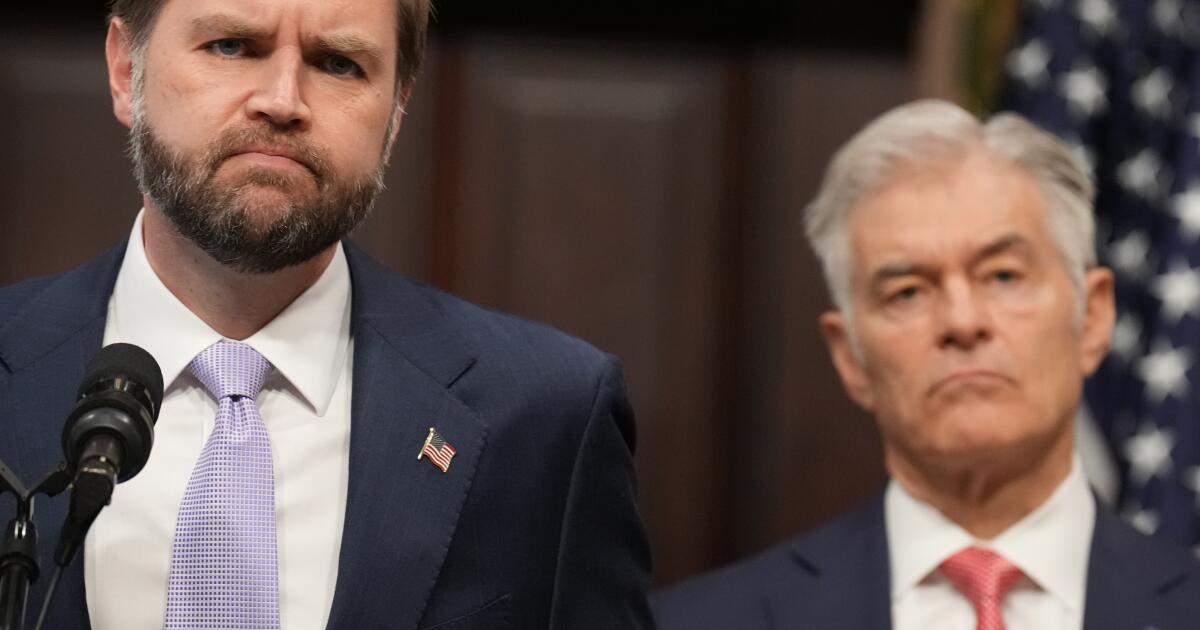
Vice President JD Vance said Wednesday that the Trump administration is deferring $1.3 billion in Medicaid reimbursements to California over concerns the state is allowing “fraudsters” to drive up costs to taxpayers, including by pushing unnecessary medications on unsuspecting patients.

“There are California taxpayers and American taxpayers who are being defrauded because California isn’t taking its program seriously. But also, you have people who’ve been prescribed medications that they don’t even need,” Vance said. “Sometimes they’ve had drugs put into their bodies that they don’t need because fraudsters have actually encouraged false prescriptions and false administration and medications.”

Vance, standing alongside Dr. Mehmet Oz, the administrator for the Centers for Medicare and Medicaid Services, said the administration is also sending letters to all 50 states informing them that if they do not “effectively and aggressively prosecute Medicaid fraud in their states,” they will see federal funding cut off as well.

“We want California to get serious about this fraud,” said Vance, who President Trump named his “fraud czar” last month.

Oz called out what he said was widespread fraud in hospice services and similar in-home care programs nationally — and particularly in the Los Angeles region — and announced a six-month moratorium on new Medicare enrollment for hospices and home health agencies.

“A third of all these programs in the entire country are in Los Angeles. Ask yourself, how is that possible? It’s not,” Oz said. “They’re not that many people dying in Los Angeles. We’re not talking about California, just Los Angeles.”

He said he and others in the administration determined that “at least half of the hospices, in the entire area around Los Angeles, are fraudulent,” and had shut down 800 of them that last year had “charged the federal taxpayer $1.4 billion,” which “will no longer be paid.” That is a major increase from the 450 providers the administration said it had suspended as of last month.

The announcement was the latest attempt by the Trump administration to highlight and rein in fraud in federal healthcare benefits programs, particularly in blue states. The actions were met with immediate push back from California officials.

“We hate fraud. But that’s NOT what this is,” Gov. Gavin Newsom’s office posted on the social media site X. “Vance and Oz are attacking programs that keep seniors and people with disabilities OUT of nursing homes. Pretty sick.”

Newsom’s office said that the growth of In-Home Supportive Services placements in California was “simple,” and due to California “keeping more people OUT of far more expensive nursing homes!”

Such services cover assistants who help people with daily tasks such as bathing, laundry or cooking; provide needed care such as injections under the direction of a medical professional; and accompany them to and from doctor’s appointments. A 2020 report by the California state auditor found that nearly three-quarters of IHSS caregivers assist a family member.

Newsom’s office wrote IHSS care costs $30,000 a year, while nursing home care costs $137,000 a year. “SAVING TAXPAYERS: $107K per person,” it wrote.

California Atty. Gen. Rob Bonta also criticized the administration’s moves.

“Once again, California appears to be targeted solely for political reasons,” Bonta said. “The Trump administration is planning to defer over $1 billion in Medicaid funding for vital programs that helps seniors and people with disabilities remain safely in their homes.

“My team is carefully reviewing all available information. We have not hesitated to challenge unlawful actions by the Trump administration, and we will continue to act whenever Californians’ rights or access to critical services are threatened,” he said.

Democratic Sen. Alex Padilla also lashed out at the Trump administration.

“The Trump Administration is attacking California over claims that they can’t back up,” Padilla wrote on social media. “Let’s be real, this isn’t about fraud — it’s about punishing a state that didn’t vote for him. Political retribution plain and simple.”

Fraud in California’s hospice industry has been a problem for years.

Authorities in the state promised to crack down on the issue after a Times investigation in late 2020 revealed that unscrupulous providers were billing Medicare for hospice services and equipment for patients who were not actually dying — with the hospice industry in the state exploding in size.

California’s Medicaid program, known as Medi-Cal, is expected to cost about $222 billion for the budget year starting July 1, including both state and federal funding. Roughly 15 million Californians, more than a third of the state, are on Medi-Cal.

Vance, a potential 2028 presidential hopeful, has taken up his work as “fraud czar” with vigor, traveling around the country to drive home the idea that the Trump administration is working diligently to bring down healthcare costs by addressing waste, fraud and abuse that is rampant across the system.

He has said that waste and abuse is particularly prevalent in Democratic-led states such as California, New York and Minnesota.

“We have red states and blue states that go after fraud aggressively, but we also, unfortunately, have some states, mostly blue states, unfortunately, that do not take Medicaid fraud very seriously,” he said Wednesday.

Vance specifically threatened to cut off what he said is billions in federal funding for state-run fraud control units that are meant to prosecute people who abuse the system, but which he said aren’t doing the work. “This is a tool that we want the states to use, but unfortunately, a lot of states aren’t using these tools at all,” he said.

The focus on fraud comes against a backdrop of criticisms that other policy measures pushed by the administration have driven healthcare costs up or made it harder for people to access healthcare — including cuts to Obamacare subsidies and new work requirements in Medicaid, which are expected to strain hospitals around the country and led to millions of people losing healthcare coverage.

Democrats and Republicans have argued over who is to blame for rising healthcare costs, and Vance and Oz have clashed with California leaders before.

In January, Newsom filed a civil rights complaint against Oz after he posted a video accusing Armenian crime groups of carrying out widespread healthcare fraud in Los Angeles. In the video, Oz was shown driving around Van Nuys, saying about $3.5 billion worth of Medicare fraud had been perpetrated by hospice and home care businesses — and “run, quite a bit of it, by the Russian Armenian mafia.”

Newsom called Oz’s claims “baseless and racist.”

The administration previously launched investigations into potential healthcare fraud in at least five states — California, Florida, Maine, Minnesota and New York — and halted some $243 million in Medicaid payments to Minnesota over fraud concerns.

The Centers for Medicare & Medicaid Services has also acknowledged using errant figures to justify a fraud probe in New York, deepening concerns in the administration’s methods for identifying problematic activity.

Vance said the deferral of funds to California and the letters warning other states to get serious is not about political retribution, but a wake up call. He said the Trump administration wants to help states root out fraud and abuse, including with new technologies — but can’t do so if they are not “willing to help themselves” first.

“We don’t want to turn off any money. What we want to do is ensure that people are taking fraud seriously. We want to protect Medicaid, we want to protect Medicare,” Vance said. “But we can’t do that if the states that are administering those programs are allowing those programs to be fleeced by fraudsters.”

The Associated Press contributed to this article.

Source link