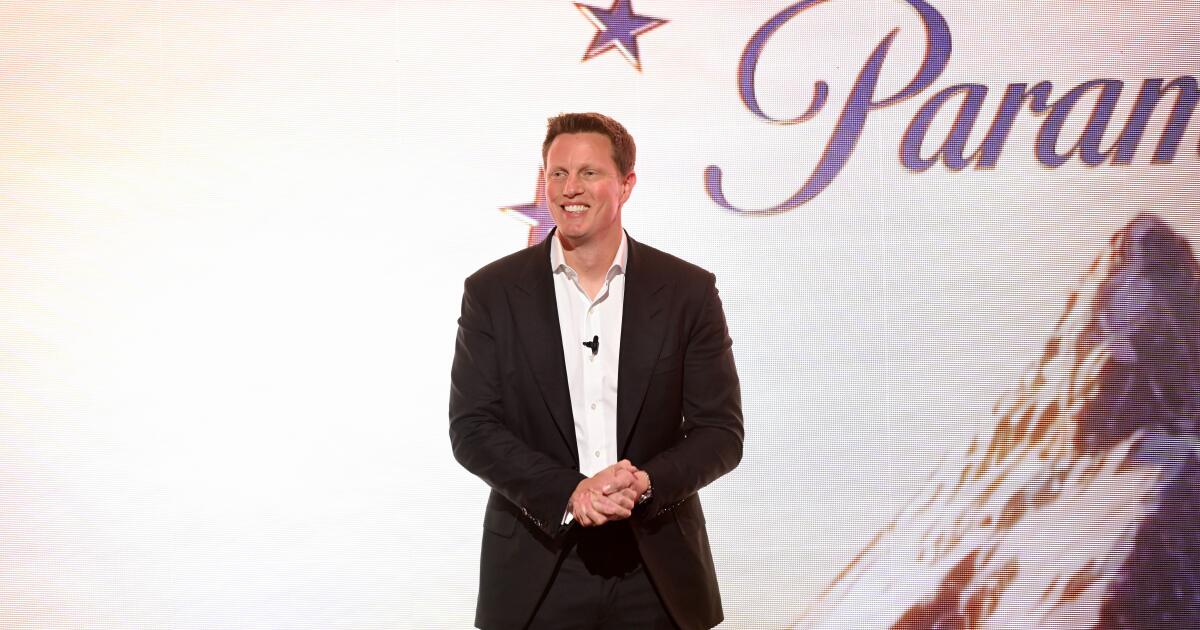
Inside David Ellison’s desperate fight for Warner Bros.
In less than a month, Paramount Skydance Chief Executive David Ellison has exhibited a dizzying range of emotions as the goal line for the coveted $111-billion Warner Bros. Discovery deal has moved farther away.
The tech scion initially exuded confidence that Hollywood’s biggest merger in decades was on a fast track to completion by September. Ellison and others downplayed efforts by California Atty. Gen. Rob Bonta to challenge the acquisition — until Bonta and 11 other Democratic state attorneys general gained momentum in their antitrust lawsuit, which now threatens to derail Paramount’s Warner Bros. deal or, at least, make it significantly more expensive.
Ellison and his executives have vacillated from anger to acceptance. Last week, Ellison attempted a high-profile reputation reboot, extolling his love for movies and blaming politics for opposition to the deal.
The mogul has told investors the company is willing to negotiate a settlement with Bonta in hopes of completing the massive merger as soon as possible.
But Ellison also is making contingency plans to shift Paramount’s historic home base from Melrose Avenue to Tennessee — or perhaps Texas — as early as this fall.
Paramount’s board has approved Ellison’s relocation plans, according to people familiar with the situation who were not authorized to speak publicly. Ellison shared the concept with his executive leadership team in a meeting last Wednesday but said his preference was to remain in California, these people said.
The proposal includes potentially selling the 65-acre Paramount lot in Hollywood — as well as the larger Warner Bros. campus in Burbank, should Paramount prevail in the merger battle. Such sales would generate revenue to help pay merger costs, one of the knowledgeable sources said.
Paramount’s sudden relocation plan has further rattled Hollywood, which already is reeling from thousands of job losses in recent years.
Bonta, in a statement Tuesday, blasted Paramount’s latest strategy, calling it “another attempt to blackmail the state into letting an illegal deal through.”
“Paramount has lost the plot as it continues to lose in court,” Bonta said. “My office remains committed to stopping illegal consolidation and protecting a vibrant California economy for businesses that play by the rules.”
Behind Paramount’s pivot is a desperate scramble to bolster its legal case and muster funds to help finance a deal Warner shareholders approved in April.
Paramount offered to pay Warner investors $31 a share as well as so-called “ticking fees” of 25 cents per share for every quarter after Sept. 30 until the transaction closes.
That sweetener was intended as a show of confidence that Paramount’s deal would sail through its regulatory reviews, unlike a Netflix acquisition that faced more regulatory scrutiny. Netflix subsequently dropped its bid.
Paramount was banking on the swift approval of the U.S. Department of Justice, which arrived in June. President Trump is friendly with the Ellison family, and he has been eager for a shakeup at CNN, one of Warner’s properties.
“Ellison thought he had an ace in the hole with Trump [and] the DOJ, but it backfired on him because the clearance was so obviously rubber-stamping,” London-based media analyst Alice Enders said. “Now, the issues have resurfaced and it’s a costly potential delay.”
The ticking fees could add $7 million a day — or $650 million a quarter — to the $81 billion that Paramount had already anticipated paying Warner shareholders. (Paramount also agreed to absorb about $30 billion of Warner Bros. debt left over from last merger, in 2022.)
Ellison has repeatedly defended his proposed purchase, saying the tie-up does not threaten competition because Hollywood has been transformed by Netflix and other deep-pocketed tech giants.
Already, Paramount has received clearances from 65 foreign regulators, including Britain and the European Commission.
To accelerate California approvals, Paramount requested a November trial date for Bonta’s suit. Instead, U.S. District Judge Araceli Martínez-Olguín scheduled a March 2 trial — dealing another blow to Paramount.
Ticking fees alone could add $2.1 billion to the cost of buying Warner Bros. In addition, Paramount said that delaying the transaction until next spring will add $190 million in bridge loan financing costs.
Paramount disclosed that it had $1.6 billion in cash on hand and a revolving loan of $3.2 billion available for its use.
If the deal fails to close by June 4, Paramount would have to pay Warner Bros. a $7-billion breakup fee. That’s when Warner’s board could pull the plug on the Paramount deal.
Puck News first reported Ellison’s latest plan to quickly move Paramount’s operations as soon as October.
“This is a plan — not a threat,” said a person who was in the room when Ellison discussed his plans but who was not authorized to comment.
The relocation campaign echoes a tactic employed by software giant Oracle Corp., co-founded by Ellison’s billionaire father, Larry Ellison.
Oracle was based in Redwood City for three decades, but in late 2020, the company moved its headquarters to Austin, Texas, joining other California tech firms leaving in protest of the state’s high taxes and steep cost of living.
Then, two years ago, the elder Ellison announced that Nashville would host Oracle’s new headquarters. At the time, Oracle saw that state’s healthcare industry as a promising growth business. Oracle since has bet heavily on artificial intelligence.
In contrast, it would be difficult for Paramount to pack up its operations because it depends on producers, directors, writers and stars to make its TV shows and movies. The two studio lots also boast dozens of soundstages; century-old fortresses that would not be easily duplicated. And many Paramount executives are not eager to leave Los Angeles.
Some observers questioned Paramount’s willingness to carry out a move, which surfaced a week after David Ellison’s guest essay in the New York Times, which described his love of Hollywood and movies ever since he was a boy.
Ellison believes the proposed Warner merger is the best way to save Hollywood, saying the combination of two storied studios would strengthen not harm the film industry.
“One moment he’s promising to reinvigorate theatrical releases. The next he’s talking about uprooting two historic companies and moving them 2,000 miles away in order to avoid a lawsuit,” said Gabriel Kahn, journalism professor at USC Annenberg School for Communication.
Paramount’s corporate headquarters are in New York but after the Ellison family’s acquisition last year, the center of gravity shifted west. Ellison and other top executives live in Los Angeles.
Another corporate move wouldn’t disrupt Bonta’s lawsuit, experts say.
Instead, they suggested Paramount’s flurry of recent activities — including winning the support of two large theater chains, AMC and Regal, with promises of a robust movie pipeline post-merger — appeared to be part of a public relations and pressure campaign.
“They lost a lot of leverage now that the trial is set for March,” said Abiel Garcia, a former prosecutor and partner at the Manhattan Beach firm Kesselman Brantly Stockinger.
“And when you don’t have leverage in court, you go the political route,” he said, adding that Paramount seems to be angling for Gov. Gavin Newsom to join the fight.
Newsom, who has presidential ambitions, has been sensitive to the flight of companies from California. However, he has avoided picking a side in the messy merger squabble.
What’s more, the governor lacks authority to intervene in the lawsuit brought by Bonta and 11 other state attorneys general.
“All I know is that if I was governor, I wouldn’t want to lose Hollywood from this state, I wouldn’t want to lose a major company like Paramount to another state,” Paramount Chief Legal Officer Makan Delrahim said late Tuesday at a Politico Live conference in Sacramento. He had been asked about the stances of Newsom and his potential successor, Xavier Becerra, the Democratic gubernatorial nominee.
“I hope it settles before court,” Becerra said at the conference. “It is easier to stand in a conference room and settle than it is to stand in a courtroom.”
Delaying the trial until March has been “devastating,” Delrahim said, adding that Paramount proposed settlement terms on May 19 — but the state attorneys general instead moved forward with their suit.
“It’s costing jobs. It’s costing a lot of uncertainty for a lot of our employees, for Warner Bros. employees,” Delrahim said.
Still, Garcia and others expressed doubts about Paramount’s full-court press.
“It just feels a little over the top. It feels like a PR blitz,” Garcia said. “It suggests to me that they think their case is weaker than I even thought.”