‘Walking is the best way to discover offbeat Corfu’: a spring hike across the Greek island | Corfu holidays
The riverside was heaving. Families spilled from cafes. A marching band trooped on to the bridge, their tasselled metal helmets dazzling in the sun. Priests with bushy beards delivered ageless chants from beneath their cylindrical kalimavkion hats. Men let off shotguns, terrifying the air. Easter Monday in Lefkimmi.
We hadn’t planned this. Simply right place, right time. The capital of southern Corfu, Lefkimmi is a working town, untroubled by tourism. There are Venetian-style houses – variously neat, tatty and decrepit – but no “attractions” to speak of. Just Corfiots doing Corfiot things: chewing the fat in their finest for this religious celebration – Greek Orthodox Easter, which falls on 12 April in 2026 – plus zipping about on scooters, drinking coffee, buying baklava and ice-creams.
“Right place, right time” was my hope for this trip to over-loved Corfu, an island of about 100,000 that, in 2025, was visited by approaching 4 million people. I was returning with fond memories. My first ever foreign holiday was here, in 1986. That was the first time I saw an olive tree, realised water could be that blue, and heard such a cacophony of cicadas it seemed the bushes were electrically charged.
That was 40 years ago. Corfu – the green queen of the Ionian Sea, Gerald Durrell’s “garden of the gods” – was already popular. In the intervening decades, development has been rampant and infrastructure, from roads to water supply, struggles to cope with the summer influx. But how about visiting off-season and off-piste? Winter can be tricky, with many places shut, so my husband and I had chosen to come in spring, exploring largely on foot, via the Corfu trail.
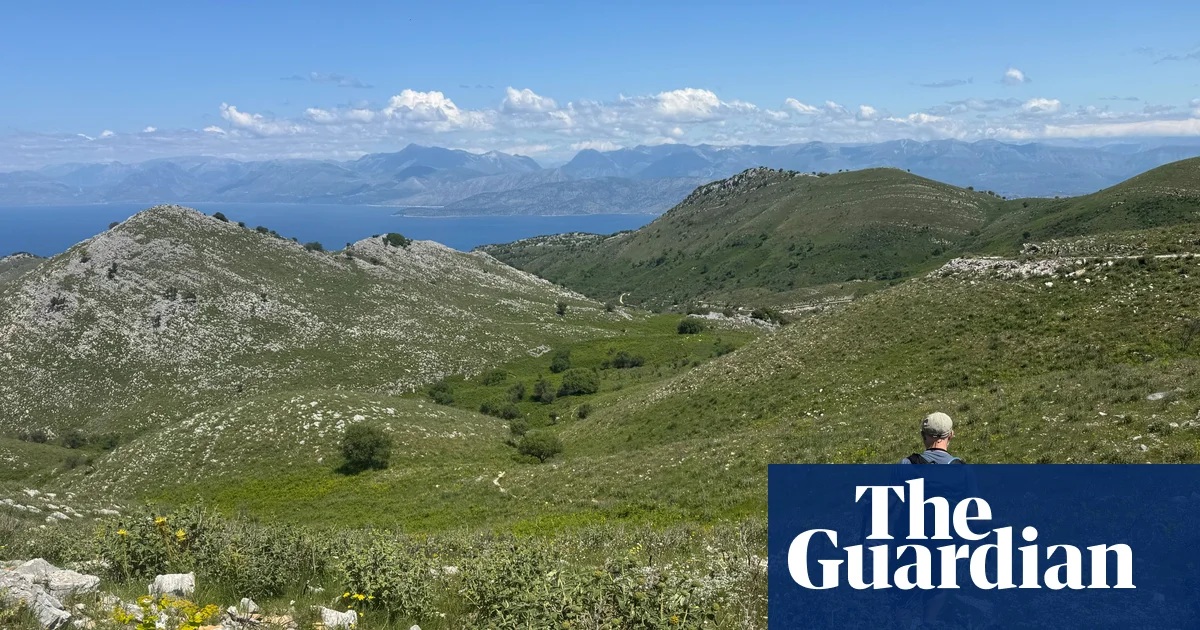
The sun was warm, the land now awake from hibernation as we set out on the 110-mile (180km) route that runs the length of the island, from Kavos to Agios Spyridon. Wriggling along the more rugged, less developed west coast, with deviations into the central hills and wide Ropa valley, it then traverses the mountainous north, always seeking the way less trodden. You could travel by (limited) buses or hire car, but doing some walking is the best way to happen upon Corfu’s offbeat bits.
We covered between 8 and 20 miles a day, though there’s no need to do all that – most walk it much more slowly. But, with our luggage being transported ahead each night to an array of simple pensions, family tavernas and beach hotels, our shoulders were light, so we were keen to roam as much as we could, following the yellow and black signs, arrows daubed on rocks and the GPS files on our phones – the route was largely well marked.
Every day, there were wonders to discover: wizened Mitéra, a 1,500-year-old olive tree near Prasoudi beach; a profusion of wildflowers, in all hues – rosy garlic, hot-purple rock roses, punchy yellow sage; a magical ancient footway between Makrata and Ano Garouna that had fallen out of use until the Corfu trail was blazed 25 years ago. The path traversed a cypress-pierced hillside before plunging into dark, forgotten olive groves that concealed what looked like the remains of a lost city, but was in fact natural rock cloaked in moss.
A few hours after these “ruins”, we arrived in Sinarades and found ourselves at the bottom of a flight of stone steps leading into the Folklore Museum. It couldn’t be open, could it? But yes, Makis beckoned us into this 19th-century farmhouse (entrance a modest €3), empty of visitors but full of the stuff of Corfiot village life: fine costumes, farming paraphernalia, fig cutters, cobblers’ tools.
It was fascinating, getting these glimpses of old Corfu, invariably inland. In the northern mountain village of Sokraki, after the only downpour to spoil our sunny skies, we drank ginger beer at Emily’s cafe, still made the traditional way, using only water, lemon juice, sugar and ginger. Then we wove our way down the narrow streets to the Lithari Olive Oil Museum, where an old family press has been restored.
The following day, we visited Old Perithia, a 14th-century village tucked beneath Mount Pantokrator, the island’s highest point. Like many similar outposts, Perithia was abandoned in the 1960s; unlike many, it has been revived, and is now a lively, living cluster of homes, tavernas, honey shops and a characterful B&B. It was a hot day, so we flopped on to the shady terrace of O Foros cafe and lingered over fresh salad, homemade pie and tsigareli (garlicky wild greens), before descending to the coast via a long-lost path, only rediscovered during the Corfu trail’s creation.
Despite being ravishingly clear and a respectable 16C (60F), there were very few swimmers in the sea. Such was the case at Myrtiotissa, halfway up the west coast – the spot where Odysseus allegedly washed ashore, and widely known as a nudist beach. A steep, skinny track leads to this cliff-backed sliver of sand, a real Instagrammer snarl-up in summer. But when we walked down, road and beach were deserted enough for us to throw off our inhibitions and clothes, and frisk Nereid-like in the waves.
If there’s one stretch of Corfu coast not to miss it’s Erimitis, the “hermit” peninsula at the island’s north-east. There used to be a naval observation post here, keeping an eye on Albania, about 2 miles away. As such, Erimitis escaped tourist development, leaving it the last stand of pristine Corfiot nature: no villas, no olives, just a scrub of oaks, myrtles and strawberry trees, brackish lagoons, butterflies and birds, herbs and wild orchids, plus rare monk seals and seagrass offshore.
But it’s under threat. In 2012, the government sold the rights to develop a portion of Erimitis to foreign investors. Organisations such as Save Erimitis and the Ionian Environment Foundation are fighting to conserve it.
Leaving the Corfu trail for the day, we picked up a footpath linking upmarket Agios Stefanos to the fishing harbour of Kassiopi, via Erimitis’s edges, a walk of about 5.5 miles. Immediately, there was a different feel here; it was a place without human touch, where the water seemed even clearer. We walked through fairytale tunnels of trees and detoured down a trail that ended at a bank, where a rope dangled down to a forest-backed beach. With no one about, it seemed silly to bother putting on swimmers, so we skinny-dipped again, now accustomed to the temperature, and warmed by the smugness of being here, now, alone. Right time, right place.
The trip was provided by Walks Worldwide, whose 15-day, self-guided Corfu Trail costs from £1,129 (shorter itineraries available), including the whole route plus nights in Kalami, near Erimitis; thecorfutrail.com