nostalgia

D23: Marvel hypes ‘X-Men’ cast but Disney nostalgia reigns

Marvel’s new X-Men are ready for their close-up — finally. The cast of the upcoming superhero film took the stage together for the first time Friday night during the Disney Entertainment Showcase at D23.

Marvel Studios President Kevin Feige capped off his portion of the presentation by formally introducing Sadie Sink, whose role in “Spider-Man: Brand New Day” had been kept under wraps before its release, as Jean Grey. Then, along with “X-Men” director Jake Schreier, they welcomed the rest of the cast.

Joining Sink in “X-Men” are Kit Connor as Cyclops, Christopher Abbott as Professor Charles Xavier, Samara Weaving as Emma Frost, Inde Navarrette as Rogue and Maya Boyd as Storm. Adam Driver, who appeared at the event in a recorded video bit, will be playing Nathaniel Milbury, better known to fans as Mr. Sinister.

“X-Men” is expected to hit theaters May 5, 2028.

Held at the Honda Center, the Disney Entertainment Showcase is one of the marquee presentations of the three-day D23 fan event where the various arms of Walt Disney Studios — including Lucasfilm, Pixar and Disney Animation — take the stage to promote their upcoming film and television projects. New CEO Josh D’Amaro received a rock star’s welcome from the more than 12,000 Disney faithful attending this year’s showcase, which was emceed by “Zootopia 2” stars and self-proclaimed “super fans” Ke Huy Quan and Ginnifer Goodwin.

Among the stars tapped to help promote their upcoming projects were Anne Hathaway (“Princess Diaries 3”); Joe, Kevin and Nick Jonas (“Camp Rock 3”); Benjamin Bratt (“Coco 2” and “Kingdom Hearts IV”); Kathryn Hahn (“Tangled”); Robert Downey Jr., Chris Evans and Hayley Atwell (“Avengers: Doomsday”); Ryan Gosling (“Star Wars: Starfighter”); and Kristen Bell, Idina Menzel and Josh Gad (“Frozen III”).

Here are the biggest reveals and takeaways from Disney’s studios showcase.

Marvel’s television future remains unclear

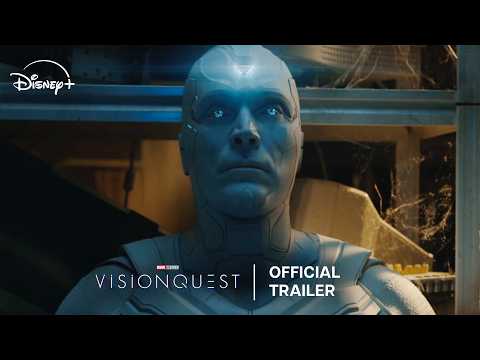
As expected, Marvel Studios turned its spotlight to “VisionQuest,” the upcoming Disney+ series starring Paul Bettany (Vision) and James Spader (Ultron). Picking up after the events of “WandaVision,” the show will see Vision “beginning to ask rather more complicated questions” about his identity and humanity, according to Bettany.

After several movie announcements at San Diego Comic-Con last month, fans had been anticipating Marvel’s D23 presentation would focus on its series slate. But “VisionQuest” was the only TV show represented at the event. (Marvel’s presentation also included a new “Avengers: Doomsday” clip and a mention of the upcoming game “Marvel’s Wolverine.”)

The lack of new series announcements, along with the recent cancellation of “Wonder Man” Season 2 and reports that Marvel is cutting back on live-action Disney+ shows, has cast a shadow on the MCU’s TV future. “VisionQuest” will premiere Oct. 14.

‘Star Wars’ fans still love Hayden Christensen

Lucasfilm President Dave Filoni brought the cast and creatives of “Ahsoka” Season 2 and “Star Wars: Starfighter” for his portion of the showcase, along with new footage from both projects.

When “Ahsoka” star Rosario Dawson invited Hayden Christensen (Anakin Skywalker) and Eman Esfandi (Ezra Bridger) to join her on stage, fans had an especially warm welcome for the prequel trilogy star.

“As always, it is such an honor to get to play Anakin Skywalker,” said Christensen. “In this new season. Anakin continues to advise Ahsoka. He challenges her and pushes her to answer the most important question in her life: Are you or are you not a Jedi?”

Shawn Levy and Ryan Gosling on stage

“Star Wars: Starfighter” director Shawn Levy, left, and Ryan Gosling, who is showing the symbol of his character Kade on his jacket.

(Kevin Mazur / Getty Images for Disney)

Director Shawn Levy and Ryan Gosling were on hand to discuss “Star Wars: Starfighter,” which will be set during a time period in the galaxy far, far away that has not yet been shown before. Gosling plays Kade Auberon, a Starfighter pilot (and possible mechanic), in the standalone film that will be set some time after the sequel trilogy.

Disney is leaning on the magic of nostalgia in live-action and animation

Lisa Kudrow and Mira Sorvino

Mira Sorvino, right, and Lisa Kudrow appeared onstage as Romy and Michele, respectively, to tease their sequel.

(Jesse Grant / Getty Images for Disney)

Much of Disney’s studio showcase focused on sequels of franchises past and present. “Romy and Michele 2” (2027) stars Lisa Kudrow and Mira Sorvino showed up in character to tease their upcoming sequel to the much-loved 1997 original, proclaiming they were now Disney princesses.

“Princess Diaries” star Anne Hathaway made an appearance to reassure fans the team was hard at work to make sure “Princess Diaries 3” was getting done right, while “Camp Rock” stars Joe, Kevin and Nick Jonas came to plug “Camp Rock 3” and its new stars. A brief first-look teaser for the live action “Tangled” (2028) concluded on a shot of Kathryn Hahn as Mother Gothel calling out to Rapunzel, right before the “Agatha All Along” star took the stage.

Even one of Disney’s oldest characters is getting a revival, thanks to filmmaker Jon Favreau. The “Mandalorian and Grogu” director shared a first look at his miniseries, “Oswald the Lucky Rabbit,” a hybrid live-action and hand-drawn 2D animated show expected to hit Disney+ in February.

On the animation side, Pixar’s Pete Doctor came armed with news about “Incredibles 3” (2028) and “Coco 2” (2029), while Disney Animation’s Jared Bush announced “Zootopia 3” before turning it over to “Frozen III” (2027).

According to Benjamin Bratt, who is returning to voice Ernesto de la Cruz, “Coco 2” is set some time in the future, where a teenage Miguel is sent back to the land of the dead for another adventure. “Frozen III,” meanwhile, will see Anna and Kristoff finally get married before the sisters meet a mysterious stranger who also wields ice magic. Olaf is also expected to find love.

The event also featured teases for “Ice Age: Boiling Point” (2027), “The Bluey Movie” (2027) and a “Kingdom Hearts” anime series.

But don’t worry, Pixar and Disney are still making original movies

a girl sitting next to a three-eyed cat that is driving

Billie Doe (Hailee Steinfeld) and Beef Roger Crummchuk (Walton Goggins) in “Hexed.”

(Disney)

Fans of animated originals can rest assured that both Pixar and Disney Animation have new stories on the way. In addition to “Hexed,” a magical coming-of-age adventure about a young girl named Billie who discovers she’s a witch that will hit theaters Nov. 25, Disney Animation announced “Clay” for 2028. According to Jared Bush, “Clay” is a story about a mentor and student named Flip and Mushi.

“I believe that new stories, new characters, new worlds are vital to the future of Disney Animation,” said Bush.

Pixar, meanwhile, announced “Ghost Market” will hit theaters in 2028. Set in Hawaii, “Ghost Market” will follow a young content creator named Kyle who encounters hungry ghosts. The studio also has “Gatto,” from “Luca” director Enrico Casarosa, on deck for 2027.
Source link

‘Elle’ taps into ’90s nostalgia with music from No Doubt, Mariah Carey

p]:text-cms-story-body-color-text clearfix”>

“I’ve talked about rain on this show more than I have in my entire life,” Kittrell says.

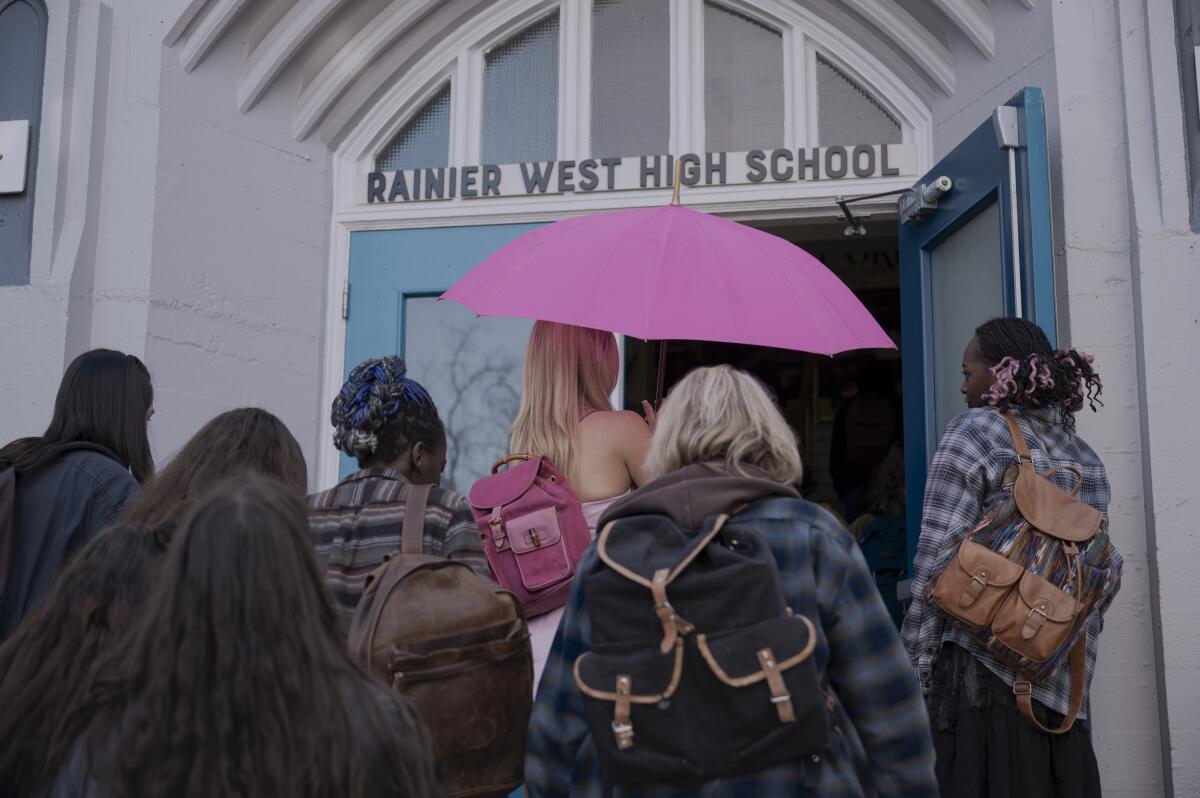
It was a constant consideration, both on set and in the writers room. Weather became a way to distinguish Elle from those around her in Seattle. The locals never carry umbrellas; Elle shows up with a pink one.

“We had a writer from Seattle who always said the city gets a bad rap because of the rain,” Kittrell says. “But the rain is what makes it beautiful — it makes Seattle green.”

A group of students walking into the entrance of a high school with one person holding a bright pink umbrella.

Elle entering the halls of Rainier West High School with her pink umbrella.

(Kimberley French / Prime Video)

That philosophy stayed with the writers, later showing up in a line Miles (Jacob Moskovitz), Elle’s crush, says to her, and ultimately leading them to Garbage’s “Only Happy When It Rains” as the show’s theme. “We were like, of course,” says Kittrell. “This is what we’ve been talking about the entire time.”

The song was originally meant to end the pilot. “Then we decided we should just be hearing it in every single episode,” says Neustadter. (The pilot instead uses Radiohead’s “Creep,” which also bookends the series.) The main title sequence, an animated “saga sell” from the studio Shine, tells the story of Elle’s move from Bel-Air to Seattle.

“We’re constantly reminding the audience of the contrast between Elle’s essence and the world she’s now in,” Neustadter adds. “There’s an optimism to ‘Only Happy When It Rains’ that feels very Elle Woods. And the irony of it is so delightful.”

Source link

Michelle Tea interviews queer historian Hugh Ryan on his new memoir “My Bad”

Hugh Ryan is an absolute superstar of queer history. His first two books, “When Brooklyn Was Queer” and “The Women’s House of Detention: A Queer History of a Forgotten Prison,” were magnets for awards and accolades. After spending recent years immersed in cultural stories, he’s turned his investigative eye on his own coming of age with the rollicking, raw, funny and sharp memoir “My Bad: A Personal History of the Queer Nineties and Beyond.” Pivoting from scholar of history to student of life, Ryan shares lessons learned from beloved but homophobic middle school teachers (“The nicest mother— I knew could accidentally curb-stomp my heart at any moment”) to ones acquired on the dance floor (“Dancing is sex on a communal level: an embodied ecstatic ritual of union”).

Ryan swung through L.A. on his book tour, and what better place to host a paean to the ’90s than the ASU FIDM Museum, where the exhibit “Obsessed: Fashion and Nostalgia in the ’90s” is serving Westwood plaids, Calvin Klein’s minimalist silk parachute sheath and Donatella’s zipper-slashed, leather mourning dress. A fellow survivor of the era, I interviewed Ryan and the evening was introduced by the exhibition’s sparkling curator, Christina Frank, who cheekily shared period photos of the author alongside images from the museum’s ’90s archives, asking: Who wore it best? Whether it was Ryan channeling designer inspo or fashion-snatching looks from the streets, the display — like the book that inspired it — was colorful and daring, inspired and eccentric and wholly unique. At a time when nostalgia for the ’90s is seemingly everywhere, “My Bad” places the decade into context, including its paradoxical freedoms and oppressions, with the intimate, funny rough language of your freakiest, funnest bestie.

Michelle Tea: Your previous books are this amazing, accessible scholarship. In “My Bad,” your language is so different — you’re cussing! The academic gloves are off — which isn’t to say that it’s not brainy. Was this just the voice that the book wanted? It’s like, “Oh, so we’re just like sitting on the curb having a cigarette together.”

Hugh Ryan: I actually wanted to buy a box of clove cigarettes while I was doing the research, but apparently they’re illegal now because they’re deadly and full of fiberglass.

So much of it is about writing it for people today who are younger, who look up to my books and are like, “I’m going to get my PhD and be just like you!,” and I was like, I didn’t do that, I’ve misrepresented myself somehow, and I want to be really real. Also, I had this job for four or five years where I ghost wrote a kids’ books series, and I was eventually fired, because I took a beloved character — who I am not allowed to name — and made her curse, which she had apparently never done in her 100-year history. When I made her say ‘hell’ and ‘damn’ while solving a mystery, the internet went wild, and you can find the Amazon page where I am ruined. So, the ability to curse in my work and have a real voice was something that, from very early on in my career, I was like, “Oh no, I got to be real careful about being too much myself on the page.”

writer Hugh Ryan
Ryan in '90s Calvin Klein; Dave Navarro walks the Anna Sui Spring/Summer 1997 runway.

Ryan in ‘90s Calvin Klein; Dave Navarro walks the Anna Sui Spring/Summer 1997 runway. (Hugh Ryan; Michel Arnaud; Gift of Arnaud Associates, 2000; From ASU FIDM Museum Collection)

MT: You needed to break that pattern of self-censoring. What was it like to shift the focus of your intellectual investigation onto yourself?

HR: Excruciating. At first I really enjoyed it, when it was just this idea. I’ve never really told these stories. In the early versions of it, everything I wrote was jokey, silly, overly stylized, not honest. I wasn’t ready to really dig in. I think that I had a lot of layers of defensiveness that I didn’t even understand I had until I had to write things down. My agent kept being, “No, no, this isn’t real, stop with these jokes, it is funny, but you have to get into the serious issues.” There was a large resistance inside me. Asking, “OK, how did my experiences relate to the ’90s as a whole?” actually let me talk about myself and the time period I emerged from. I needed that scaffolding to feel comfortable.

MT: How do you feel about Gen X’s legacy as basically the coolest generation?

HR: I mean, I kind of love it.

MT: We’re having the most sex, even though we’re so old now. And we’re tough, because we’ve survived so much queer trauma. You write in “My Bad” about having Snapple bottles thrown out windows at you.

HR: If you looked queer and you were out in the world, it was just accepted that at some point during the day someone was going to be violent towards you. Verbally, maybe physically. It just was what it was. Though I will say, having now, later in my life, thrown some Snapple bottles really hard just to feel it, it does feel very good. They’re heavy, they’re glass, they explode. If you can get your hands on some classic ’90s Snapple, just throw them, just try it.

MT: We have to have a queer, Gen X ritual of throwing Snapple bottles, like a rage room.

Various photos of writer Hugh Ryan in 1994-1999.

Ryan in the ‘90s. In his new memoir “My Bad,” Ryan looks back on this time with the intimate, funny rough language of your freakiest, funnest bestie.

(Hugh Ryan)

HR: I do think that it’s easy to forget all of that, because I think we all wanted to forget it to a certain degree. We wanted to let go of our pain. Both the people who were hurt and the people who caused those hurts had some amount of evolution. This is something I think about a lot with my family. If you read the book, in the early chapters it’s rough with my folks. They were loving, but also had no idea what to do with me. I was not just gay, I was weird and trans and confused, and always making noise and acting out and being inappropriate. There’s all this tough stuff, and then we try to forgive each other and let it go, but without saying it. Writing the book was this moment of, “Oh no, am I making us talk about all the bad times again?” It took me sitting with that and realizing — that’s the only way to get to the other side. I’ve seen this change in my family, and it felt important to document how shitty it was, so we could see the change.

MT: What sign are you?

HR: Cancer.

MT: You’re Cancer?!

HR: Yeah, tell me about it. I know so little about astrology. It’s the straightest thing about me, how little I know about astrology.

MT: I don’t even know what to say, because I’m getting such Aquarius-Virgo-Gemini from you that Cancer is just blowing my mind.

HR: I do have a shell, I know that about myself. And that was my first two books. Now I’m trying to invite people in.

MT: Will you talk about the club kid scene in New York City in the ’90s?

HR: I just touched up on the edges of it. The club kid movement really stopped after effective retrovirals come in, in 1996. Suddenly club kids saw a future for themselves, and did not all imagine that they were going to die of AIDS imminently. The ones who I’ve interviewed have said, “That’s the moment at which suddenly, dressing for Friday night no longer felt like what you spend two weeks doing.” But when it was happening, it was amazing. There were these free magazines in New York City, HX and Next, little queer rags full of party promotions and photos of half-naked people in clubs, and ads for those awful viatical companies that would buy up your life insurance if you had AIDS. They were very weird, but they’re like style bibles for me. And then you would go to the clubs.

When you went to Limelight, there would be two entrances, one for straight people and one for gay people. The bouncer at the line for the straight entrance was a giant gay guy, who — this was abusive, and probably wrong, but it was very funny — he’d be like, “You two make out if you’re gonna tell me you’re gay, make out or you don’t come in.” You only got access to half the club if you went in the straight entrance — the other half was only for queer people, and so you would have these straight folks trying to get in. It was amazing, and it was a place where I came to really love my body, because up until then the only things I had been told my body were for were sports, and that was never going to be me. There, I could dance all night.

Limelight was the coolest, but I loved Tunnel. Tunnel was 80,000 square feet of nightclub in a former railway terminal. There was a room entirely designed by the artist Kenny Scharf, and it was covered in fake fur — in a club when smoking was still allowed! It was the worst smelling place I’ve ever been in my whole life. I would sneak down there wearing giant Jnco raver pants, and watch everyone. These giant pants had these huge pockets in them, and I would put a big, gallon Ziploc bag with a clean T-shirt and clean socks inside the pant pocket. When the night was done I would go out, get food, change my clothes, and put the dirty clothes inside the Ziploc bag. I still had to have the pants on. I carried like the smell of 1,000 humid homosexuals with me everywhere I went.

Various photos of writer Hugh Ryan in 1994-1999.

The club, Ryan says, “was a place where I came to really love my body, because up until then the only things I had been told my body were for were sports, and that was never going to be me.”

(Hugh Ryan)

MT: Speaking of being grimy — you were also really affected by Burning Man.

HR: I had met this guy, we totally fell in love. He was a high school dropout computer hacker who was the epitome of the bisexual ’90s — longhaired, androgynous, everything I wanted to be. You know, that very queer thing of: Do I want you, do I want to be you, should we go on a road trip or a killing spree? We were in love and I did not want to go back to school. I had had a terrible junior year, and I was looking to make new mistakes. He was like, “I’m gonna go to this thing called Burning Man, do you want to go? It’s out in the desert, there’s all this art, and it’s super cool,” and I was like, “When is it?” And it was the very first week of classes my senior year, and I was like, “Yeah, absolutely.”

It was amazing. We got adopted by these people who called themselves the Church of Mez, or Mezbians. They were extremely rich Microsoft engineers. We were completely unprepared, because we’d f—ing come in on the Greyhound bus. You’re supposed to bring a gallon of water per person per day, just to start with, and we had nothing. We had a tent and a sleeping bag, and these people thought we were somewhere between pets and aphrodisiacs.

It felt like such an amazing thing to get to touch. And I know that all of those people ended up being like fascist tech bros of today, I’m sure, and I worry about the environmental degradation that I did not know anything about. And it was so white, so many white people with dreadlocks and those terrible tribal tattoos. Like many things in the book, I have to write about it tenderly, even though I know there are so many problems. I don’t think I would be who I was if I didn’t show some tenderness towards those spaces that made me, or at least allowed me to see myself.

Michelle Tea is the author of more than 20 books for grown-ups, teenagers and children.


Source link

‘The De Los Podcast’: editors talk best Latin music of 2026, so far

As 2026 reaches its halfway point, the editors of De Los are eager to talk about Latin artists to watch — and share their hottest music takes. Over the years, award-winning music journalist Suzy Exposito and Director of Latino Initiatives Fidel Martinez have documented the rise of genres like reggaeton and música Mexicana in mainstream culture.

In her work for Vogue, The Times and Rolling Stone, Exposito has interviewed influential artists like Shakira, Cardi B and Bad Bunny (the last of which made history as the first Rolling Stone cover story written by a Latina journalist).

Martinez has an impressive roster of his own, having interviewed many stars in the Mexican and Chicano music scenes, from Fuerza Regida to Natalia Lafourcade.

Reflecting on a landmark year for Latin music

On this week’s episode of “The De Los Podcast,” they weigh in on the explosive impact of 2025 on the genre: between Bad Bunny‘s Super Bowl halftime show and Karol G‘s Coachella headlining performance, last year was nothing short of a groundbreaking for Latin music.

“Being there, you could feel barriers coming down,” Martinez, who reported live from the Super Bowl in February, said. “It wasn’t Bad Bunny trying to validate us in front of others. It was him saying, ‘This is who we are, and we are proud of who we are.’”

According to the RIAA, 2025 was the first year that Latin music sales in the U.S. reached $1 billion, in its 10th consecutive year of growth. In 2016, American Latin music sales were at just below $150 million.

“It highlights how quickly and with what speed the genre has been taking off,” Martinez said.

However, as Exposito notes, at times, it came at the cost of originality.

A Latin music trend that De Los is leaving behind this year

“Our generation is too married to the past,” Exposito said. “How can we evolve musically if we keep trying to re-create our grandparents’ music?”

Nostalgia, De Los editors note, has driven the wide-ranging popularity of last year’s most successful Latin projects. As Exposito says, the artists “mine the past in their own ways.”

In Bad Bunny’s “DtMF” and Karol G’s “Tropicoqueta,” classic genres like salsa, plena and cumbia took center stage. “DtMF” samples El Gran Combo de Puerto Rico while in Fuerza Regida samples Mexican classics like Vicente Fernández.

While comforting and educational for younger generations, Martinez argues that artists relying on nostalgia could turn that effort into becoming more experimental with their sound.

Some artists, however, are resisting the nostalgia trend, making De Los’ best albums list of 2026 … so far.

De Los’ 2026 Latin albums you need to hear

Suzy’s picks:

Alvaro Díaz, “Omakase”

“He’s experimental … and taking bold swings, with producers like Tainy,” Exposito said.

“Omakase,” which the Puerto Rican star released in May, blends Latin trap elements with electronic, R&B and in one track, cumbia, for a diverse, thoughtful album that Diaz equates in his De Los story to the Japanese dish omakase, or a platter decided by the chef.

RaiNao, “Marcría”

With a worldplay title that blends the words “malcriada” (badly raised woman) and “cria por el mar” (born in the sea), RaiNao’s project promises earthly, intimate lyricism with experimental musicianship.

“The way she melds jazz with reggaeton and folkloric elements, I really enjoy,” Exposito said. “I really appreciate people (like RaiNao) who can remix but also introduce seemingly disparate elements, like saxophone and Caribbean music.”

Other picks include Ibeyi’s “Offering” and Diles Que No Me Maten’s “Escrito en Agua.”

Fidel’s picks:

Julieta Venegas, “Norteña”

Venegas, who De Los interviewed last month, wrote a memoir alongside this album, which delves into her Tijuana heritage with Mexican collaborators like Bronco, is what Martinez calls “a chef’s kiss.”

“She’s such a fascinating character because she started as an indie rocker,” Martinez said. “This album is a love letter to Tijuana. It’s just the perfect fusion of tradition and pop.”

Hermanos Espinoza, “Linaje”

Two brothers from the Rio Grande Valley, Hermanos Espinoza performed at De Los’ SXSW showcase and blew the audience away with their live energy and accordion work.

“Their project talks about lineage. This album certainly has a point of view,” Martinez said. “With this album, they said, música Mexicana can be like rock and roll.”

Also on the list are Tito Doble P’s “Acomodo” and Trio Asesino’s self-titled.

To hear more about 2026’s emerging artists and De Los’ music hot takes, check out “The De Los Podcast.”

Source link