Meteor

Typhoons Paired With CCA Fighter Drones Armed With Meteor Missiles Eyed By UK

BAE Systems is exploring how the Eurofighter Typhoon could control uncrewed collaborative combat aircraft (CCA) as part of a broader effort to introduce new capabilities for the jet. The company is currently pursuing concepts to integrate CCAs with the Typhoon to expand ‘combat mass’ and better address emerging threat environments. Ultimately, however, the experience gained here will be ported over to the future Tempest combat jet — designed to work closely with drones from the outset.

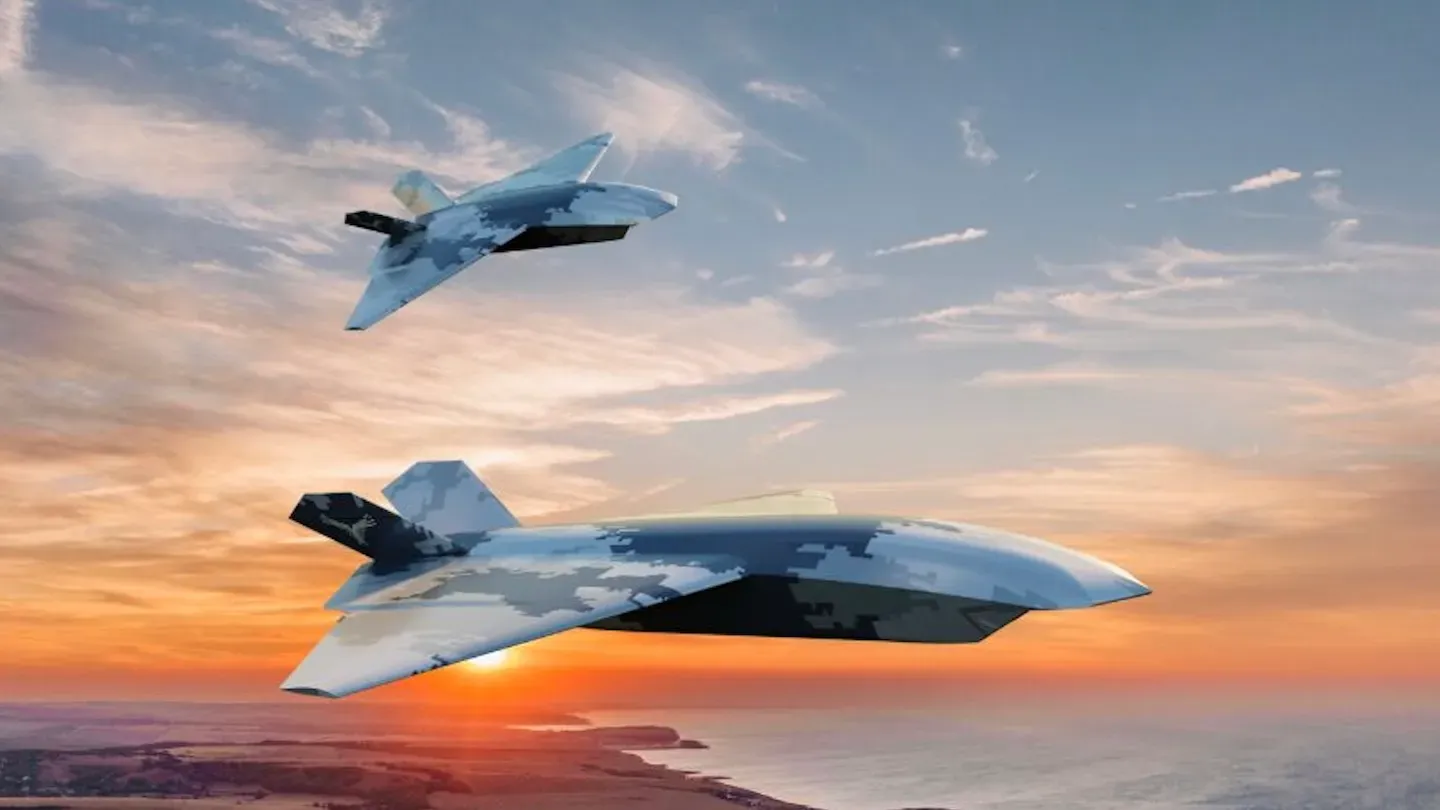
At this point, BAE Systems is working on concepting how Typhoon/CCA could work and is also investing as a company in CCAs and crewed-uncrewed teaming more generally. The work involving the Typhoon and CCAs has accelerated over the previous 12 months. Officials from BAE Systems outlined the work so far in a briefing at the Farnborough Air Show today, just a week after the U.K. Royal Air Force launched a new CCA program, named Storm Fighter, which you can read more about here. That program should lead to a CCA that can fly into combat with the Typhoon, F-35, and Tempest.

BAE Systems concept artwork of a Storm Fighter CCA. BAE Systems

Speaking at Farnborough, Chris Moon, Typhoon Future Capability Director, BAE Systems, explained:

“Unsurprisingly, what we’re finding is that in the enlarged battlespace of the future, we’re able have a Typhoon — some people use the phrase ‘quarterback,’ choose what you will — with its extensive radar capabilities at range, and speed and agility, processing, to be able to work alongside collaborative combat aircraft and increase the combat mass that is needed from our air forces into the future, and the persistence and the range at which they’re able to reach, and bring more missiles into the fight.”

The CCA capabilities are planned to be added to the Typhoon under a much wider effort known as the Long-Term Evolution (LTE) program. This is expected to roll out a number of other features that will ensure that the jet can get the most out of teaming with CCAs. These features include the large-area display (LAD) cockpit, European Common Radar System (ECRS) Mk 2, and the Striker II helmet-mounted display system.

A Royal Air Force Typhoon fighter lands at RAF Akrotiri following a mission in the Middle East. Crown Copyright

In terms of technology, the ECRS Mk 2 is especially interesting here. As well as the various advantages of an active electronically scanned array (AESA), it has a swashplate repositioner, an articulated mounting that means the antenna can be swung to face at far greater angles off the centerline. This allows a much wider field of regard, with a significant boost in angular (azimuth) coverage. It allows the Typhoon to retain missile guidance even when beaming and hiding in the Doppler notch of the enemy’s radar, which functions much like a blind spot.

A Typhoon fitted with ECRS Mk 2 radar inside an anechoic chamber. BAE Systems

In the past, Eurofighter has claimed that the repositionable array provides a field of regard that is “some 50 percent wider than traditional fixed-plate systems.”

Eurofighter

All of these components have been tested in a CCA environment in a specially equipped Typhoon simulator.

Moon highlighted one particular scenario, off the east coast of Scotland, in which a pair of Typhoons worked with a four-ship of CCAs to extend the range, coverage, and persistence of the crewed jets. The scenario can be expanded to include the entire east coast of the United Kingdom, adding more Typhoons and CCAs as well as F-35Bs.

More detail was provided by Andrew ‘Blyty’ Mallery-Blythe, Typhoon Operational Requirements Manager at BAE Systems.

A huge advantage here is the new LAD cockpit, replacing the Typhoon’s current three-multifunction display (MFD) configuration with a single unit.

The Typhoon Large Area Display in a simulator. BAE Systems

Using the LAD means that “everything is available,” Blyty said. “You can see everything at the top level. You have to do very little manipulation to the display. The LAD provides a literal big picture of the combat scenario, including friendly assets, among them the various CCAs, with their heading, height, speed, and what they’re carrying in terms of sensors or stores.

“What we’re trying to take advantage of is combat mass,” Blyty added. “Obviously, combat mass I don’t really need to explain in any great detail. We’ve got four CCAs and two Typhoons. Clearly there’s an improvement and an increase in combat mass without having to have those additional very expensive, complex aircraft. We can bring more weapons to the fight through the use of the CCAs.”

SHAW AIR FORCE BASE, S.C. -- Flight Lieutenant Andrew Mallery-Blythe, 79th Fighter Squadron F-16 pilot, stands in front an F-16 here Aug. 21. Leftenant Mallery-Blythe is an exchange pilot from Royal Air Force, United Kingdom. The pilot exchange program exchanges military pilots from different countries to learn how other countries perform and fly missions. The focus of the program is to improve nation relations and pilot adaptability. (U.S. Air Force photo/Staff Sgt. John Gordinier)
While still a Royal Air Force pilot, Andrew ‘Blyty’ Mallery-Blythe completed an F-16 exchange with the 79th Fighter Squadron at Shaw Air Force Base, South Carolina. U.S. Air Force photo/Staff Sgt. John Gordinier Staff Sgt. John Gordinier

In terms of attrition, the Typhoon is classed as a strategic asset in these concepts, while a CCA is more of a tactical asset.

“We certainly don’t want to put ourselves in a position where we’re going to lose one of those [CCAs], but it’s a tactical asset,” Blyty continued. “That means that we can position them far closer to the threat, potentially taking a little bit more risk with those assets. They’re also smaller, they have a lower observability, and that is also an advantage that our friendly Typhoons exploit.”

A simulator is used to test the Typhoon/CCA crewed-uncrewed teaming concept. BAE Systems

Having a better overview of the battlespace via the LAD cockpit, ECRS Mk 2 radar, Striker II helmet, and the CCAs themselves is only one part of the equation.

BAE Systems is also trying to minimize the workload on the pilots. This is especially important for the U.K. Royal Air Force, which has reduced the number of two-seat Typhoons in its fleet, scrapping all its Tranche 1 ‘T-birds.’ Other nations are meanwhile working on developing CCA concepts by relying heavily on two-seat combat aircraft, with the back-seater a ‘drone controller.’

Blyty: “We don’t want to be in a situation where the pilot is having to close-control each of those assets. There’d be far too much workload. So through our rapid prototyping, and the way that we’ve been doing this, we’ve been looking into how we minimize that workload and how we give simple commands through the extant HOTAS [‘hands on throttle and stick’ controls] to send those CCAs to carry out our task with the minimum workload that we can achieve.” It is meanwhile widely understood that drones require an advanced autonomy package to facilitate this level of ease of use by a single pilot.

A Eurofighter Typhoon during a low level flying sortie in the Lake District, Cumbria, UK. Picture: Mark Wright/BAE Systems.
A Typhoon during a low-level flying sortie in the Lake District, United Kingdom. Mark Wright/BAE Systems Mark Wright/BAE Systems

Blyty went on to run through an engagement scenario, again aided by the LAD’s ‘god’s eye view’ of the battlespace. A kill box was drawn on the LAD before the hostile aircraft entered that area.

“Once that was activated — we do that through a button on the screen which is just off the top — we effectively give the CCAs the authorization or the command that they can engage anything that enters that kill box.”

With that command, the CCAs start employing weapons, including very long-range Meteor air-to-air missiles, the ramjet-powered weapon that the Typhoon also carries.

The aspiration to have CCAs armed with Meteor is a significant one, due to the very particular set of capabilities that the missile brings. The Meteor is among the longest-ranged of any Western air-to-air missile, generally considered to be able to engage certain types of targets out to around 130 miles. Critically, while CCAs are already a forward extension of the fighter, a missile of this kind would provide a major increase in engagement range when combined with the uncrewed jet, allowing the Typhoon to stay outside the engagement range of the enemy.

The missile also uses a two-way datalink, which feeds it with in-flight updates as it flies out to its target and provides the pilot in the launch aircraft with information on the Meteor’s fuel, energy, and tracking state. Adding CCAs into the mix, provided they have their own sensors, would allow them to pass data to the Typhoon and to the Meteor, regardless of which platform launched the missile.

Meteor thumbnail

Meteor


Ultimately, of course, the CCAs might end up with different missiles entirely, including a successor to the Meteor that is now being developed. Regardless, air-to-air combat at extended ranges is very much part of the U.K.’s CCA thinking. Meanwhile, we are already seeing CCA-type aircraft firing beyond-visual-range missiles in tests in the United States and elsewhere.

In this particular scenario, Blyty said the Typhoons were at a distance of roughly 114 miles from the enemy.

“Let’s say that’s outside the range of Meteor,” Blyty continued, downplaying the likely true range of the missile, which is a closely guarded secret. “The CCAs, less than half that. Let’s say that’s within the range of Meteor. So, we’ve got a clear tactical advantage that those CCAs have over the Typhoons. They’re on a little bit more risk out there than the Typhoons are. But that’s entirely appropriate to how we manage those Typhoons with the ECRS Mk 2 as a more strategic asset, and we quarterback the CCAs as a more tactical asset.”

Blyty said that BAE Systems is working on a lot more features to minimize pilot workload, without providing more details.

Meanwhile, BAE Systems has been working alongside QinetiQ on crewed-uncrewed teaming in the air, with a synthetic trial in which a Typhoon, a swarm of QinetiQ Banshee drones, and a Malloy Aeronautics T-150 small heavy-lift uncrewed aerial system (UAS) were flown using current operational military datalinks including Link 16.

The Typhoon and drones involved in the synthetic trial with QinetiQ. BAE Systems

Clearly, concept demonstrations of how crewed combat aircraft could operate alongside CCAs, highlighting the role of crewed-uncrewed teaming in future air operations, are a high priority as the Typhoon continues to evolve. The United Kingdom has not exactly been quick to adopt the CAA concept, at least compared to the United States and China, but with uncrewed platforms very much at the forefront of the recent Defense Investment Plan, that looks like it is set to change.

Contact the author: thomas@thewarzone.com

Thomas Newdick is a staff writer at TWZ, where he covers military aviation, defense technology, weapons systems, and international security. Based in Berlin, Germany, he reports on conflicts, military modernization efforts, and emerging aerospace technologies around the world, with a particular interest in airpower and its role in contemporary warfare. His reporting is informed by deep expertise in modern and historical airpower, particularly in Europe, with a focus on military aviation, air campaigns, and aerospace developments across the continent and beyond.


Source link

Meteor explodes off Boston coast, causes loud blast

May 30 (UPI) — A meteor exploded just off the coast of Massachusetts, causing a loud boom, Saturday afternoon.

Locals reported on social media that they heard a loud blast at about 2 p.m. EDT, and meteorologists have said it was likely a meteor.

Officials at the National Weather Service told WBUR that it was up to NASA to confirm that it was a meteor, but it may require finding pieces of debris to confirm it, 1 Degree Outside meteorologist Danielle Noyes told the station.

The U.S. Geological Survey did not detect an earthquake, Noyes added.

Meteorologist Nick Stewart posted on X, showing images from the National Oceanic and Atmospheric Administration: “The flash density product really shows this anomalous ‘flash,’ which is pretty distinctive of a bolide/meteor reentry. East of Boston. This is the likely source of the loud boom/explosion.”

A NOAA data map shows the flash over the bay.

WBZTV in Boston posted on its Instagram account that meteors cause a sonic boom because, “They enter Earth’s atmosphere at anywhere from 25,000 to 160,000 miles per hour, and larger space rocks can travel deep enough to create pressure waves.”

The station’s meteorologist Eric Fisher posted about the blast on his Instagram account. “CONFIRMED: Meteor exploding on entry caused that big boom across the Boston area Saturday afternoon!”

Local residents told Boston 25 News what the blast was like.

“Yes, I did, thought it may have been an explosion from the power plant next door. It vibrated my apartment. Though it lasted about 3 to 4 seconds … longer than most explosions. Did not sound like thunder,” one viewer said.

Another said there were two explosions.

“I was outside in Framingham with my dog. Heard and felt two huge blasts. Felt the shockwave. Definitely not thunder. Was from the east/southeast from where I was standing. Scared the crap out of us,” another viewer told the TV station.

Comedian, actor and podcaster Adam Carolla touches his star during an unveiling ceremony honoring him with the 2,846th star on the Hollywood Walk of Fame in Los Angeles on May 27, 2026. Photo by Jim Ruymen/UPI | License Photo


Source link

Ukrainian Gripen Fighters To Arrive In 2027, Long-Range Meteor Missiles Claimed To Be Included

A timeline has been provided for the arrival of Saab Gripen fighters in Ukraine, with the first jets to be delivered early next year. Significantly, as well as getting another modern Western combat jet, Ukraine expects to receive highly capable Meteor beyond-visual-range air-to-air missiles, Ukraine’s President Volodymyr Zelensky has announced.

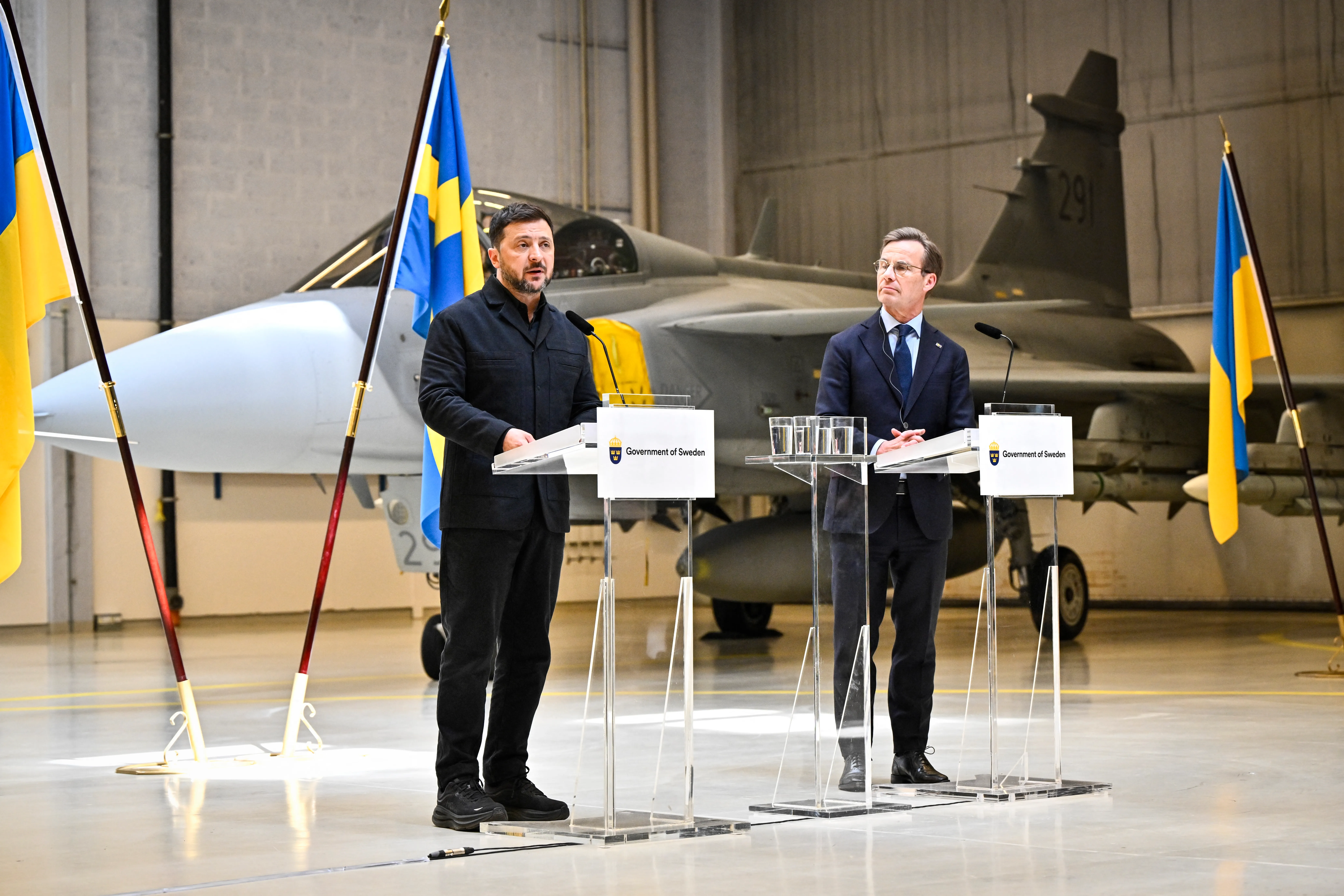
After meeting Zelensky in the city of Uppsala, Sweden today, Sweden’s Prime Minister Ulf Kristersson announced that his country will donate up to 16 Gripen C/Ds to Ukraine. These will be secondhand jets drawn from Swedish stocks, to expedite delivery. Handover of the jets in Ukraine will take place in early 2027, Kristersson added.

Ukraine's President Volodymyr Zelensky (L) and Swedish Prime Minister Ulf Kristersson address a press conference at the F16 air flotilla in Uppsala, Sweden on May 28, 2026. Ukraine plans to buy up to 20 latest model Gripen fighter jets and Sweden will donate 16 older models to boost its air defence, the two countries said on May 28, 2026 during a surprise visit to Sweden by the Ukrainian president. Ukraine plans to allocate 2.5 billion euros ($2.9 billion) from an EU loan for the new aircraft, the Swedish government said in a statement. (Photo by Christine Olsson/TT / various sources / AFP via Getty Images) / Sweden OUT
Ukrainian President Volodymyr Zelensky (left) and Swedish Prime Minister Ulf Kristersson address a press conference in Uppsala, Sweden on May 28, 2026. Photo by Christine Olsson/TT / various sources / AFP via Getty Images

According to Swedish officials, the training of Ukrainian pilots and technicians on the Gripen C/D is already underway and will be expanded this fall.

In the longer term, Kristersson confirmed that Ukraine plans to acquire an initial batch of up to 20 of the more advanced Gripen E/F versions. Writing on X today, Swedish Minister for Defense Pål Jonson said that the Gripen E/F would be financed with a $2.9-billion European Union loan. The long-term ambition remains 100-150 Gripen aircraft, he added.

Despite it having a similar outward appearance to the Gripen C/D, the Gripen E (and the two-seat Gripen F version) is regarded as a completely new aircraft type — as you can read about here.

A two-ship formation of Gripen E (left) and Gripen C (right). Saab

“Ukraine has clearly identified the Gripen aircraft as a priority option for its air force in the long term and intends to purchase the newest version, the Gripen E,” Kristersson said. “Negotiations are ongoing, and we will be able to transfer these aircraft by 2030.”

In a press release, Saab reiterated that it has not yet signed any contract nor received an order relating to the Gripen E/F for Ukraine, meaning this transfer only exists as a statement of intent for now.

According to Saab, “The next steps for the Ukrainian and Swedish authorities will be to complete the negotiations regarding Ukraine’s acquisition of Gripen E/F, which is expected to take place in batches, and Saab will support this process.”

In the meantime, the Swedish government has also announced that it will replace the donated Gripen C/D aircraft in the Swedish Air Force inventory. “Dialogue regarding Sweden’s replacement of the donated capability will be initiated soon,” Saab said.

A pair of Swedish Air Force Gripen Cs. Saab

Last October, as we reported, Kristersson and Zelensky signed a letter of intent (LOI) including a potential export deal covering “likely between 100 and 150 fighter jets,” according to Kristersson. The LOI was signed at Linköping, the site of Saab’s manufacturing facility for the Gripen.

As for second-hand Gripens, Ukraine has repeatedly been linked with a possible transfer of secondhand Swedish Air Force Gripen C/Ds, and Zelensky previously said he would like to see the first of these delivered from 2026.

While the Gripen C/Ds are now set to arrive later than hoped, it remains a big deal for the Ukrainian Air Force. Although the service has already received Western-supplied F-16s and a smaller number of Mirage 2000s, the Ukrainian Air Force still relies heavily on its Soviet-era fighters. The MiG-29, in particular, has been continually adapted to carry new weaponry, both Western-supplied and locally developed, but these are aging jets and the fleet has been steadily reduced by attrition.

Perhaps the most important part of the Gripen transfer will involve the armament for the fighter.

Zelensky specifically mentioned that he expects the Gripen C/Ds to be armed with the Meteor missile.

Swedish Minister for Defense Pål Jonson said that the Gripen C/D “can be delivered with weapons such as IRIS-T, AMRAAM, and the long-range Meteor missile. This is about aircraft, weapons, skills and sustainment.”

Earlier this year, the Ukrainian Ministry of Defense confirmed that the Meteor was one of the weapons being lined up for the next Swedish security aid package for Ukraine.

As we have discussed in the past, the Meteor would provide Ukraine with a class of air-to-air weapon that it badly needs to redress the balance against Russian fighter jets.

Undoubtedly, the Meteor is among the most capable air-to-air missiles in operational service anywhere in the world. Thanks to its ramjet propulsion, which can be throttled during different phases of flight, the Meteor is generally considered to be effective against certain types of targets out to around 130 miles.

Meteor thumbnail

Meteor


The Meteor also features an active radar seeker for the terminal phase and a two-way datalink that feeds it with in-flight updates as it flies out to its target and provides information to the pilot in the launch aircraft.

While the AIM-120 Advanced Medium-Range Air-to-Air Missile (AMRAAM) that arms Ukraine’s F-16 fighters also has an active radar seeker, it lacks the range of the Meteor.

The most capable AMRAAM identified as being used by Ukraine is the AIM-120C-8, which is generally assumed to be able to hit targets at a distance of between 75 and 100 miles.

The wreckage of an AIM-120C-8 missile, apparently found in the aftermath of a Russian air attack on Dnipro, last month. via Dnipro Main News/Telegram

Of course, in practical applications, the range of both the Meteor and AMRAAM is affected by a whole range of factors, above all, the energy and altitude state of the launching aircraft and the target.

However, the Meteor could bring a significant shift to the airpower balance over Ukraine.

Russia has repeatedly exploited the long range of its R-37M air-to-air missile, known to NATO as AA-13 Axehead, typically launching them from jets flying outside the range of the missiles carried by Ukrainian fighters, as well as from most ground-based air defense systems.

A Russian Su-35S launches an R-37M air-to-air missile. Russian Ministry of Defense screencap

With a reported range of 124 miles against certain types of targets, the R-37M flies to its target on a lofted trajectory, controlled by an inertial navigation system with mid-course radio correction, and uses an active radar seeker for its terminal phase attack.

Mainly used by Su-35S Flanker multirole fighters and MiG-31BM Foxhound interceptors, the R-37M is a missile we have examined in detail in the past. It has long been a thorn in the side of Ukrainian Air Force fighter pilots.

As TWZ had previously pointed out, Meteor is the best candidate for Ukraine to try and redress the balance in the air war when faced by the far-reaching R-37M and would finally put Russian aircraft at risk within their own missile ranges.

At the same time, the Meteor would give Ukraine a weapon that can target Russian jets delivering standoff munitions, again from outside the range of Ukrainian air defenses. Zelensky today said the missile “would stop Russian glide bomb attacks,” something that has been a huge problem for Ukrainian air defenses since this class of weapons was introduced.

A Russian UMPK-series glide bomb under the wing of a Su-34 Fullback strike fighter. Russian Ministry of Defense screencap

As we’ve highlighted in detail as far back as April of 2022, aside from its Meteor capability, the Gripen, even in its earlier C/D versions, would be the best fit for Ukraine.

Designed during the Cold War to meet the Soviet threat, the Gripen was engineered for efficiency, durability, and ease of operation under wartime conditions. It was specifically designed to be serviced and rearmed by small teams — often including conscript personnel — while operating from dispersed locations such as roads and improvised airstrips instead of traditional air bases. The aircraft’s entire concept centers on maintaining combat operations in demanding environments, including prolonged cold-weather conditions.

A Swedish Air Force Gripen C at a remote base. Saab

“Gripen was built for a country that may have to fight outnumbered, under pressure and from dispersed bases,” Swedish Minister for Defense Pål Jonson said. “That makes it highly relevant for Ukraine: high readiness, rapid turnaround, modern weapons and the ability to operate under constant threat,” he added.

Overall, the Gripen is particularly compatible with the decentralized and highly mobile style of warfare Ukraine is currently practicing.

At the same time, it should be noted that even with the F-16, the Ukrainian Air Force has developed tactics and equipment to operate these jets from dispersed locations around the country. Even before the current conflict, Ukrainian fighters were training to make use of highways as alternatives to traditional runways.

A video shows vehicles intended to help with distributed operations of Ukrainian F-16s:

Project 61: an ecosystem for F-16s by Come Back Alive Foundation thumbnail

Project 61: an ecosystem for F-16s by Come Back Alive Foundation


The capabilities of the Gripen and Meteor would also be enhanced by working in combination with the two Saab 340 airborne early warning and control (AEW&C) aircraft equipped with Erieye radar that have been donated by Sweden.

Ukraine’s Saab 340 AEW&C can function as an airborne fighter control platform by detecting and tracking Russian targets, prioritizing threats, and directing fighters to intercept them. Through its datalink system, the aircraft can also transmit mid-course guidance updates directly to missiles in flight. As a result, fighter pilots may not even need to activate their own radar when engaging a target. Instead, the missile can be assigned a target before launch, fired, and then continuously guided by updates from the AEW&C aircraft throughout its flight.

The first evidence of the Saab 340 AEW&C being used over Ukraine emerged in March this year, but its activities have remained closely under wraps.

Taken together, the arrival of the Gripen and Meteor missile would represent one of the most significant upgrades yet for the Ukrainian Air Force. Beyond simply adding another Western fighter type, the package would introduce a highly survivable, dispersed-operating combat jet paired with one of the world’s most capable long-range air-to-air missiles and supported by Swedish AEW&C assets.

Even without the Meteor, the Gripen C/D could help Ukraine challenge Russia’s long-standing advantage in beyond-visual-range air combat while fitting naturally into the more decentralized operating model the Ukrainian Air Force has already been forced to adopt throughout the war. At the same time, it will provide valuable experience for crews and serve as a stepping stone for the future Gripen E/F.

Contact the author: thomas@thewarzone.com

Thomas is a defense writer and editor with over 20 years of experience covering military aerospace topics and conflicts. He’s written a number of books, edited many more, and has contributed to many of the world’s leading aviation publications. Before joining The War Zone in 2020, he was the editor of AirForces Monthly.


Source link