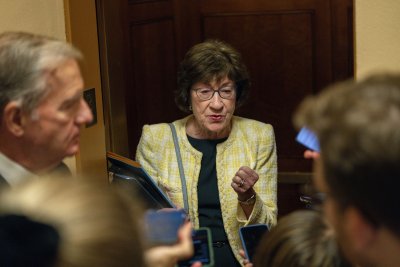
Lisa Murkowski

Senate passes resolution to begin budget reconciliation to fund DHS

April 23 (UPI) — Senate Republicans were up all night voting, eventually adopting a budget reconciliation package Thursday morning to prepare to fund the Department of Homeland Security.

The Senate plans to fund the department without Democrats’ help. The resolution was adopted at around 3:30 a.m. EDT Thursday by a vote of 50-48 after about six hours.

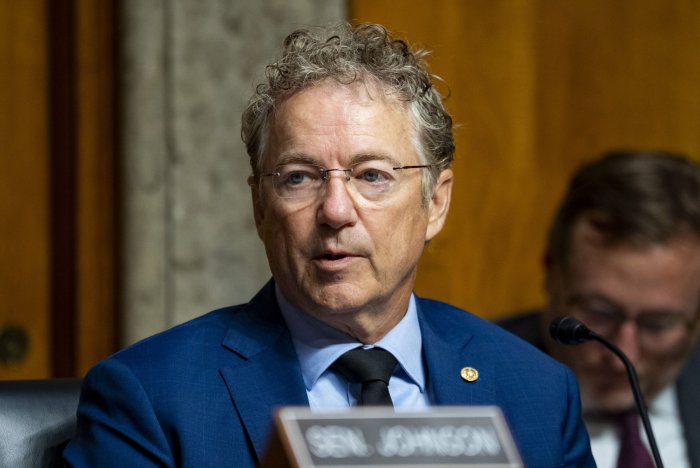
The only Republicans to vote against the resolution were Sens. Lisa Murkowski, R-Alaska, and Rand Paul, R-Ky. The bill now goes to the House. If the House adopts the resolution, the final funding bill can be written and voted on by Congress.

They are following a deadline of June 1 set by President Donald Trump.

“We have a multistep process ahead of us, but at the end Republicans will have helped ensure that America’s borders are secure and prevented Democrats from defunding these important agencies,” said Senate Republican Leader John Thune, R-N.D.

Thune told fellow senators to keep the package narrow to ensure speedy passage.

Since the January deaths of Renee Good and Alex Pretti in Minnesota, both shot and killed by DHS officers, Democrats have refused to support funding the department without reforms. The department has been shut down since Feb, 14, though Trump told the department to use emergency funds to pay essential workers.

Just before the Easter recess, the Senate passed a bill that would fund most of DHS but not ICE and Border Patrol. But the House rejected it.

Republicans are hoping to fund the department through 2029 at a cost of between $70 and $80 billion.

The late-night vote-a-rama included votes about amendments that could be added to the resolution. Two Republican Senators who are vulnerable in the November elections — Sens. Susan Collins, R-Maine, and Dan Sullivan, R-Alaska — broke ranks on some amendments.

Collins and Sullivan voted for amendments to lower health care costs, to reverse last year’s Supplemental Nutrition Assistance Program cuts and to tackle insurance companies that delay or deny medical care. Sen. Josh Hawley, R-Mo., joined with Collins and Sullivan on the latter.

Sen. Bernie Sanders, I-Vt., also sponsored an amendment that would tell the budget committee chair to help cut prescription drug prices by half. Hawley, Collins and Sullivan supported Sanders on it. Sanders said his amendment would codify ensuring that Americans wouldn’t pay more for prescriptions than Canadians or Europeans.

The amendments wouldn’t have the power to force Republicans’ hands, but they would make Republicans go on record about their views of these items.

“This reconciliation, or this budget act, will show who’s on whose side, and clearly if Republicans vote against our amendments, they’re not on the side of the American people,” Democratic Leader Chuck Schumer, D-N.Y., said on the Senate floor.

Homeland Security Secretary Markwayne Mullin told Fox and Friends on Tuesday that the department will run out of money for salaries next month.

“I’ve got one payroll left, and there is no more emergency funds so the president can’t do another executive order because there’s no more money there,” The Hill reported he said.

The resolution does not include the SAVE America Act, the voter security bill that Trump and other Republicans have pushed for. Sen. John Kennedy, R-La., sponsored an amendment to add similar restrictions, but it failed 48-50. Collins, Murkowski, Sen. Thom Tillis, R-S.C., and Sen. Mitch McConnell, R-Ky., voted against it.

FBI Director Kash Patel speaks during a press conference at Department of Justice Headquarters on Tuesday. The Trump Administration announced charges against the Southern Poverty Law Center, which the government alleges funneled over $3 million toward white supremacist and extremists groups. Photo by Bonnie Cash/UPI | License Photo

Source link

Senate Republicans again block Democrats’ bid to limit war powers

April 23 (UPI) — Senate Republicans have again blocked the Democrats from curbing President Donald Trump‘s ability to wage war with Iran, as negotiators try to find a diplomatic end to the conflict during the fragile cease-fire.

The Senate voted 51-46 on Wednesday afternoon against Sen. Tammy Baldwin‘s War Powers Resolution, the fifth time since March 4 that the Senate has voted against directing the removal of U.S. Armed Forces from hostilities with Iran until authorized by Congress.

As with previous votes, Wednesday’s was mostly along party lines with Republican Sen. Rand Paul of Kentucky again voting with his Democratic colleagues, and Democratic Sen. John Fetterman of Pennsylvania again voting with the Republicans.

“This entire war has been unnecessary, illegal and unwise. And we need to put a check on this president before it gets even worse,” Baldwin said from the Senate floor on Wednesday.

“Unfortunately, the president has shown us that he did not have a plan after day one. The president said the war would be over in a matter of days; we are coming up on the two-month mark with no real end in sight. And over the course of 50-plus days we have seen nothing short of a disaster.”

Sen. Tammy Duckworth, D-Ill., a veteran, vowed in a statement that the Democrats will continue to do all in their power to end the war.

“It’s infuriating that Senate Republicans keep shirking their oaths and giving Donald Trump the green light to plunge our nation even deeper into his war of choice, further endangering our troops abroad and surging prices at home,” she said.

“This wanna-be dictator keeps breaking every single promise he’s made to the American people who are sick and tired of watching Republicans duck their responsibility to stop this chaos.”

The war began Feb. 28 with the United States and Israel attacking Iran.

Since then, 13 Americans have been killed. At least 3,646 people have been killed in Iran, according to HRANA.

Gas prices have surged as Iran has restricted access to the important Strait of Hormuz energy transportation route, and the United States is enforcing a blockade of Iran’s ports, cutting it off from sea-based trade.

The vote was held as a two-week cease-fire was to end before President Donald Trump announced an indefinite extension amid negotiations. On Wednesday, Iran’s military claimed to have seized two cargo ships in the conflict over the waterway.

Since the war began, Democrats have been seeking to rein in Trump’s war powers, arguing the ongoing war with Iran violates the Constitution, which mandates that only Congress has the power to declare war.

Democrats in the Senate have pledged to use their powers to force weekly debates on the war as well as weekly votes, forcing Republicans to repeatedly and publicly state their position on the conflict.

The vote was held less than a week before the 60-day limit of the war passes. On April 28, the War Powers Act will compel Trump to seek congressional authorization for the war.

Sen. Lisa Murkowski, R-Alaska, has said that Trump should have sought Congress’ authorization, and appears to be leading Republican efforts to draft legislation for the continuation of the use of military force as that deadline comes.

“My focus is on the safety of America’s armed forces and the American civilians who are on the ground in the Middle East,” she said in a statement in early March, just days after the war began.

“At this point, we have little choice but to continue the military operation to degrade and destroy Iran’s capability for nuclear weapons.”

Source link

Means’ surgeon general nomination is stalled as senators question her experience and vaccine stance

Wellness influencer Dr. Casey Means’ nomination to be U.S. surgeon general is stalled a month after senators of both major political parties grilled her on vaccines and other health topics during a tense confirmation hearing, deepening doubts about her ability to secure the votes she needs for the role.

The nomination has languished despite ongoing efforts from the White House and Make America Healthy Again activists, revealing how intractable rifts over health policy can be even when Congress has shown deference to President Trump. It’s become the latest snag in Health Secretary Robert F. Kennedy Jr.’s agenda after two legal setbacks last week.

Means, a 38-year-old Stanford-educated physician who became disillusioned with traditional medicine and did not finish her surgical residency program, has faced scrutiny for her lack of experience and potential conflicts. Another sticking point has been her close alignment with Kennedy, whose efforts to dramatically pull back vaccine recommendations have been slammed by lawmakers and medical groups.

To advance to a full Senate vote, Means likely needs every Republican on the Senate Health, Education, Labor and Pensions Committee to support her nomination. But after last month’s hearing, two of them — Sens. Lisa Murkowski of Alaska and Susan Collins of Maine — told reporters they still had questions for her.

Murkowski told reporters Tuesday that “I’m just in the same spot” when it comes to those hesitations. Collins and Republican committee chairman Sen. Bill Cassidy, a physician from Louisiana who interrogated Means about vaccines during the hearing, didn’t respond to multiple inquiries about the delay.

White House spokesman Kush Desai said in a statement that the Trump administration has been having “productive conversations with the Senate” to advance Means. He added that her “elite academic credentials, research background and advocacy on America’s chronic disease epidemic will make her a critical asset for President Trump’s push to Make America Healthy Again.”

Kennedy spokesman Andrew Nixon reinforced the Republican administration’s support for Means and praised her message calling for healthier lifestyle choices rather than “sick care.”

Contentious hearing set the stage for a tough path to confirmation

Means promotes ideas popular with the MAHA movement, including that Americans are overmedicalized and that diet and lifestyle changes should be at the center of efforts to end widespread chronic disease.

But she’s been criticized for having an inactive medical license, for sometimes failing to disclose financial relationships with brands she promotes and for some of her past health-related comments.

Senators asked her during her hearing about how she would speak to the public about vaccines.

Murkowski and Cassidy pressed Means about her past doubts about the birth dose of the hepatitis B vaccine, which the U.S. Centers for Disease Control and Prevention stopped recommending for all children late last year in a move later temporarily blocked by a federal judge. Means called the hepatitis B vaccine important and lifesaving but said parents should make their own decisions with their doctors.

Cassidy also asked Means whether she would advise Americans to vaccinate against the flu and measles amid outbreaks across the country. She didn’t make that commitment, instead emphasizing the importance of informed consent.

Collins asked Means about her past advocacy for the therapeutic use of psychedelic mushrooms. Means, who has spoken positively of her own experience with the drugs, said she wouldn’t recommend psychedelics for the American public.

Kennedy’s supporters put pressure on hesitant senators

Once it appeared Murkowski and Collins were undecided, MAHA activists orchestrated a push to support Means’ bid by surging phone calls to the two senators.

“Please call both of them. Call them time after time. Get your friends to call them,” Tony Lyons, head of the Kennedy-aligned group MAHA Action, told supporters earlier this month.

Others have loudly opposed Means’ nomination. Dr. Jerome Adams, Trump’s first-term surgeon general, has repeatedly called her unqualified for her lack of an active medical license. He said in an interview that Republicans in Congress and in the Trump administration have told him they disapprove of the pick but see it as Kennedy’s choice.

“What I keep hearing from folks is, ‘This is what Bobby wants,’” he said.

While surgeons general aren’t mandated by law to have an active medical license, they are required to be part of the U.S. Public Health Service Commissioned Corps, a group of health professionals that says members should have up-to-date licenses.

Means said during her confirmation hearing that she had voluntarily made her Oregon medical license inactive, and that Adm. Brian Christine, who runs the Commissioned Corps, had testified that she was eligible to serve.

Even if Means advances out of committee, she might have difficulty securing confirmation by the full 100-member Senate. Republican Sen. Thom Tillis of North Carolina, who isn’t seeking another term, told the Associated Press that he’s leaning against voting for Means.

“Her resume already puts me on alert — and then I don’t think she did herself any favors in the hearing,” Tillis said.

Means’ confirmation delay is unusually long

At nearly 300 days since her nomination in May, Means’ confirmation process has taken almost twice as long as the average presidential pick in Trump’s second term, according to data from the nonprofit Partnership for Public Service. The group found that in the first 400 days, the average time between nomination and confirmation for Trump’s nominees was 157 days.

Sometimes the process has gone far more quickly. Markwayne Mullin, the new Department of Homeland Security secretary sworn in Tuesday, had his confirmation hearing, floor vote and swearing-in all within a weeklong period.

One reason for Means’ drawn-out nomination is the birth of her son, which happened last October on the day of her initially scheduled confirmation hearing.

But Chris Piper, manager of public policy and stakeholder engagement at the Partnership for Public Service, said the length of time that has passed since Means’ rescheduled confirmation hearing also is unusual. He said candidates are often voted out of committee within a week of their hearing.

“A monthlong delay following a hearing is atypical for most nominations, particularly at this level of position,” he said.

Swenson writes for the Associated Press. AP writers Joey Cappelletti and Stephen Groves in Washington contributed to this report.

Source link

Senators seek review of Trump administration handling of Epstein files

March 11 (UPI) — A bipartisan group of senators penned a letter to the Government Accountability Office on Wednesday calling for an investigation into the Justice Department over its handling of the Jeffrey Epstein files release.

The letter accuses the Justice Department of noncompliance with the Epstein Files Transparency Act, the bipartisan law overwhelmingly passed by both chambers of Congress last year. The lawmakers shared concern that the department has still not released all of the files it is required to by the law, despite a December deadline.

Sens. Dick Durbin, D-Ill., Ben Ray Lujan, D-N.M., Jeff Merkley, D-Ore., and Lisa Murkowski, R-Alaska, signed the letter. They also shared concerns about the files that have been released, including victims’ names not being redacted and alleged coconspirators’ names being redacted.

The Government Accountability Office is an independent and nonpartisan agency in the legislative branch. Its purpose is to operate as a watchdog over the federal government, with the authority to investigate and perform audits.

“Contrary to Congress’s explicit directive to protect victims, these records included email addresses and nude photos in which the names and faces of publicly-identified and non-public victims could be identified,” the letter said. “But when it came to information identifying powerful business and political figures who are alleged coconspirators or material witnesses, DOJ appears to have heavily redacted those.”

The senators are requesting that Comptroller General Orice Williams Brown reviews the department’s process it used to review, redact and release the files. They specify that they want the Government Accountability Office to investigate whether the release of the files “has serve to cover up child sexual abuse.”

The Epstein files have continued to be a source of contention between lawmakers and the Trump administration more than two months after the Justice Department was required by law to release the files.

Lawmakers have pushed for answers about the delayed and mistake-filled release from Attorney General Pam Bondi, leading to fiery exchanges in a House Judiciary Committee hearing last month.

The House Oversight Committee issued a subpoena for Bondi’s testimony last week. Five Republicans joined all of the Democrats in the committee in voting for the subpoena.

“This horrific scandal is one where powerful, wealthy men groomed, abused, and raped young women, men, and children,” the letter from the senators reads. “It is critical to understand what led to DOJ’s failure to redact the victims; information and re-victimize those individuals while violating the Epstein Files Transparency Act in its redactions of information related to their alleged abusers.”

Source link