languages

French blockade looms over Commission’s plan to fast-track trade deals in English

Published on

France will push back against a European Commission plan to fast-track ratification of trade agreements by circulating only English-language versions during talks with EU governments and lawmakers, skipping translation into the bloc’s 24 official languages, according to several sources.


ADVERTISEMENT


ADVERTISEMENT

The slow ratification of the contentious EU–Mercosur trade deal has frustrated the Commission, which wants to accelerate negotiations and bring deals into force more quickly as it seeks new markets amid rising geopolitical tensions.

Translating the agreements into every official EU language can take months due to the legal scrubbing required before the ratification process begins. The EU executive has confirmed to Euronews that trade chief Maroš Šefčovič told EU trade ministers in February that the trade deal with India concluded on 27 January could serve as a test case for using English as the main language during ratification.

“We lost almost €300 billion by not having the Mercosur agreement in place since 2021, if it comes to the GDP, and more than €200 billion in export opportunities,” Šefčovič told journalists after meeting ministers on 20 February, adding that once negotiations end it can take up to 2.5 years before businesses can operate in partner countries.

“In today’s world, we cannot simply lose the time,” he said.

Šefčovič said the Commission would ensure the agreements are translated into all 24 official EU languages once published in the Official Journal, i.e. after ratification. He added the proposal was backed by at least seven member states at the meeting, though not all countries had time to speak.

French sources who spoke to Euronews were insistent that Paris would vigorously oppose the move to English-only agreements if necessary.

“As a matter of principle, we defend the use of all the languages of the Union, and in particular French, which is one of the EU’s working languages,” one official told Euronews.

‘Transparency, precision and understanding’

Language policy in the bloc’s institutions remains politically sensitive for countries such as France, whose language has declined sharply over the past decades as English massively dominates daily work in the European Union institutions – despite French, German and English being the three working languages.

“Switching entirely to English raises a legal and democratic issue, and the Commission is well aware of it,” an EU diplomat told Euronews.

On its website, the European Commission says linguistic diversity is essential and that the EU promotes multilingualism in its institutional work.

The bloc once even had a commissioner dedicated to multilingualism, though the portfolio was gradually merged with others and eventually disappeared.

“I have the impression that in some cases the Commission seizes the opportunity to push the idea that English has a superior status, and that the other official languages are translation languages that can come later,” Michele Gazzola, expert in language policy, said.

He added that relying only on English during ratification could pose problems for members of the European Parliament, and even more so if national parliaments are involved.

“It’s a matter of transparency, precision and understanding.”
Source link

Where are the most endangered languages in the world? | Arts and Culture News

More than 7,000 languages are spoken around the world today and at least 3,000 of them, or 40 percent, are endangered.

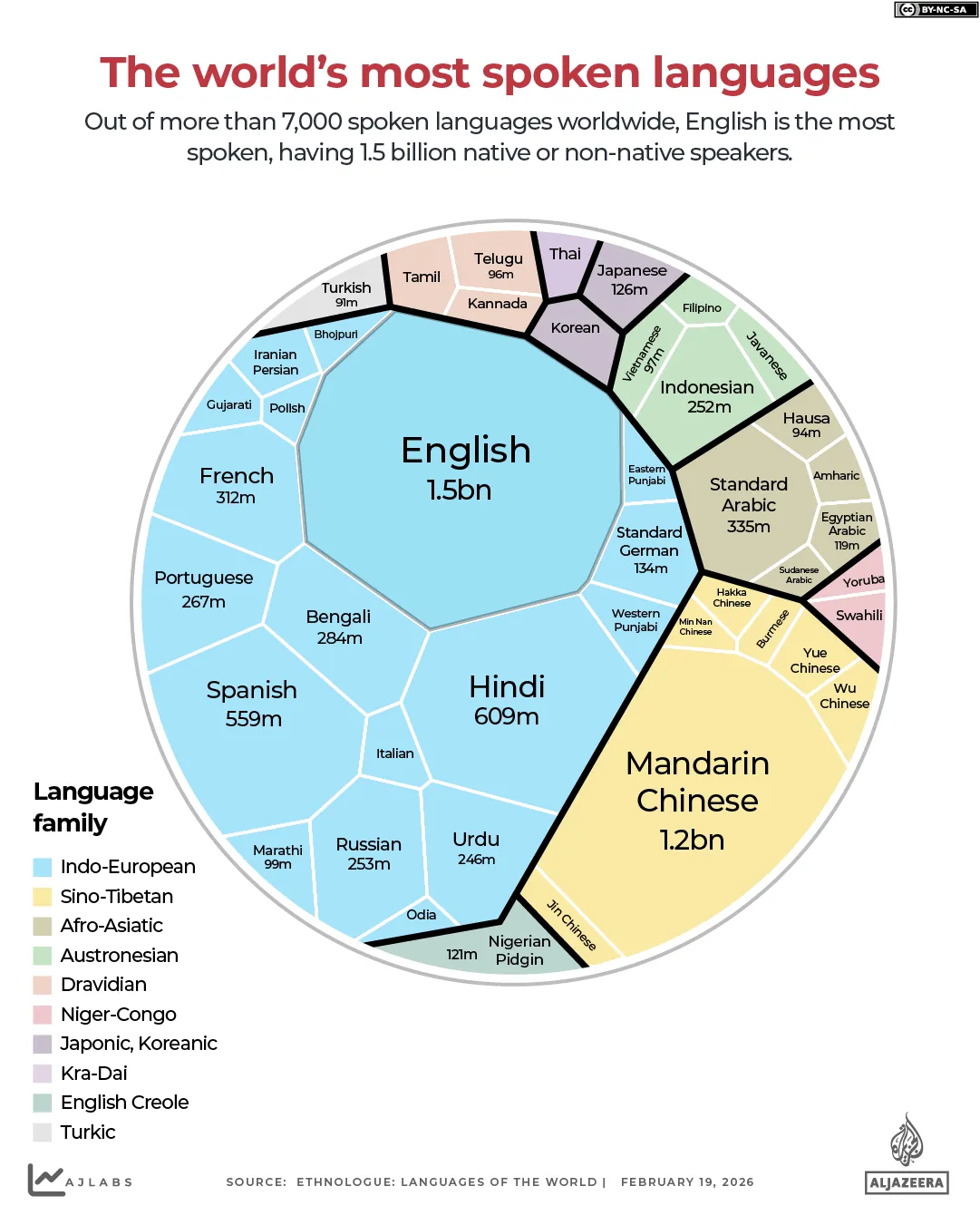
English is the most widely spoken language, with approximately 1.5 billion speakers in 186 countries. Two out of every 10 English speakers are native, while the remaining 80 percent speak English as their second, third or higher language, according to Ethnologue, a database which catalogues the world’s languages.

Mandarin Chinese is the second most spoken language with almost 1.2 billion speakers. However, when accounting for native speakers, it is the largest language in the world, owing to China’s large population.

Hindi comes in third at 609 million speakers, followed by Spanish (559 million), and Standard Arabic (335 million).

INTERACTIVE - The world’s most spoken languages - Feb 18, 2026-1771502232

There are 293 known scripts – sets of graphic characters used to write a language – according to The World’s Writing Systems, a reference book about global scripts.

More than 156 scripts are still in use today, while more than 137 historical scripts, including Egyptian Hieroglyphs and Aztec pictograms, are no longer in use.

The Latin script, which is used to write English, French, Spanish, German and more, is used in at least 305 of the world’s 7,139 known living human languages. More than 70 percent of the world’s population use it.

INTERACTIVE - The world’s most common scripts - fEB 18, 2026-1771502264

Which are the most endangered languages?

Of the 7,159 languages spoken worldwide, 3,193 (44 percent) are endangered, 3,479 (49 percent) are stable, and 487 (7 percent) are institutional, meaning they are used by governments, schools and the media.

A language becomes endangered when its users begin to pass on a more dominant language to the children in the community. Many are used as second languages.

According to Ethnologue, some 337 languages are said to be dormant while 454 are extinct.

Dormant languages are those that no longer have proficient speakers, but the language still has social uses and the language is part of the identity of an ethnic community. Extinct languages are those that have no speakers and no social uses or groups that claim it as part of their heritage or identity.

According to Ethnologue, 88.1 million people speak an endangered language as their mother tongue. There are:

  • 1,431 languages with fewer than 1,000 first-language speakers
  • 463 with fewer than 100 speakers
  • 110 with fewer than 10 speakers

INTERACTIVE - The world’s most endangered languages-1771512469

Just 25 countries are home to some 80 percent of the world’s endangered languages. Oceania has the most endangered languages, followed by Asia, Africa and the Americas.

Some endangered languages include:

Oceania 

In Australia, Yugambeh, an endangered Aboriginal language, is spoken by the Yugambeh people, primarily across the Gold Coast, Scenic Rim and Logan in eastern Australia.

In recent years, a strong community-led revitalisation programme and the use of learning apps have made the language more accessible to younger generations.

Asia 

Japan’s Ainu (Ainu Itak) is a critically endangered language. According to UNESCO, it can’t be linked with certainty to any family of languages. The exact number of Ainu speakers is unknown, however a 2006 survey showed that out of 23,782 Ainu, 304 know the language.

Africa

In Ethiopia, Ongota is a critically endangered language.

It was spoken by a community on the west bank of the Weito River in southwest Ethiopia. There are only about 400 members of the community left, with a handful of elders speaking the language.

Americas

In North and Central America, almost all Indigenous languages are endangered. Louisiana Creole, a French-based creole with African and Indigenous influences, is a seriously endangered language in the United States, with it mostly spoken by elders.

Leco is an endangered Indigenous language spoken in Bolivia and is considered an isolated language – one that has no genetic relationship to other languages. The language is only now spoken by elders with a Leco ethnic population of only about 13,500.

Europe

Cornish (Kernewek), spoken in southwest England, was marked as an extinct language by UNESCO, until it was revived and in 2010 changed to an endangered language. It is spoken as a first language by 563 people according to the 2021 England and Wales census.

Source link

Ramadan Mubarak 2026: Hear greetings in different languages | Interactive News

Here is how to wish someone during the holy month of Ramadan in different languages around the world.

Following the sighting of the crescent by the moon-sighting committee on Tuesday, Saudi Arabia has announced that the first day of fasting will be Wednesday, February 18.

There are nearly two billion Muslims globally, accounting for almost one-fourth of the world’s population. Indonesia has the largest Muslim population, approximately 242 million, followed by Pakistan (230 million), India (210 million), Bangladesh (160 million), and Nigeria (120 million).

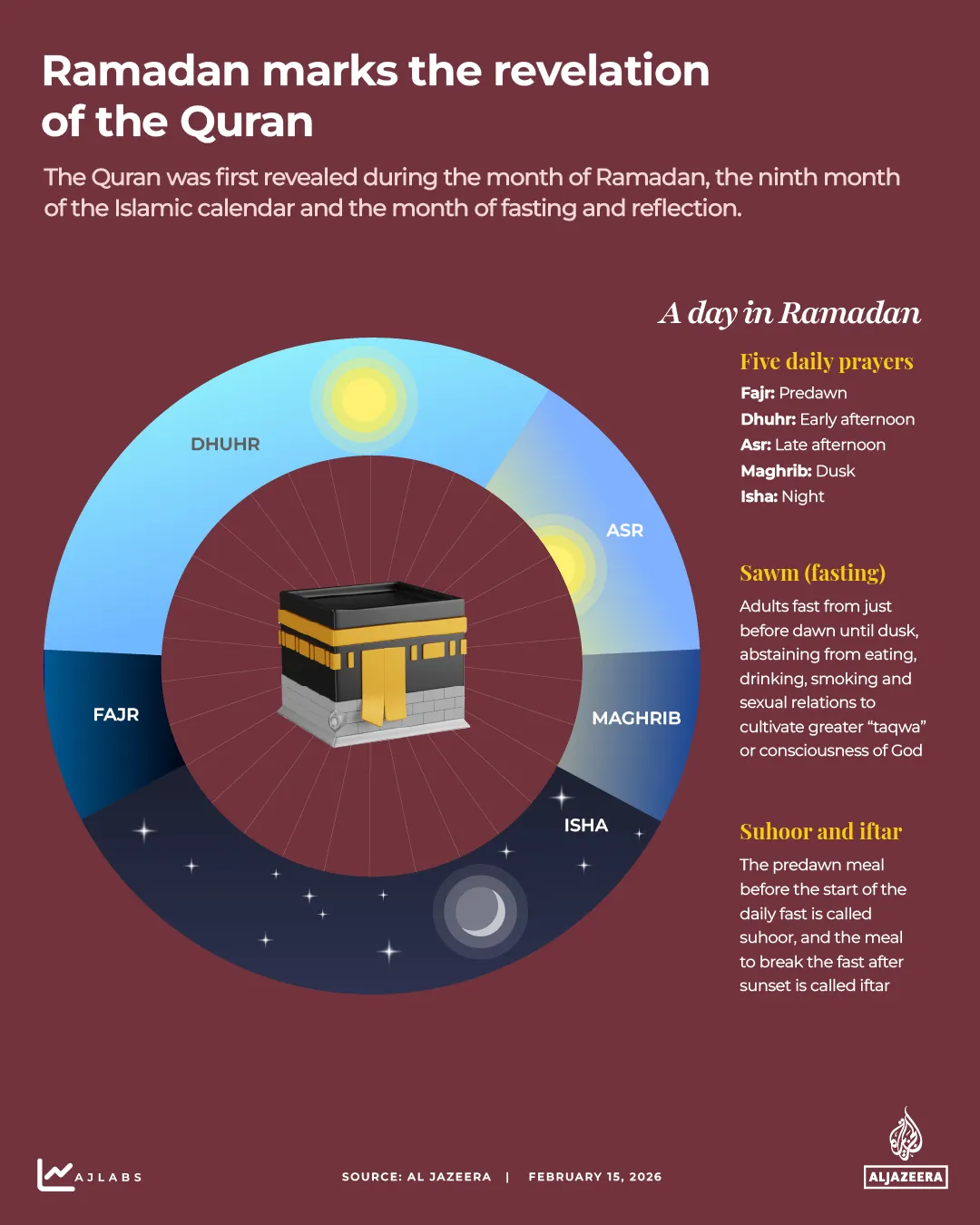
As the holy month begins, many Muslims have been preparing for a period of fasting, reflection, and community. Those observing the fast start their day with a predawn meal, suhoor, and break their fast at sunset with iftar.

Why is Ramadan holy?

Muslims believe that Ramadan is the month when the first verses of the Quran were revealed to the Prophet Muhammad more than 1,400 years ago.

Fasting is one of the five pillars of Islam, along with the Muslim declaration of faith, daily prayers, charity, and performing the Hajj pilgrimage to Mecca if physically and financially capable.

Interactive_Ramadan_2026_Quran_Revealed

Ramadan sayings in different languages

The month begins with the sighting of the new moon, often accompanied by an outpouring of greetings to mark the occasion. Many Muslim-majority countries have their own traditional greetings in their native languages.

Among the most common sayings are “Ramadan Mubarak” and “Ramadan Kareem”. These are Arabic sayings that translate to “blessed Ramadan” and “generous Ramadan”, respectively.

Greetings are not limited to the spoken language. They also extend to sign language and Braille. Some countries have their version of sign language, but placing one hand horizontally across the mouth is common among most to represent fasting.

Below is a collection of Ramadan greeting cards that you can download and share.

Interactive_Arabic-1771254998
(Al Jazeera)
Interactive_Assamese-1771255034
(Al Jazeera)
Interactive_Bengali-1771255067
(Al Jazeera)
Interactive_Bosnian-1771255098
(Al Jazeera)

Interactive_Bahasa-1771306094

Interactive_Dhivehi-1771255183
(Al Jazeera)
Interactive_English-1771255215
(Al Jazeera)
Interactive_French-1771255251
(Al Jazeera)
Interactive_Hindi-1771255287
(Al Jazeera)
Interactive_italian-1771255316
(Al Jazeera)

Interactive_Malay-1771306127

Interactive_Mandarin-1771255395
(Al Jazeera)
Interactive_Nepali-1771255426
(Al Jazeera)
Interactive_Pashto-1771255452
(Al Jazeera)
Interactive_Persian-1771255498
(Al Jazeera)
Interactive_Somali-1771255524
(Al Jazeera)

Interactive_Spanish-1771306172

Interactive_Turkish-1771255580
(Al Jazeera)
Interactive_Uzbek-1771255605
(Al Jazeera)
Interactive_Urdu-1771255637
(Al Jazeera)
Interactive_Sign Language-1771255676
(Al Jazeera)
Interactive_Braille-1771255710
(Al Jazeera)

Source link