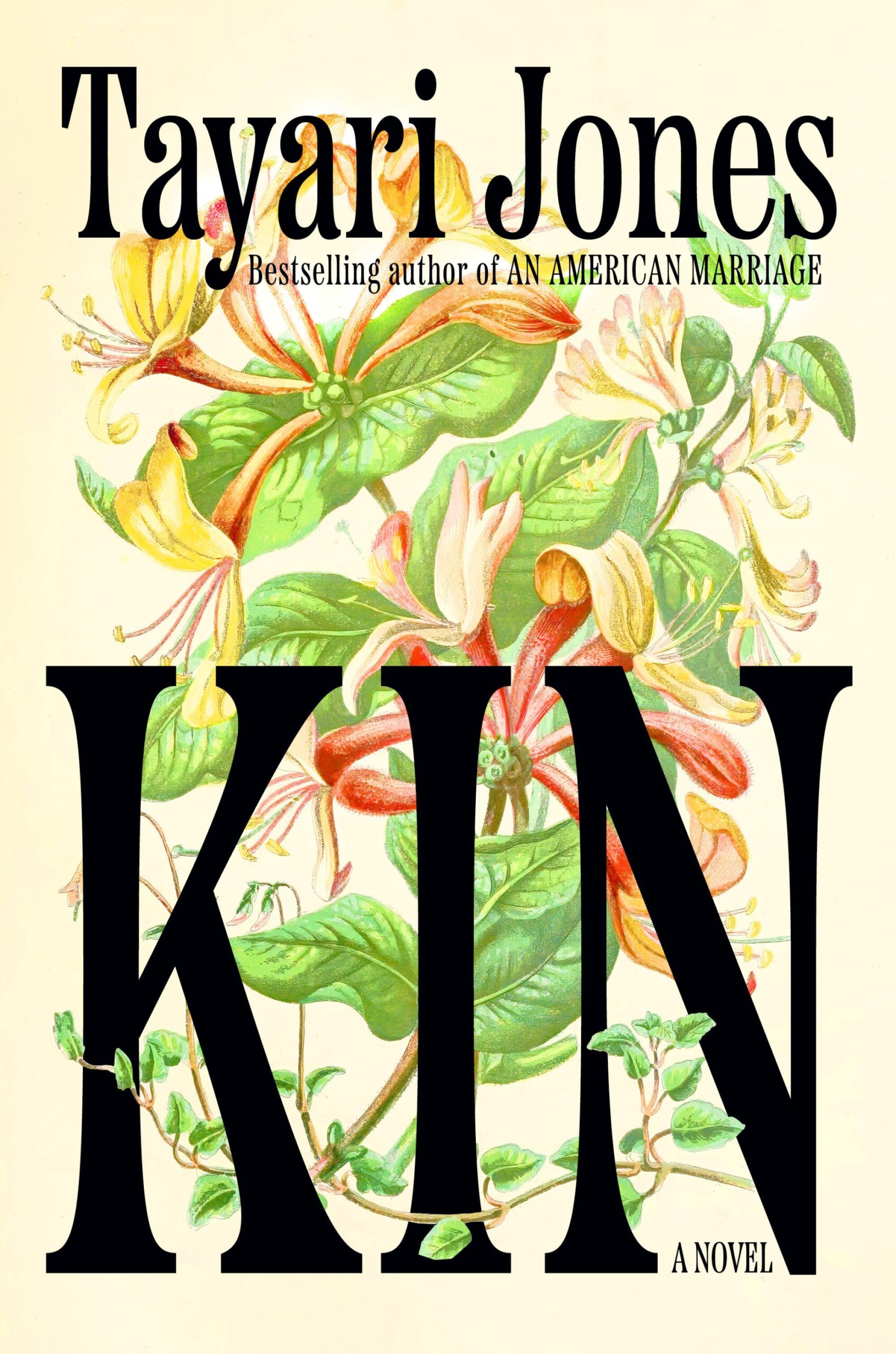
Tayari Jones on “Kin,” a new Oprah’s pick, and battling Graves’ Disease
Tayari Jones was feeling intense pressure to deliver a follow-up to her 2018 bestseller, “An American Marriage.” She was three years past her publisher’s deadline. Worse, she had begun to suffer symptoms of what was ultimately diagnosed as Graves’ disease, a serious autoimmune condition that attacks the thyroid. At the time she didn’t know what was causing pain in her right leg and the intense itching on her arms, legs and torso — or why her handwriting had “gone funky.” Meanwhile, 200 pages in, the novel she owed Knopf Publisher and Editor in Chief Jordan Pavlin wasn’t coming together.
She confided to a close friend, “This book got me feeling like a clown right now.” Jones began to doubt that she was ‘worthy’ of another literary success.
“You know how musicians say ‘that band was swinging’? I wasn’t swinging,” Jones, who lives in Atlanta, tells me during a recent phone call.
She says she turned to an empty notebook, and began word doodling — scrawling random words, going wherever her pen took her. “Kin,” the magnificent novel that emerged, is out now. Oprah recently announced that it’s her latest book club pick (the second time Jones has been honored with the selection).

“Kin: A Novel” by Tayari Jones
(Knopf)
On the Shelf
Kin
By Tayari Jones
Knopf: 368 pages, $32
If you buy books linked on our site, The Times may earn a commission from Bookshop.org, whose fees support independent bookstores.
“Kin” was supposed to have been an entirely different book — an of-the-moment novel about gentrification in the New South — but what materialized from Jones’ creative experiment was a tiny Louisiana town called Honeysuckle, amid the 1950s and Jim Crow. Then, as Jones puts it, “Annie and Vernice [her main characters] introduced themselves.” All of Jones’ previous fiction has been contemporary, and at first she didn’t know what to make of the path Annie and Vernice were leading her on. “I don’t write historical,” observes Jones, “I’m a writer of my own era.” Not to mention she’d always been suspicious of writers who claim their characters came to them fully realized.
Even at that point, Jones still believed Vernice and Annie might just be part of a larger backstory, perhaps parents to protagonists she had yet to conjure. “So I stuck with it to find out.” The more she wrote, the more the puzzle pieces began to fit together. Annie’s journey out of Louisiana takes her through a sharecropping brothel in Mississippi, then on to Memphis where she is convinced she will find and reunite with her mother. Meanwhile, Vernice attends Spelman (the HBCU Jones is a ’91 graduate of).
Jones began to suspect that she’d had a previously undetected ulterior motive for moving her book to the past. She wondered if “Kin” was actually an effort to better understand her parents, particularly her mother, a former economist who’d been active in the civil rights movement. “My mother is a very tight-lipped person,” Jones says. “I knew very little about her life, and maybe this was my imagination trying to crack the code.”
Jones’ progress wasn’t without its setbacks. She was deep into the writing of “Kin” when her Graves’ disease flared in earnest. Her blood pressure spiked. She got winded just climbing the stairs to her bedroom. She landed in the emergency room with a life-threatening “thyroid storm,” requiring surgery and daily medication. Then her eyesight deteriorated, which necessitated a month of radiation. But she powered through, and sent off the manuscript.
Jones’ editor, Pavlin, admits the novel she received was a surprise. “But it was as perfect a novel as I’ve ever read,” she says. “No publisher in their right mind would stand on anything as insignificant as a contractual description in the face of such a work.”
“Kin” deftly alternates points of view between Vernice and Annie, narrating events by way of a vernacular that would be at home on a front porch rocking chair. When Annie takes a job at a nightclub in Memphis, she says of its penny-pinching owner: “The man was tight as a skeeter’s teeter.” Jones is equally adept at the delicate prose, as in this description of a well-worn family Bible: “The paper, thin as butterfly wings, was heavy with wisdom.”
While Jones had Toni Morrison’s short story “Recitatif” in mind while writing “Kin,” her take on the subject is singular. “Vernice and Annie remain friends because each of them is the keeper of the other’s true self,” she says. “Friendship is particularly meaningful because it’s a relationship you’re constantly recommitting to — reupping.”
Now that “Kin” is out in the world, and Jones has weathered the bumpy road to publication day, we asked her if she’s nervous about how it will be received eight years after her previous novel was published. “I am not ambitious now in the way I was then,” she says. “I’ve learned what success can and cannot do for a person. You have to learn to be satisfied. People say ‘don’t rest on your laurels,’ but what are laurels for?”
Haber is a writer, editor and publishing strategist, and co-founder of the Ink Book Club on Substack. She was director of Oprah’s Book Club and books editor for O, the Oprah Magazine.