Column: North Korea’s party congress reinforces Kim’s rule

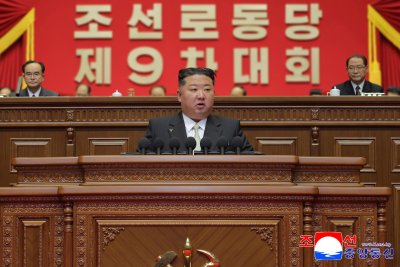
North Korean leader Kim Jong Un (C) speaking during the opening of the Ninth Congress of the Workers’ Party of Korea (WPK) in Pyongyang, North Korea, 19 February 2026 (issued 20 February 2026). File. KCNA / EPA
March 3 (Asia Today) — North Korea’s ninth congress of the Workers’ Party, held in Pyongyang from Feb. 19 to 25, reinforced leader Kim Jong Un’s centralized rule and reaffirmed the country’s nuclear posture, according to Cho Young-ki, secretary general of the Korea Foundation for the Advancement of the Korean Peninsula.
The party congress, convened every five years as the party’s highest decision-making body, drew about 5,000 delegates. It reviewed the Central Committee’s work, revised party rules and elected key leadership posts. Cho wrote that while the congress is formally tasked with deliberation, it primarily ratifies decisions already made by Kim and the leadership.
Kim declared that the past five years produced economic achievements “worthy of pride” despite internal and external challenges and said the country had permanently secured its status as a nuclear power. He pledged to pursue qualitative economic development under a “people-first” principle in the next five-year period.
Kim also defined inter-Korean relations as those between hostile states, dismissed Seoul’s reconciliation policies and reiterated North Korea’s nuclear deterrence. At the same time, he left open the possibility of negotiations with the United States if Washington withdraws what Pyongyang calls a hostile policy.
A key feature of the congress was renewed emphasis on what the regime calls a “Five-Point Party Building Line,” first proposed in 2022 and formalized in 2023. The line centers on strengthening political, organizational, ideological, disciplinary and work-style controls within the party.
Cho argued that reaffirming the five-point line formalizes Kim’s governing ideology and tightens centralized discipline under a party-centered system. The congress re-elected Kim as general secretary, revised party rules and reshuffled leadership posts.
Notably, the Political Bureau Standing Committee expanded from four to five members, and Kim’s sister, Kim Yo Jong, was reinstated and promoted, reinforcing what Cho described as a patronage structure around the leader. Twenty-three of 39 executive members were replaced in a generational reshuffle. Senior official Choe Ryong Hae was reported to have stepped back from his previous role near the top of the hierarchy.
Cho wrote that the five-point line ultimately serves to justify and entrench Kim’s centralized authority. He argued that the congress underscores North Korea’s lack of intention to abandon its nuclear weapons and signals a hardening of its stance toward South Korea.
Since the mid-1990s, Cho wrote, South Korea has operated under what he described as illusions that goodwill or dialogue alone could persuade Pyongyang to denuclearize. He said the latest congress challenges those assumptions.
Cho concluded that outside information remains one of the few factors that authoritarian systems fear. He pointed to North Korean laws enacted in recent years aimed at blocking foreign cultural and ideological influence, arguing they reflect the regime’s sensitivity to external information flows.
He said South Korea has a responsibility to expand technological and institutional means for North Koreans to access outside information, enabling independent thought and action.
Cho Young-ki, secretary general of the Korea Foundation for the Advancement of the Korean Peninsula and former professor at Korea University
※ The views expressed in this column are those of the author and may not reflect the position of this publication.
— Reported by Asia Today; translated by UPI
© Asia Today. Unauthorized reproduction or redistribution prohibited.
Original Korean report: https://www.asiatoday.co.kr/kn/view.php?key=20260303010000561