
inroads

China’s AI is quietly making big inroads in Silicon Valley | Technology

China’s AI models are quickly gaining traction in Silicon Valley, becoming integral to the operations of American companies and earning the praise of a growing list of tech leaders.

Their rapid ascent has highlighted the competitive edge that Chinese developers such as Alibaba, Z.ai, Moonshot, and MiniMax have been able to gain by offering so-called “open” language models at much lower costs than their rivals in the United States.

Recommended Stories

list of 4 itemsend of list

The trend has also cast a critical glare on the US’s efforts to stunt China’s tech sector with export controls on advanced chips, which have not stopped Chinese developers from approaching the capabilities of Silicon Valley’s tech giants.

Airbnb CEO Brian Chesky generated headlines in October when he revealed that the short-term rental platform had opted for Alibaba’s Qwen over OpenAI’s ChatGPT, praising the Chinese model as “fast and cheap”.

Social Capital CEO Chamath Palihapitiya revealed the same month that his company had migrated much of its work to Moonshot’s Kimi K2 as it was “way more performant” and “a ton cheaper” than models from OpenAI and Anthropic.

Programmers on social media also recently highlighted evidence that two popular US-developed coding assistants, Composer and Windsurf, were built on Chinese models.

The assistants’ developers, Cursor and Cognition AI, have not publicly confirmed their use of Chinese technology and did not respond to requests for comment, though Z.ai has said the speculation aligns with its “internal findings.”

AI
AI letters are shown on a laptop screen next to the logo of the Deepseek AI application in Frankfurt am Main, Germany, on April 1, 2025 [Kirill Kudryavtsev/AFP]

Nathan Lambert, a machine learning researcher who founded the Atom Project, an initiative to promote open models in the US, said such public examples were the “tip of the iceberg”.

“Chinese open models have become a de facto standard among startups in the US,” Lambert told Al Jazeera.

“I’ve personally heard of many other high-profile cases, where the most valued and hyped American AI startups are starting training models on the likes of Qwen, Kimi, GLM or DeepSeek,” Lambert said, adding that many US firms have been reluctant to publicly disclose their use of Chinese technology.

While it is not possible to precisely quantify the usage of different AI models, industry data points to the rising popularity of Chinese offerings.

Chinese AI tools, including MiniMax’s M2, Z.ai’s GLM 4.6 and DeepSeek’s V3.2, took up seven spots among the 20 models with the most usage last week, according to data from OpenRouter, a platform that connects developers with AI models.

Among the top 10 models used for programming, four were developed by Chinese firms, according to OpenRouter.

In the open model space, China’s clear lead is evident, with cumulative downloads surpassing 540 million as of October, according to an Atom Project analysis of data from hosting platform Hugging Face.

Rui Ma, the founder of Tech Buzz China, said Chinese models are particularly attractive to fledgling startups, while “high-resource organisations” have gravitated towards premium US models.

“These are typically cost-conscious early-stage companies that experiment widely, and many of them will not survive,” Ma told Al Jazeera.

Unlike leading US platforms such as ChatGPT, China’s open-weight large language models make their trained parameters – called weights – publicly available.

While open-weight models do not generate licensing or subscription fees, running them at enterprise scale requires large amounts of computing power, which creators can offer to users at a cost.

Developers such as Beijing-based Z.ai and Hangzhou-based DeepSeek have reported using older-generation chips that are not subject to US export controls, in relatively small quantities, dramatically reducing training and hardware costs compared with their Silicon Valley rivals.

“The success of these Chinese models demonstrates the failure of export controls to limit China,” Toby Walsh, an expert in AI at the University of New South Wales, told Al Jazeera.

“Indeed, they’ve actually encouraged Chinese companies to be more resourceful and build better models that are smaller and are trained on and run on older generation hardware. Necessity is the mother of invention.”

With lower input costs, Chinese firms have been able to offer their services far more cheaply than their US peers.

In an analysis published by AllianceBernstein in February, DeepSeek’s pricing for its models at the time was estimated to be up to 40 times cheaper than OpenAI’s, for instance.

Alibaba
The logo of Chinese technology firm Alibaba is seen at its office in Beijing, China [File: Mark Schiefelbein/AP Photo]

“I do think China’s AI progress has been underestimated, partly because the signal is fragmented,” Greg Slabaugh, a professor who studies AI at Queen Mary University of London, told Al Jazeera.

“Much of the uptake of Chinese models is in China. China’s scale in AI publications and patents has long been visible; the emergence of open-weight models simply makes that capability more globally consumable.”

Some industry analysts have likened China’s approach to AI to the strategy undertaken by Chinese firms in other industries, such as solar panels, that flooded markets with cheap goods.

“This is the solar panel playbook running on software,” Poe Zhao, a Beijing-based tech analyst, wrote last week in his Substack newsletter, Hello China Tech.

But while Chinese AI models have made inroads with their low cost, US tech giants are in a strong position to dominate the high-end market and highly regulated sectors where considerations such as national security are paramount, according to analysts.

Ma, the Tech Buzz China founder, said the development of AI could end up following a similar trajectory to the Android and iPhone platforms, the former of which has about three times as many users worldwide.

“Over the longer term – likely faster than what we saw in the mobile era – it’s entirely possible that AI adoption might follow similar economic dynamics. There are simply more users in the world who prioritise affordability than those who choose premium options,” Ma said.

“But that doesn’t mean the greatest margins or market capitalisation will exist at the low end; value may still concentrate where differentiation, performance and trust command a premium.”

“In Fortune 500 and regulated sectors, widespread adoption is probably not imminent,” said Slabaugh, the Queen Mary University of London professor, referring to the uptake of Chinese models.

“If there is a ‘rude awakening’, it may come on the pricing and flexibility front rather than from a sudden displacement of US models.”
Source link

Trump made inroads with Latino voters. The GOP is losing them ahead of the midterms

President Trump made historic gains with Latinos when he won reelection last year, boosting Republicans’ confidence that their economic message was helping them make inroads with a group of voters who had long leaned toward Democrats.

But in this week’s election, Democrats in key states were able to disrupt that rightward shift by gaining back Latino support, exit polls showed.

In New Jersey and Virginia, the Democrats running for governor made gains in counties with large Latino populations, and overall won two-thirds of the Latino vote in their states, according to an NBC News poll.

And in California, a CNN exit poll showed about 70% of Latinos voting in favor of Proposition 50, a Democratic redistricting initiative designed to counter Trump’s plans to reshape congressional maps in an effort to keep GOP control of the House.

The results mark the first concrete example at the ballot box of Latino voters turning away from the GOP — a shift foreshadowed by recent polling as their concerns about the economy and immigration raids have grown.

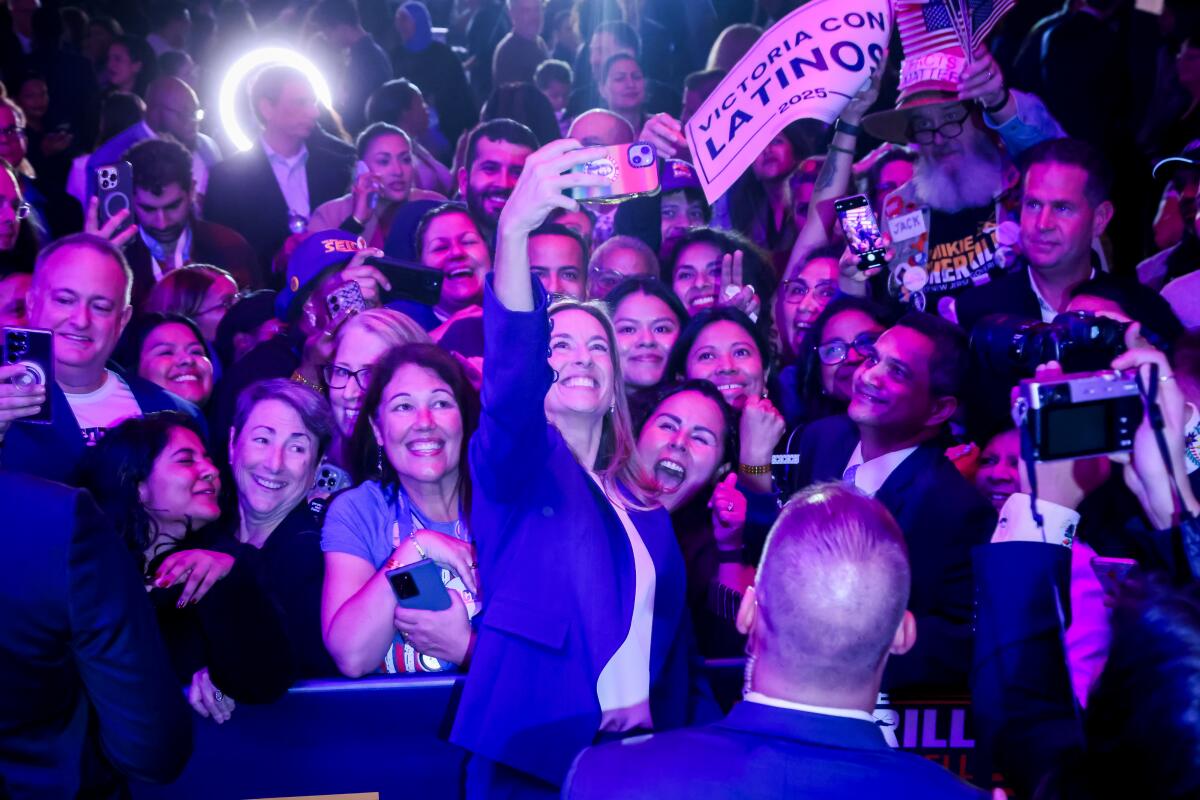
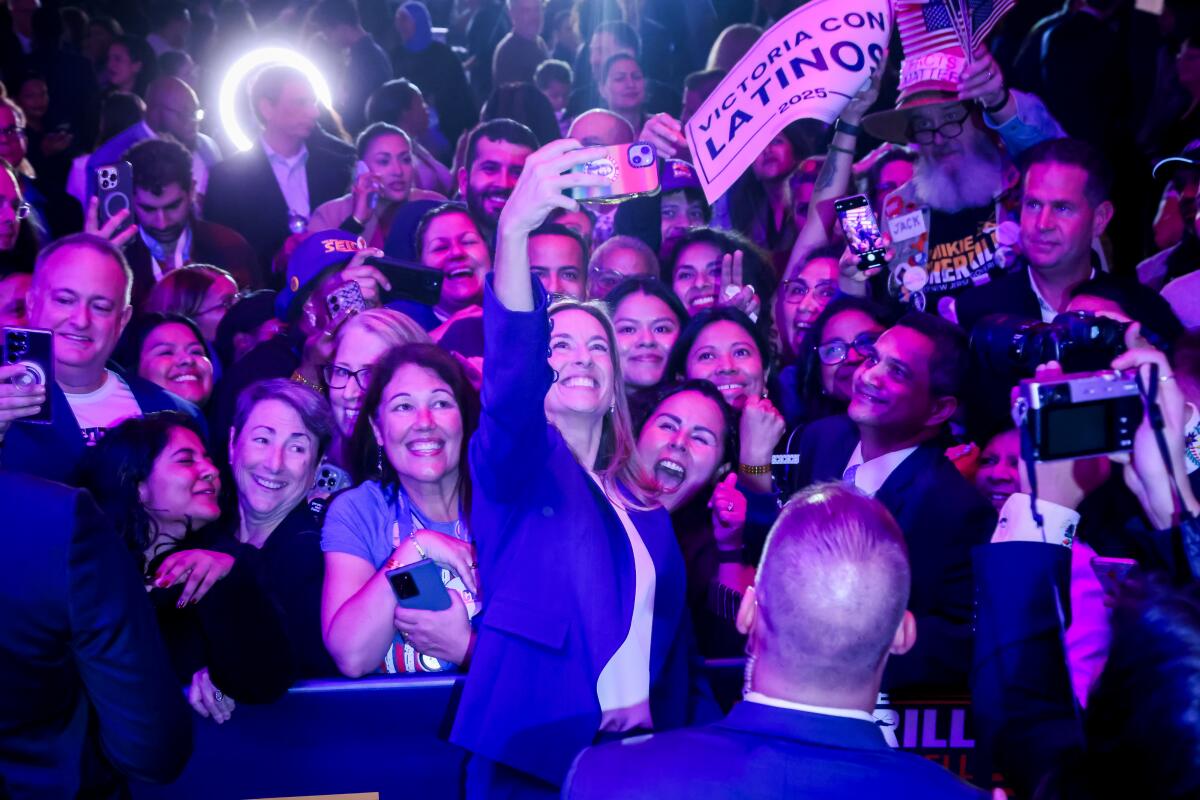
Mikie Sherrill, Democratic gubernatorial candidate for New Jersey, takes a photo with election night supporters.

Democratic Rep. Mikie Sherrill celebrates with supporters after being elected New Jersey governor.

(Michael Nagle/Bloomberg via Getty Images)

If the trend continues, it could spell trouble for Republicans in next year’s midterm elections, said Gary Segura, a professor of public policy, political science and Chicana/o studies at UCLA. This could be especially true in California and Texas, where both parties are banking on Latino voters to help them pick up seats in the House, Segura said.

“A year is a long time in politics, but certainly the vote on Prop. 50 is a very, very good sign for the Democrats’ ability to pick up the newly drawn congressional districts,” Segura said. “I think Latino voters will be really instrumental in the outcome.”

Democrats, meanwhile, are feeling optimistic that their warnings about Trump’s immigration crackdown and a bad economy are resonating with Latinos.

Republicans are wondering to what degree the party can maintain support among Latinos without Trump on the ticket. In 2024, Trump won roughly 48% of the Latino vote nationally — a record for any Republican presidential candidate.

Some Republicans saw this week’s trends among Latino voters as a “wakeup call.”

“The Hispanic vote is not guaranteed. Hispanics married President Donald Trump but are only dating the GOP,” Republican Rep. Maria Elvira Salazar of Florida said in a social media video the day after the election. “I’ve been warning it: If the GOP does not deliver, we will lose the Hispanic vote all over the country.”

Economic issues a main driver

Last year Trump was able to leverage widespread frustration with the economy to win the support of Latinos. He promised to create jobs and lower the costs of living.

But polling shows that a majority of Latino voters now disapprove of how Trump and the Republicans in control of Congress are handling the economy. Half of Latinos said they expected Trump’s economic policies to leave them worse off a year from now in a Unidos poll released last week.

In New Jersey, that sentiment was exemplified by voters like Rumaldo Gomez. He told MSNBC he voted for Trump last year but this week went for for the Democratic candidate for governor, Rep. Mikie Sherrill.

“Now, I look at Trump different,” Gomez said. “The economy does not look good.”

Gomez added he is “very sad” about immigration raids led by the Trump administration that have split up hardworking families.

While Latino voters fear being affected by immigration enforcement actions, polling suggests they are more concerned about cost of living, jobs and housing. The Unidos poll showed immigration ranking fifth on the list of concerns.

In New Jersey and Virginia, Democrats’ double-digit victories were built on promises to reduce the cost of living, while blaming Trump for their economic pain.

Marcus Robinson, a spokesman for the Democratic National Committee, said Democrats “expanded margins and flipped key counties by earning back Latino voters who know Trump’s economy leaves them behind.”

“These results show that Latino communities want progress, not a return to chaos and broken promises,” he said.

Republicans see a different Trump issue

GOP strategist Matt Terrill, who was chief of staff for then-Sen. Marco Rubio’s 2016 presidential campaign, said the election results are not a referendum on Trump.

Latino voters swung left because Trump wasn’t on the ballot, he said.

Last year “it wasn’t Latino voters turning out for the Republican party, it was Latino voters turning out for President Trump,” he said. “Like him or not, he’s able to fire up voters that the Republican party traditionally does not get.”

With Trump barred by the Constitution from running for a third term, Republicans are left to wonder if they can get the Latino vote back when he is not on the ballot. Terrill believes Republicans need to hammer on the issue of affordability as a top priority.

Mike Madrid, a “never Trump” Republican and former political director of the California Republican Party, has a different theory.

“They’re abandoning both parties,” Madrid said of Latinos. “They abandoned the Republican party for the same reasons they abandoned the Democratic party in November: not addressing economic concerns.”

The economy has long been the top concern for Latinos, Madrid said, yet both parties continue to frame the Latino political agenda around immigration.

“Latinos aren’t voting for Democrats or Republicans — they’re voting against Democrats and against Republicans,” Madrid said. “It’s a very big difference. The partisans are all looking at us as if we’re this peculiar exotic little creature.”

The work ahead

Democrat Abigail Spanberger was elected governor in Virginia in part because of big gains in Latino-heavy communities. One of the biggest gains was in Manassas Park, where more than 40% of residents are Latino. She won the city by 42 points, doubling the Democrats’ performance there in last year’s election.

The shift toward Democrats happened because Latinos believed Trump when he promised to bring down high costs of living and that he would only go after violent criminals in immigration raids, said Democratic strategist Maria Cardona, who worked with Spanberger’s campaign on outreach to Spanish-language media.

Instead, she argued, Trump betrayed them.

Cardona said Medicaid cuts under Trump’s massive spending package this year, along with the reduction of supplemental nutrition assistance amid the government shutdown, have Latinos families panicking.

“What Republicans misguidedly and mistakenly thought was a realignment of Latino voters just turned out to be a blip,” she said. “Latinos should never be considered a base vote.”

Political scientists caution that the election outcomes this week are not necessarily indicative of how races will play out a year from now.

“It’s just one election, but certainly the seeds have been planted for strong Latino Democratic turnouts in 2026,” said Brad Jones, a political science professor at UC Davis.

Now, both parties need to explain how they expect to carry out their promises if elected.

“They can’t sit on their laurels and say, ‘well surely the Latinos are coming back because the economy is bad and immigration enforcement is bad,’” Jones said. “The job of the Democratic party is now to reach out to Latino voters in ways that are more than just symbolic.”

Source link