improve

Trump’s order to pay TSA officers: When will airport lines improve?

With spring break in full swing, airline passengers continued to wait it out at major U.S. airports after President Trump signed an executive order to pay Transportation Security Administration officers aimed at alleviating long security lines.

Trump’s executive order Friday instructed the Department of Homeland Security to pay TSA officers immediately, although it’s unclear when the impact of that move will start to be felt at airports.

The signing came at a busy travel time of the year, with spring breaks at school districts and colleges and the upcoming Passover and Easter holidays.

Betty Mitchell arrived at Philadelphia International Airport at 12:30 a.m. Saturday for a 5 a.m. flight to visit family, but she said the airline desk did not open until 3 a.m. Once it did, there was a sudden influx of passengers to squeeze into the TSA screening lines.

“All at once it became a madhouse,” Mitchell said.

She waited nearly three hours to get through TSA screening but missed her flight. She was able to board the next available one.

“It was crazy long lines,” she said. “Never have I seen it that long. If the airlines work with TSA in these [troubled] times, maybe it would help the public.”

What’s the current situation on the ground?

Some passengers with very early flights Saturday were luckier than Mitchell, reporting they had little problem getting through airport security lines. But that may have been an anomaly. Others at some of the busiest airports wrote on social media that security lines were growing exponentially longer by the hour.

“We have not previously experienced checkpoint wait times similar to what we are seeing this morning,” Baltimore/Washington International Thurgood Marshall Airport said in a post Saturday on X. Officials at the airport recommended travelers arrive four hours before their scheduled departure time.

When will TSA employees be paid?

Homeland Security Secretary Markwayne Mullin said TSA personnel could get paid as soon as Monday, a relief for workers who have gone without pay since Feb. 14.

While that is welcome news to many, it remains to be seen whether that promise materializes on schedule and if it brings an immediate end to snaking lines at airports.

Caleb Harmon-Marshall, a former TSA officer who runs a travel newsletter called Gate Access, said the staffing crisis won’t improve significantly until officers are confident they won’t be subjected to more skipped paychecks.

“If it’s only for a pay period, that’s not enough to bring them back,” Harmon-Marshall said. “It has to be an extended pay for them to come back or want to stay there.”

He estimates longer lines could linger for another week or two.

How soon will this help with airport delays?

It’s hard to tell. Airports that had passengers standing in screening lines that clogged check-in areas or showing up far too early for their flights will need to decide whether to reopen checkpoints or expedite service lanes they closed or consolidated due to inadequate staffing.

A few airports experienced daily TSA officer callout rates of 40%. Nationwide Thursday, more than 11.8% of the TSA employees on the schedule missed work, the most so far, the Department of Homeland Security said Friday.

Nearly 500 of the agency’s approximately 50,000 officers have quit since the partial shutdown started, the department said.

How do I monitor wait times before my flight?

Check airport conditions early and often, including official websites and social media accounts where airports share timely updates and guidance, according to experts.

Many airports Saturday urged passengers to allow at least four hours for both domestic and international screenings.

“Wait times can change quickly based on passenger volume and TSA staffing,” according to an advisory posted Saturday morning on the website of John F. Kennedy International Airport in New York.

Wait times listed on the MyTSA mobile app may not be accurate because TSA hasn’t been actively managing its sites during the shutdown. On third-party websites that track TSA lines, estimated wait times could be outdated during the shutdown if they rely on publicly available data, experts say.

Raby and Sedensky write for the Associated Press.

Source link

Women’s Six Nations: We know we need to improve – Wales coach Sean Lynn

Among those individuals is Tyrone Holmes, who was appointed Wales’ new defence coach after three years in the same role with Scotland.

Lynn says he has been very impressed with the South Africa-born former flanker and expects to see a “big improvement” in that area, especially with Holmes being full-time.

“It’s what we will be needing to be competitive,” said Lynn, who admits his side were “bullied off the park” in their World Cup opener against Scotland.

Brython Thunder coach Ashley Beck will attempt to revive Wales’ stale attack, while Exeter Chiefs head coach Steve Salvin will be working with the forwards on an interim basis.

“It’s new voices, new faces and big energy,” said Lynn.

“What we’re going after is that consistency, every coach who’s coming in is making sure that we are following the process.

“I want us to be more hard-working, competitive, and when you’re in those competitive games and you find those winning moments, those game-changing moments, that’s where I feel this team can grow.”

Source link

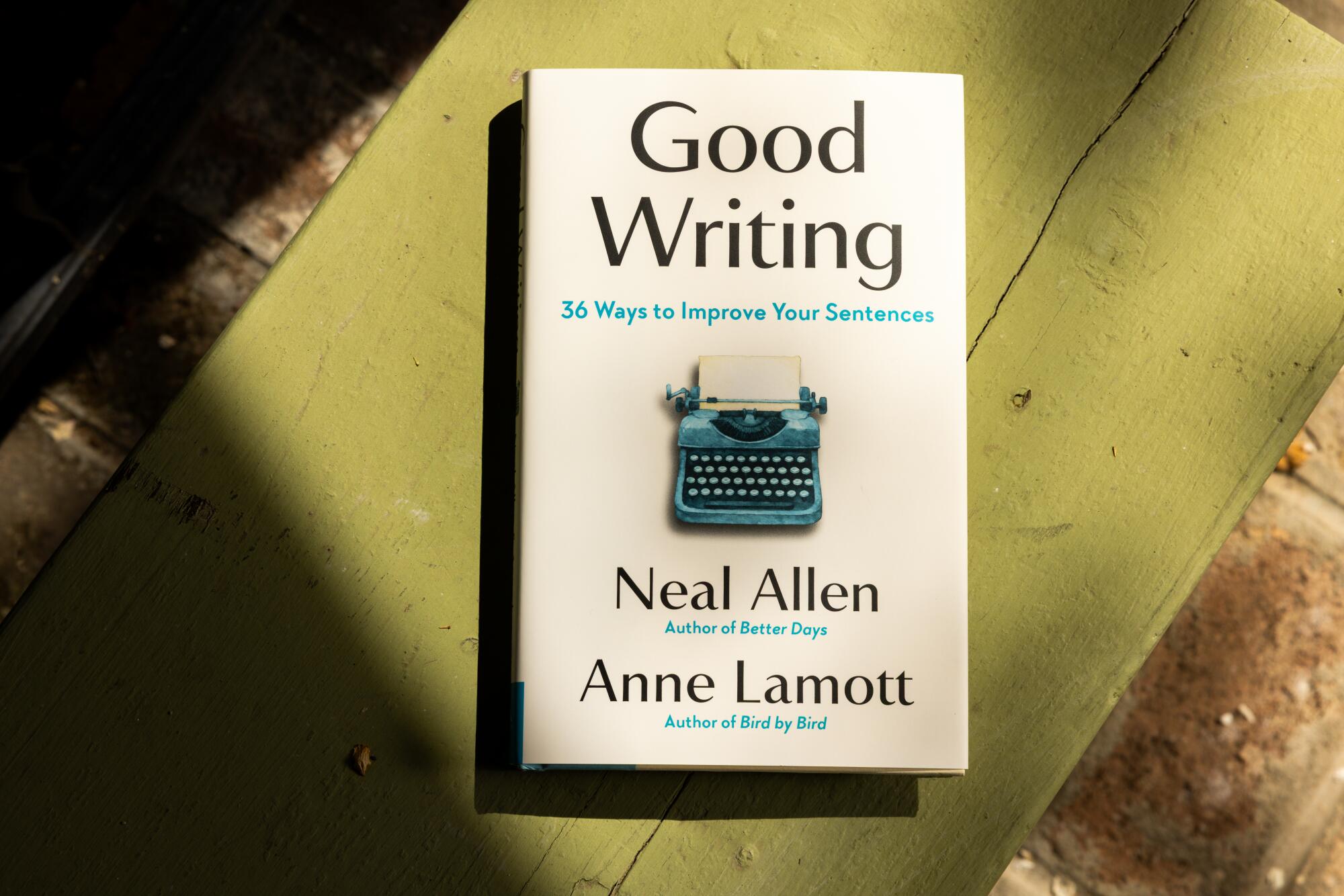
Anne Lamott and Neal Allen share ’36 Ways to Improve Your Sentences’

On the Shelf

Good Writing: 36 Ways to Improve Your Sentences

By Neal Allen and Anne Lamott
Avery: 208 pages, $27

If you buy books linked on our site, The Times may earn a commission from Bookshop.org, whose fees support independent bookstores.

They’re so darn cute together, these two. Neal Allen, father of four, newspaper reporter turned corporate executive turned spiritual coach turned author of two spiritual guidebooks, stands a full head of hair taller than his dread-headed wife, who calls him her “current husband.” He calls her his “remarkable and beautiful partner” and himself “Mr. Anne Lamott.”

And no wonder. Author Anne Lamott has published 21 books, with worldwide sales in the millions. “Bird by Bird,” her 1994 writing handbook, which has sold more than 1 million copies and continues to sell approximately 40,000 copies each year, became a meme before there were memes. Thirty-two years later, the titular phrase has made appearances everywhere from “Ted Lasso” (Coach Beard: “I hate losing.” Coach Lasso: “Bird by bird, Coach.”) to a Gloria Steinem interview in Cosmopolitan (“Every writer, truth-seeker, parent, and activist I know is in love with one or more books by Anne Lamott”).

Ask a famous writer how they do what they do, and “Bird by Bird” will likely get honorable mention. Harlan Coben, whose 35 novels have sold roughly 90 million copies, calls “Bird by Bird” his “favorite writing manual.” “I use it like a coach’s halftime speech to get me fired up to write.”

In a 2007 interview, “Eat Pray Love” author Elizabeth Gilbert called herself Lamott’s “literary offspring.” Paula McLain, who wrote the 2011 blockbuster “The Paris Wife,” told me: “I return to ‘Bird by Bird’ again and again because Anne Lamott tells the truth about how hard this work is — and then somehow makes you laugh about it.”

I reached out to best-selling memoirist and novelist Dani Shapiro to ask if she had her own experience with the book. “A writer is always a beginner,” she said. “And there is no better companion than ‘Bird by Bird.’”

Lamott and Allen partnered to write "Good Writing."

Lamott and Allen partnered to write “Good Writing.”

(Christie Hemm Klok / For The Times)

Lamott, 71, and Allen, 69, met in 2016 on the 50-plus dating site OurTime.com. Nine months later, they bought a woodsy Marin County home with room for Lamott’s son and grandson. Sam, when he was 1 year old, was the subject of his mom’s first bestseller, the 1993 memoir “Operating Instructions.” His son Jax was the subject, at age 1, of his grandmother’s 2012 memoir, “Some Assembly Required.”

“We were watching U.S. Open tennis one night and Neal said, ‘Can I ask you something?’” Lamott told me via email. “I barely looked away from the TV, and he asked me to marry him. I said, ‘Yes, if we can get a cat.’”

After a decade of marriage, Lamott and Allen have undertaken a professional collaboration whose outcome, like their union, is greater than the sum of its parts. “Good Writing: 36 Ways to Improve Your Sentences” is as sharply specific as “Bird by Bird” is wanderingly wonderful: as winning a companion piece as two winning companions could create. The table of contents is itself a mini-manual of writerly tips: “Use Strong Verbs.” “Sound Natural.” “Keep it Active.” “Stick with Said.” “Don’t Show Off.”

Lamott and Allen.

Lamott and Allen.

(Christie Hemm Klok / For The Times)

I spoke to the late-life lovebirds about their process of marital manuscript-making: the good, the not so good and the blackmailing.

Meredith Maran: How did writing “Bird by Bird” compare to co-authoring “Good Writing”?

Anne Lamott: “Bird by Bird” was literally everything I knew about writing, everything I had been teaching my students for years. It was definitely my book. “Good Writing” was definitely Neal’s book. I just foisted my attention on him and threatened to undermine the marriage if he did not let me contribute.

MM: Neal, what on earth convinced you that you could add something to one of the world’s most popular writing books —written by your wife, no less?

Neal Allen: Oh, I’m not adding anything to “Bird by Bird,” which is a complete classic. It’s everything you need to know about becoming a writer. “Good Writing” is about what comes next: a second draft. And while it’s not fair to call “Bird by Bird” a craft book — it’s much more — it’s fine to define “Good Writing” that way.

"Helping each other with our work is one of the richest aspects of our life as a married couple," Lamott said.

“Helping each other with our work is one of the richest aspects of our life as a married couple,” Lamott said.

(Christie Hemm Klok / For The Times)

MM: In producing this joint project, how did you two negotiate the differences between your writing styles and personalities?

AL: We didn’t need to negotiate. Neal somehow manages to be both elegant and welcoming, whereas I think I am more like the class den mother, with a plate of cupcakes, exhorting people not to give up, trying to convince them that they can only share their truth in their own voice, that their voice is plenty good, and that when they get stuck, as we all do, I know some tricks that will help them get back to work.

NA: I once asked AI to describe the difference between my writing and Annie’s. AI answered that I explain things to readers; Annie helps readers reach catharsis. I think that’s absolutely right.

MM: How did you come up with the book’s fab format, whereby each of you writes your own introduction, and then each chapter starts with Neal’s thoughts about one of the 36 rules and ends with Annie’s?

NA: Annie first asked if she could annotate what I had written. That scared the bejesus out of me. When she started writing her own essays in her own voice, I was quite relieved. One of the format’s surprising strengths is that Annie always gets the last word. I explain the rule; then she helps the reader find their way and resolve their issues with the rule. There’s a downside: I don’t get to respond when she tells the reader to ignore me.

A man in a green shirt

“I’m not adding anything to ‘Bird by Bird,’” Allen said. “It’s everything you need to know about becoming a writer. ‘Good Writing’ is about what comes next: a second draft.”

(Christie Hemm Klok / For The Times)

MM: In your intro, Anne, you recall Neal telling you he was working on a writing book. “Well. Hmmmph,” you replied. “I had written a book on writing once …” How did professional jealousy, competitiveness, possessiveness, or, on the brighter side, tenderness, collaborative spirit and generosity play out as you wrote a writing book together?

AL: We have no competitiveness or jealousy when it comes to each other’s writing. We just want the other person to write the most beautiful work they can. We are each other’s first reader, and editor, and while of course I feel attacked if Neal suggests even the tiniest change to my deathless prose, I have come to understand that his suggested cuts and additions save me from myself. Helping each other with our work is one of the richest aspects of our life as a married couple.

NA: There’s no way around “Bird by Bird,” and I just have to deal with that. My worry was whether Annie really wanted to be associated with my little book. I’m envious of Annie’s brilliance, of course, but we speak the same writing language and we love it equally.

MM: What are each of you proudest of, “Good Writing”-wise?

AL: We just recorded the audio version, and I was surprised by how much practical help the book offers. Also, I love the tone, which is so conversational and sometimes, I hope, pretty funny.

NA: I had the opposite reaction to recording the audio version. I saw all the opportunities for readers to mock me. In the 18 months between writing a final draft and the book showing up in stores, we’ve both flipped from believing it reflects well on us to thinking it’s a disaster. Luckily, both of us haven’t ever thought it sucks at the same time.

MM: That is fortunate. Also, Neal, I’m not sure you answered my question.

NA: What am I proudest of? That the book exists. I carried around these rules for improving sentences for years. I think a lot of writers do a book because they notice it’s not out there, and why isn’t it? And then they shrug, ‘Well, I guess it’s up to me.’ That’s how I came into all three of my books.

AL: May I just add that I’m proud to introduce my seriously charming and breathtakingly wise husband to a wider audience.

Festival of Books

“Written by Hand: Lexicons, Storytelling, and Protecting Human Language in an Age of Artificial Everything” (featuring Anne Lamott and Neal Allen)

The Los Angeles Times Festival of Books, USC Town and Gown, Sunday, April 19, 10:30 – 11:30 a.m.

Admission is free. Ticket required.

Source link

Senate passes bipartisan housing bill to improve access and affordability

The Senate passed a broad bill on Thursday to make U.S. housing more accessible and affordable, a rare bipartisan effort in Congress to address a growing national problem.

The bill, which passed 89 to 10, would reduce regulations, regulate corporate investors and expand how housing dollars can be used to build affordable homes and rentals. It will now head back to the House, which passed a similar bill earlier this year.

“We have a housing shortage all across America,” said Sen. Elizabeth Warren (D-Mass.), who worked with Republicans to win overwhelming support from both parties for the legislation. “We need more housing of every kind. More housing for first-time home buyers, more housing for renters, more housing for seniors, more housing for people with disabilities, more rural housing, more urban housing, more, more, and more.”

The legislation, she said “will help drive down prices.”

Senate Banking Committee Chairman Tim Scott (R-S.C.), led the effort with Warren. He said ahead of the vote that the Senate could “do what so many people failed to do in this legislative body for the last few decades, and that is pass consequential legislation that makes it easier to become a homeowner.”

Roadblocks ahead for the legislation

Despite the overwhelming bipartisan vote in the Senate, It’s unclear whether the House will pass the legislation again — or if President Trump will sign it.

Trump has strongly backed the bill through the bipartisan negotiations, but he has also slowed its momentum with a declaration last weekend that he won’t sign any new measures unless Congress passes legislation that would require voters to show proof of citizenship and end most mail-in balloting. The Senate is expected to begin consideration of that bill next week, but it is unlikely to pass as all Democrats oppose it.

At the same time, House leaders have indicated that they are unlikely to accept the Senate version of the housing legislation and have suggested they could launch a formal conference process to negotiate a final deal between the chambers — a process that could take months.

Senate Majority Leader John Thune (R-S.D.) said ahead of the bill’s passage on Thursday that conference negotiations are a possibility, “but obviously the quickest way to do this would be to pick up the Senate bill and pass it.”

If the White House wants that to happen, he said, “they’ll probably have to make that argument to House leadership.”

Making housing more attainable

The bill would give local governments more power on housing issues, allow banks to invest more in affordable housing and lift limits on the number of units in a public housing development that can receive private financing through Section 8 funding that helps rehabilitate properties.

“You’ve got many provisions in this bill that stop treating the U.S. like one single housing market and start giving local leaders the tools they need to fix their unique regional puzzle,” said Peter Carroll with Cotality, a company that tracks housing data.

The bill aims to make homebuilding easier by streamlining some regulations that require environmental reviews and inspections. It also eliminates a limit on a grant for emergency shelter beds and street homelessness outreach.

As many affordable housing developers are leaning on manufactured and modular homes that can be transported to areas that need housing, the legislation also lifts the requirement that they have to be built on a permanent chassis, making them easier to build and design.

Housing advocacy and policy groups say they wish the bill went further by investing money in building more housing and assisting renters.

“This legislation is the product of essentially senators and House members wanting to come up with something that could pass with both Democratic and Republican votes, which means it’s inherently less ambitious,” said Yonah Freemark, a researcher at Urban Institute.

Corporate investors

One of the more contested provisions of the bill would bar institutional investors from buying single-family homes — a top priority for Trump.

The bill defines such investors as any that directly or indirectly own 350 or more single-family homes. Investors of any size would not be required to sell single-family homes bought before the date that the bill becomes a law.

They would still be allowed to buy or build single-family homes if they rent them out, but would be required to sell them to an individual homebuyer after seven years and offer that buyer “price concessions” and give tenants a 30-day “first-look” period when the time comes to sell the home.

A need for reform

The U.S. housing market has been in a slump dating back to 2022, when mortgage rates began to climb from pandemic-era lows.

Sales of previously occupied U.S. homes have been hovering close to a 4-million annual pace now going back to 2023 — well short of the 5.2-million annual pace that’s historically been the norm. They slowed last year to a 30-year low and have remained sluggish so far this year, declining in January and February versus a year earlier.

A sharp run-up in home prices, especially in the early years of this decade, and a chronic shortage of homes nationally worsened by years of below-average home construction have left many aspiring homeowners priced out of the market.

Meanwhile, while the median U.S. monthly rent has been declining for more than two years, it was still 15.2% higher in January than it was at the start of 2020, according to data from Realtor.com.

The trends have ratcheted pressure on lawmakers this year, with midterm elections looming in November, to show they’re working on ways to make homeownership and rental housing costs more affordable.

Kramon, Veiga and Jalonick write for the Associated Press. Kramon reported from Atlanta and Veiga reported from Los Angeles.

Source link