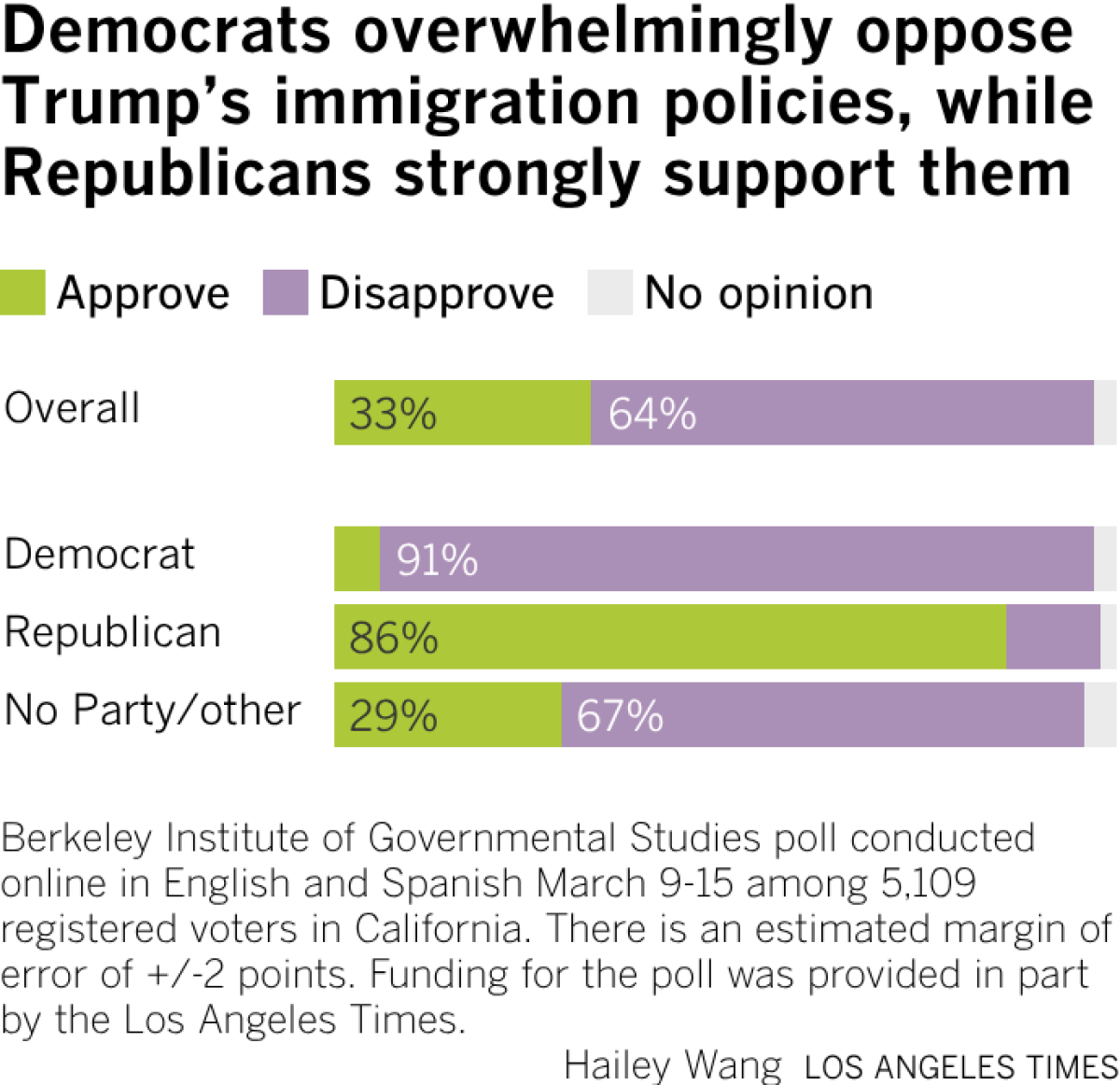
WASHINGTON — Two-thirds of California voters disapprove of President Trump’s immigration policies and a majority believe those policies are discriminating against Latinos, according to a new poll.
Nearly half of the voters said they were concerned that they, a family member or a close friend could be detained because of Trump’s immigration policies.
The findings of the UC Berkeley Institute of Governmental Studies poll, released Wednesday, show that most Californians haven’t budged on their thoughts about the president’s approach to immigration since he returned to office. A poll last August similarly showed strong disapproval of the Trump administration’s approach to immigration enforcement.
The poll, which was conducted for the Los Angeles Times, showed the usual division along party lines when voters were asked whether they trust the U.S. Border Patrol and Immigration and Customs Enforcement, whether agents should wear masks while on duty, and whether Latinos are being discriminated against.
“This suggests that a significant number of voters see ICE infringement on the individual rights of the undocumented as also potentially leading to broader infringements on citizens’ rights,” said G. Cristina Mora, co-director of the institute and a sociology professor at UC Berkeley who studies race and immigration.
“Latino voters also seem to particularly worry about the way that racism is motivating current immigration practices,” she said, which is likely tied to the Supreme Court’s approval of immigration agents detaining people on the basis of their perceived race, ethnicity, language or occupation.
The overall disapproval among voters of Trump’s immigration policies — 64% — was down a bit from the August poll, in which 69% of respondents said they disapproved of how immigration enforcement was being carried out in California.
Republicans appear to be more approving of immigration policies now, with 86% saying they approve of Trump’s immigration policies — up from 79% approval of enforcement in California last August.
Mora said the tilt among California Republicans toward the Trump administration could be due, in part, to the framing of the question, which asked about “President Trump’s immigration policies.”
Any time Trump’s name is included, Republicans are more likely to agree with him, she said. The same effect is seen when asking about other issues, such as the economy.
Another factor could be the timing, Mora said. Last summer, federal agents conducted widespread raids in Los Angeles before moving on to target other cities, such as Chicago and Minneapolis.
Now that the administration has shifted away from some tactics that resulted in escalations of violence, Republicans are “falling in line” again with the administration, she said.
“My hunch is it was shocking,” Mora said of the immigration raids last summer. “Things have normalized because the tension is somewhere else.”
Seeking to de-escalate after two protesters were shot and killed by federal agents in Minneapolis, the president tapped his border advisor Tom Homan to take control of the immigration enforcement operation there.
Republican strategist Ford O’Connell said that’s why voters are more supportive.
“Tom Homan being in charge and publicly taking a much lighter touch and appearing reasonable to the average voter is why you’re seeing this turnaround,” he said.
But Democratic strategist Maria Cardona said that that’s wishful thinking and that ICE’s approach hasn’t substantially changed.
“It only went down five points,” she said, referring to the disapproval of Trump’s policies. “That’s not the American people being on the side of the administration — it’s that they’re not seeing American citizens murdered on their screens every day.”
One question saw strong division among Republicans: Should immigration agents be allowed to enter the homes of suspected undocumented immigrants without a judge-approved search warrant?
Among California Republicans, 45% said no, 38% said yes, and 17% said they have no opinion.
O’Connell said that’s because Republicans strongly value civil liberties, especially around property.
Republicans were more strongly in favor of a different policy, allowing ICE agents to wear masks while on duty. While 91% of Democrats opposed the policy, 68% of Republicans favored it.
In the August poll, 45% of Republicans said federal agents should be required to show clear identification when carrying out their work. That desire for identification doesn’t appear to extend to being fully identifiable by face.
O’Connell said Republicans understand the concern over agents increasingly being doxxed.
“The administration wants to find a happy medium there, whether it’s a nameplate or a badge number,” he said. “There is wiggle room.”
Nearly 7 in 10 respondents said they want state and local authorities to intervene when they witness unlawful detentions or excessive use of force by federal immigration agents.
Voters were also asked about their level of concern that they, a family member or a close friend could be detained because of Trump’s immigration policies. While 85% of Republicans said they are not too concerned or not concerned at all, 63% of Democrats said they are somewhat or very concerned.
Overall, nearly half of the respondents, 45%, said they are somewhat or very concerned. Among racial and ethnic groups, 62% of Latino voters, 46% of Black voters and 43% of Asian or Pacific Islander voters said they are somewhat or very concerned.
“The Latino community has always wanted to think the best of this country and they still do,” Cardona said. “Our positivism, our optimism, our hope in a better future is second to none. I think that’s what you’re seeing in those numbers, even as our community feels totally attacked.”
Mora said the high concern among Black residents is notable because, while most Black Californians aren’t immigrants themselves, Los Angeles has one of the largest concentrations of Blaxicans — the children of one Black parent and one Latino parent.
Beyond intermarriages, Black residents in California are also likely to have immigrant friends or neighbors, she said.
O’Connell took a different view: “I don’t think we can glean anything from it other than how one party focuses more on identity politics than the other.”
The Institute of Governmental Studies poll was completed online in English and Spanish from March 9 to 15 by 5,109 registered voters in California.