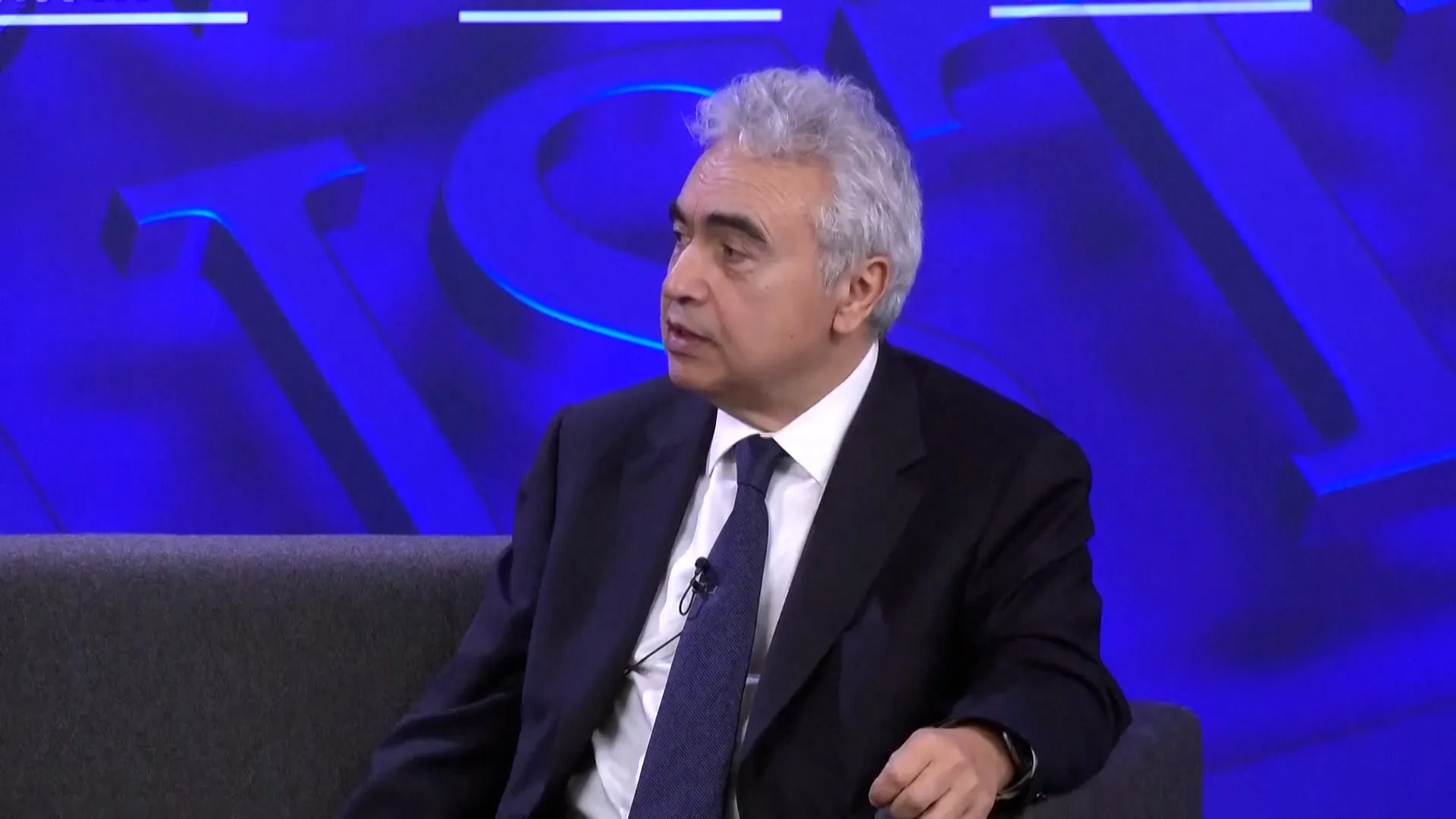
IEA chief warns of ‘very severe’ global energy crisis | Newsfeed
IEA may release more oil as the Iran war hits supply, with chief Fatih Birol warning of a severe global energy crisis.
Published On 23 Mar 2026
IEA may release more oil as the Iran war hits supply, with chief Fatih Birol warning of a severe global energy crisis.

Brent futures rose sharply on Thursday, spiking above $100 before easing slightly but remaining higher than levels seen earlier in the week as markets stay incredibly volatile.

This comes despite an unprecedented decision by the 32-member International Energy Agency (IEA) on Wednesday to release a record 400 million barrels to calm markets, more than double the volume released after Russia’s 2022 invasion of Ukraine.
Following the IEA decision, Iran stepped up its offensive campaign and launched strikes on Omani oil storage facilities at the Salalah port and multiple ships in and near the Strait of Hormuz, sending prices higher again.
The US alone is contributing 172 million barrels. Germany, France and Italy also confirmed they would tap their stocks, while Japan said it would begin releases next Monday.
IEA executive director Fatih Birol described the current Iran-related crisis as an “oil market challenge unprecedented in scale”, adding that the collective response reflected “strong solidarity” in defence of global energy security.
Exports of crude and refined products from the region have dropped to 10-15% of pre-war levels, with the Strait of Hormuz, which normally carries one-fifth of the world’s oil, effectively closed to the large majority of tankers.
The new Iranian strikes came at lightning speed, directly after the IEA announcement.
Drones targeted fuel storage tanks and silos at Oman’s Salalah port, igniting fires that Omani authorities were still working to contain late on Wednesday.
British maritime security firm Ambrey confirmed damage to the facilities, while Danish shipping giant Maersk temporarily halted port operations.
Omani officials stressed there had been “no disruption to the continuity of oil supplies or petroleum derivatives” inside the country itself, while Iranian state media reported that President Pezeshkian had assured Oman’s sultan the incident would be investigated.
At the same time, six vessels were struck in the Gulf and Strait of Hormuz.
Among the reports, there was confirmation of a projectile hitting a container ship near the UAE and strikes on two tankers in Iraqi waters.
UK Maritime Trade Operations, and other monitoring groups, attributed the incidents to Iranian forces or proxies.
These developments, occurring the very day of the reserves release, appear to have smothered the anticipated calming effect on prices.
As of Thursday, the number of ships struck in the region since the beginning of the conflict rose to at least sixteen.
Some analysts note that the sheer volume of the release could itself be interpreted negatively. Previous coordinated actions never exceeded 183 million barrels.
The scale of the release suggests importing nations already view the disruption as the most severe and long-lasting in decades.
Even worse, a record release may not be enough.
Speaking to Euronews, Warren Patterson, Head of Commodities Strategy at ING, was blunt in his assessment.
“A record 400 million barrel release from emergency reserves is helpful, but it’s not going to go very far to offset the roughly 15 million daily supply currently disrupted.”
Patterson also added that “the only solution that will bring oil prices down on a sustained basis is getting oil flowing through the Strait of Hormuz again.”
Oxford Economics echoes this concern, warning that “the economic effect of higher energy costs rises as the oil price increases,” in a report that seemingly indicates the crisis is far from over and we have yet to feel the compounding effect of the initial shock.
With the reserve release failing to calm prices, attention has turned to Russian oil as a potential source of additional supply.
The US Treasury last week granted Indian refiners a 30-day waiver to purchase Russian crude from vessels already stranded at sea, though the measure expires on 4 April and deliberately excludes new shipments.
Following the G7 emergency discussions on Wednesday, French President Emmanuel Macron stated that the group had agreed “the situation does not justify lifting any sanctions” on Russia, emphasising the need to increase global production instead.
The contrast between Washington’s narrow waiver and the G7’s firm collective position leaves little prospect of sanctions relief acting as a meaningful pressure valve, a view shared by analysts.
“Any sanction relief for Russia would see some marginal supply increases, but again not enough, with Russia’s oil output having held up well in recent years despite sanctions,” Warren Patterson of ING told Euronews.
Should tensions persist, analysts warn prices could climb substantially higher.
Oxford Economics identifies $140 per barrel as the threshold at which the global economy tips into mild recession, reducing world GDP by 0.7% by year-end and pushing the UK, the Eurozone and Japan into contraction.
The managing director of the IMF, Kristalina Georgieva, also stated that every 10% increase in oil prices, provided they persist for most of the year, will push up global inflation by 0.4% and reduce worldwide economic output by as much as 0.2%.
“The risk is stark,” Patterson warned. “It’s only a matter of time before we see oil prices hitting fresh record highs if the conflict is not swiftly and decisively resolved.”
The IEA’s intervention has provided a temporary buffer, but with little visible impact on prices.
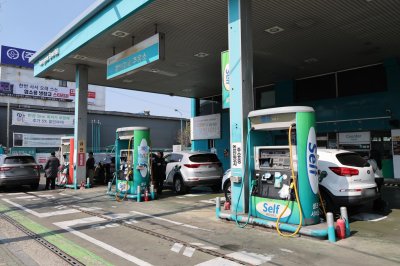

South Korea is in discussions with the IEA over the agency’s proposal to release strategic oil reserves, Seoul officials said Wednesday. This photo, taken Mar. 10, shows a gas station in Seoul. Photo by Yonhap
The South Korean government is “closely involved” in discussions with the International Energy Agency (IEA) over the agency’s reported proposal to release strategic oil reserves to help stabilize soaring oil prices, Seoul officials said Wednesday.
Officials at the Ministry of Trade, Industry and Resources confirmed Seoul’s participation in the reported IEA discussions to Yonhap News Agency, following media reports saying that the IEA has proposed the largest-ever release of oil reserves to its 32 member countries, including South Korea.
According to the report by the Wall Street Journal, IEA members are expected to soon decide on the proposal in an extraordinary meeting.
“South Korea is closely involved in discussions over a coordinated release of strategic oil reserves by the IEA,” a ministry official said.
The country currently holds around 1.9 billion barrels of oil reserves, which is enough to last more than 200 days.
“We have yet to decide how much oil will be released from our reserves with the IEA’s decision,” a ministry official said.
The Seoul government has released its strategic oil reserves on five occasions since 1990, all through international coordination.
The occasions included the 1991 Gulf War, the 2011 Libya crisis and the outbreak of the Russia-Ukraine War in 2022.
Copyright (c) Yonhap News Agency prohibits its content from being redistributed or reprinted without consent, and forbids the content from being learned and used by artificial intelligence systems.
International Energy Agency chief says talks aim to assess conditions as US-Israel war on Iran fuels global uncertainty.

Published On 10 Mar 202610 Mar 2026
Share
The International Energy Agency (IEA) is set to hold an emergency meeting to assess the situation in the Middle East as the US-Israeli war on Iran continues to roil global energy markets.
Fatih Birol, the agency’s executive director, said representatives of IEA member states would meet on Tuesday to assess “the current security of supply and market conditions” amid the conflict.
list of 3 itemsend of list
“I have convened an extraordinary meeting of IEA member governments, which will take place later today to assess the current security of supply and market conditions to inform a subsequent decision on whether to make emergency stocks of IEA countries available to the market,” Birol said.
This week, oil prices hit their highest levels since mid‑2022 amid concerns of prolonged shipping disruptions linked to the war and reduced output from some key producers in countries that have been targeted by retaliatory Iranian strikes.
While the market reversed late in the day on Monday, with benchmarks falling below $90 a barrel, uncertainty persists around how long the United States-Israel war will drag on.
The Strait of Hormuz, a critical Gulf waterway through which about one-fifth of the world’s oil supplies passes, has effectively been shut down as a result of the war.
“If this drags on, it is not just going to be energy prices” that are affected, Al Jazeera’s Osama Bin Javaid explained. “It is going to have an impact on global economies.”
Bin Javaid noted that the extraordinary IEA meeting comes after Group of Seven (G7) countries met to discuss possible actions to help stabilise global energy markets.
European governments have been on edge about the prospect of a repeat of the energy crisis they faced in 2022, when prices surged to record peaks after Russia’s full-scale invasion of Ukraine.
“The IEA will be presenting an in-depth analysis of the pros and cons of releasing stocks now,” the European Union’s Energy Commissioner Dan Jorgensen said before the agency’s meeting.
Earlier on Tuesday, G7 energy ministers stopped short of deciding on the release of strategic oil reserves in a call, instead asking the IEA to assess the situation before acting.
“Everyone is willing to take measures to stabilise the market, including the United States,” French Finance Minister Roland Lescure told reporters after the latest talks.
“We have asked the IEA to elaborate scenarios for a potential oil stock release; we need to be ready to act at any moment,” he added.
EU leaders also will discuss competitiveness, including energy prices, on a call later in the day with German Chancellor Friedrich Merz, Italian Prime Minister Giorgia Meloni, Belgian Prime Minister Bart De Wever, and others.