‘Something Very Bad Is Going to Happen’ creator on horror and marriage
You might expect a screenwriter working in the horror genre to be relatively difficult to scare, but Haley Z. Boston, the creator and executive producer of Netflix’s harrowing new limited series “Something Very Bad Is Going to Happen,” insists that is not the case.
“I’m afraid of everything,” Boston, 31, said during a recent Zoom conversation. “I’m afraid of horror movies, but that’s why I love them so much, because they scare me. A lot of horror people are desensitized and looking for something to shake them. I am the opposite. I am easily afraid.”
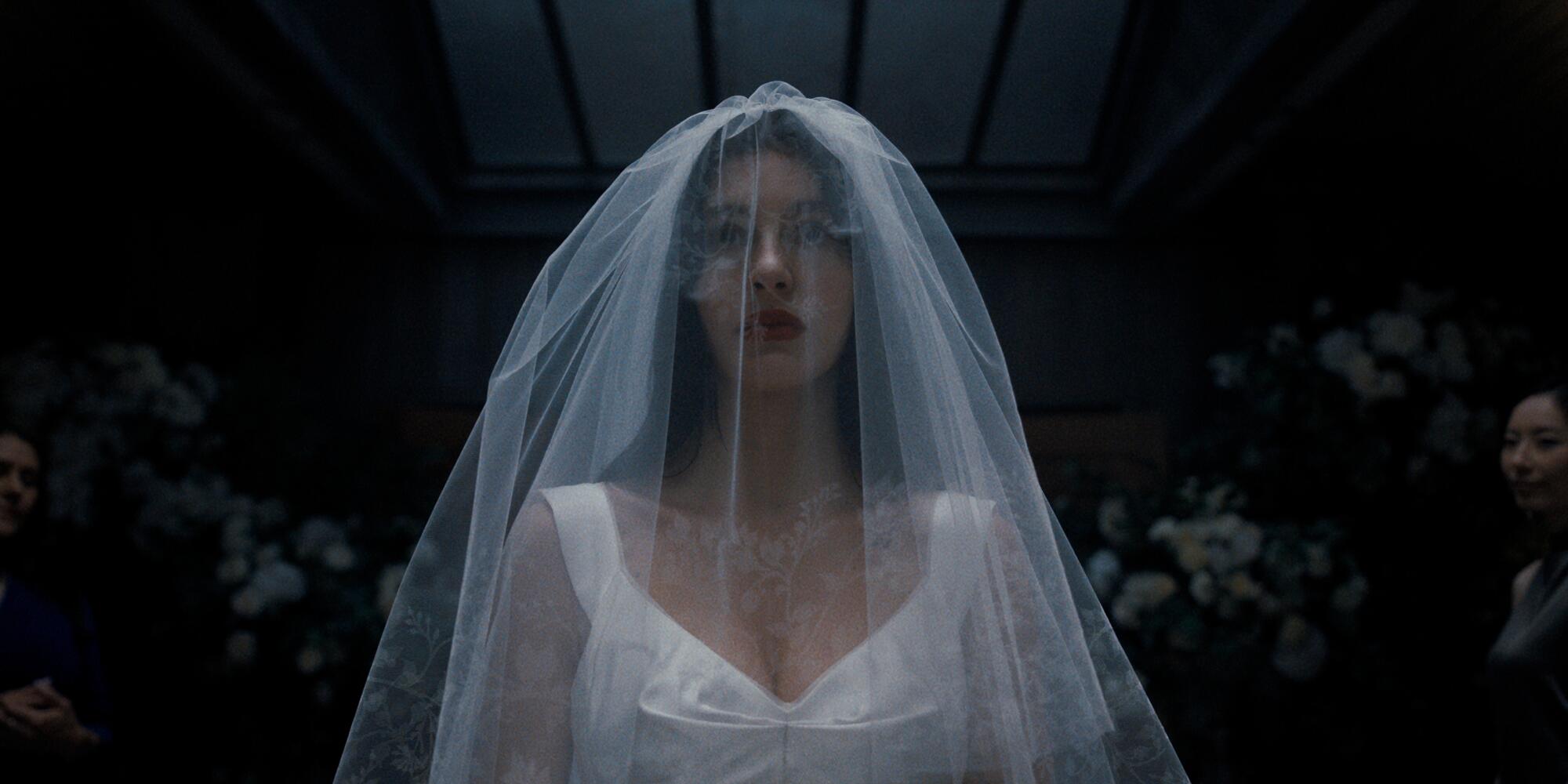
The easily frightened — and the recently engaged — might be advised to approach Boston’s new series, which premiered Thursday, with caution. A haunting fusion of David Lynch surrealism and “Rosemary’s Baby” paranoia, “Something Very Bad Is Going to Happen” traces the peculiar and ominous events that unfold in the week leading up to the nuptials between wary Rachel (Camila Morrone) and trusting fiancé Nicky (Adam DiMarco), as overseen by Nicky’s mother Victoria (Jennifer Jason Leigh).
Faced with inexplicable truths about Nicky’s family and her own past, Rachel becomes convinced that saying “I do” has the potential to prove deadly, and she comes to fear what might take place when she walks down the aisle.

Camila Morrone as Rachel Harkin in Netflix’s “Something Very Bad Is Going to Happen.”
(Netflix)
“I’d seen people in their wedding, in their vows, say, ‘I never once had a doubt,’” Boston said. “I’m like, ‘How could you not constantly question everything?’ It felt very natural to me to explore that idea in a horror show where the doubt is the horror.”
Horror has long been a preoccupation for Boston. The Oregon native has a tattoo of the phrase “Carrie White burns in hell” to commemorate her favorite film, Brian DePalma’s landmark Stephen King adaptation, “Carrie.” She distinguished herself writing episodes of weird, atmospheric series including Netflix’s “Brand New Cherry Flavor,” a nightmarish exploration of witchcraft and filmmaking in 1990s L.A., and “Guillermo del Toro’s Cabinet of Curiosities,” also for Netflix.
Her installment in the Oscar-winning director’s anthology series, “The Outside,” was inspired by a comic titled “Some Other Animal’s Meat” and followed the unnerving transformation one woman undergoes after purchasing a beauty cream advertised on a late-night infomercial. “It’s all about being an outsider and feeling different, and I related to that,” Boston said.
Boston began writing at the age of 11, and after seeing Quentin Tarantino’s “Kill Bill” in her early teens, she became interested in filmmaking. “I was so taken by the way that the story is told, and I love a revenge story,” she said. “That’s when I started to think, ‘Is this something? Who wrote that? How does any of this work?’”
She had considered following her parents’ path and choosing a career in medicine, but during her first formal writing class at Northwestern University, she felt that she’d found her calling. “I was like, ‘No, this is it. This is what I want to do,’” Boston said.

“I’m like, ‘How could you not constantly question everything?’” Haley Z. Boston says about marriage. “It felt very natural to me to explore that idea in a horror show where the doubt is the horror.”
(Christina House / Los Angeles Times)
After graduation, she moved to L.A., taking a job in the William Morris Endeavor mailroom and writing scripts on her own time. A high school slasher movie she’d penned in college landed her an agent. Soon after, her pilot for a “sapphic murder story” inspired by “Killing Eve” netted her 22 pitch meetings — the first was with director Sam Raimi, whose early-career “Evil Dead” movies are beloved cult classics. “I was 24, and I did the scariest thing at the time possible,” Boston said. “Sometimes I think if you don’t think too much about how terrifying it is, and you’re just thrown into it, that’s better.”
With “Something Very Bad Is Going to Happen,” Boston found herself thrown into the position of showrunner without ever having spent any real time on a set. Yet Morrone says Boston was the picture of confident professionalism throughout the shoot. “There’s just a grace to her,” Morrone said. “Even if she was overwhelmed, you would just never see it. These are her words and her world, and she inherently knows the character and the story so well that she could really navigate any questions thrown at her because it lives in her.”
The series is something profoundly personal for Boston. Growing up with parents whose marriage seemed idyllic had left her struggling once she began dating, and she channeled many of her own anxieties into the show. “They’ve been together for 37 years or something,” Boston said of her parents. “I felt all this pressure knowing that that exists. It always felt like a curse. You have this great example of what a marriage is, and I always found myself weighing every little romantic tryst against this 30-year marriage — which was unhelpful.”
She hit upon the premise for the series right around her 27th birthday, a time when more and more of her friends began to get married, and developed the idea while working on other projects. By the time Boston sat down to write the pilot episode, she knew the narrative and the characters so well that it took her just two weeks to finish.
Pitching the series, she met with “Stranger Things” creators Matt and Ross Duffer, who were so impressed by her vision that they signed on to executive produce “Something Very Bad Is Going to Happen” through their Upside Down Pictures banner.
“From reading one page of her script, it became very clear that this is someone who has a very unique voice,” Ross said. “It was unlike anything we’d ever read before. Immediately, we were like, ‘We have to be involved with this. We have to help bring her vision to life.’”

Rachel (Camila Morrone) and Nicky (Adam DiMarco) experience peculiar and ominous events leading up to their wedding.
(Netflix)
Matt added, “Haley has such a specific sense of humor. It’s very dark, very dry, but it also feels incredibly real. Her characters talk very much in the same way that real people talk. I find that sadly rare in the scripts that you read.”
The series was filmed in Toronto in January 2025 with directors Weronika Tofilska (“Baby Reindeer”), Lisa Brühlmann (“Killing Eve”) and Axelle Carolyn (“American Horror Story”) behind the camera. Boston said she and her collaborators would often reference specific films — everything from “The Celebration” to “Uncut Gems” — as a shorthand for the tone they were hoping to strike in a given episode. “I really love a story that takes something normal and grounded and gives one twist on it that throws you into a different world and makes you see things in a different way,” Boston said.
With “Something Very Bad Is Going to Happen” poised to elevate Boston’s Hollywood profile, establishing her as one of the most exciting voices in horror, she’s already planning for her future, writing a film that she intends to direct. “I love the horror community, but it is still such a boy’s club, and I really want to infiltrate it,” Boston said.
“The genre has been so much about women, and in studying feminist theory in horror, especially back in the ’70s, the genre forced men to relate to women — you’re watching a woman survive, which is ultimately very powerful,” she added. “I find it interesting how many men are making horror movies about women. I talked about ‘Carrie.’ I love that movie, but it’s missing something. Same with ‘Rosemary’s Baby.’
“This show is such a great opportunity to begin my career in this genre — now, I want to continue my reign of terror.”