How do you stand up to lies and brutality? Maybe you blow a whistle
Frank Clem, a pickleball pal of mine, recently put out the word that he was collecting whistles to deliver to the front lines of anti-ICE demonstrations in downtown Los Angeles, Highland Park, Pasadena and other locations.
I was out of the country at the time, but shortly after I returned, I thought about Clem when Minneapolis nurse Alex Pretti was shot dead by ICE agents at a protest in Minnesota. It wasn’t long before the Trump administration’s top officials took turns blaming the victim, lying about the circumstances and calling Pretti an assassin.
Pretti’s distraught parents responded with this:
“The sickening lies told about our son by the administration are reprehensible and disgusting.”
And yet entirely unsurprising, given the state of disinformation and the blatant corruption of legal and moral codes of conduct under Trump, who just the other day was blowing gas yet again about the 2020 election being stolen.
How do you stand up to a president who hypocritically pardons drug kingpins and other rabble, including the barbarians who beat up cops and ransacked the Capitol, even as he invades cities to terrorize and abduct working people?
Maybe you blow a whistle, for starters.
I know, it’s a small gesture. But Clem and others are choosing sides, standing up for their communities, and refusing to remain silent as it becomes clear that the ICE agenda is less about law and order and more about the politics of scapegoating.
I came upon a story on Fox11 about a broader whistle brigade in Los Angeles. Musician Hector Flores, of Las Cafeteras, said he had been distributing free whistles to coffee shops because “we’ve got to protect one another,” and a whistle can sound the alarm that ICE agents are on the prowl.
If Trump were honest about rounding up violent criminals, we wouldn’t need this kind of resistance. But arrests of immigrants with no criminal records are increasing, and the majority of them are here to work and support their families. And U.S. employers have embraced and relied on them as essential contributors to the economy.
When I couldn’t immediately get hold of Flores, I called the owner of Cafe de Leche, the Highland Park coffee shop he had delivered whistles to. Matt Schodorf told me he was fresh out of whistles, and I thought of Clem, who agreed to meet me at Cafe de Leche with a special delivery.
Clem, an actor, is someone you want on your pickleball team because he comes to play and he covers a lot of ground. You might have seen him in theater productions, on TV shows or in movies, and you couldn’t possibly not have seen him as the emu farmer in a Liberty Mutual commercial.
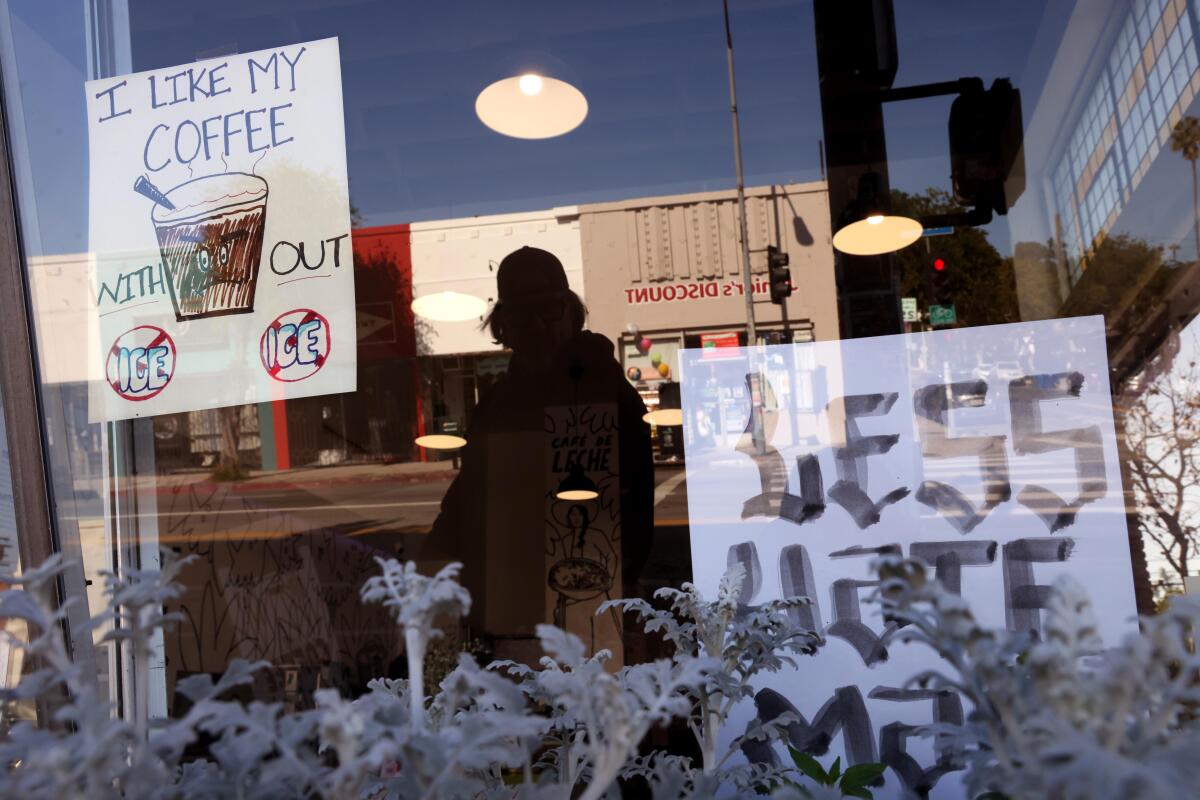
Clem walked past a window sign that says “I Like My Coffee Without ICE” and took a seat at Cafe de Leche. He was wearing an L.A. ballcap and carrying a shopping bag containing hundreds of whistles.

A sign reading “I like my coffee without ICE” is posted in the window of Cafe de Leche in Highland Park. Cafe owners Matt and Anya Schodorf have been giving away whistles to customers to be used for ICE sightings and at demonstrations.
(Genaro Molina / Los Angeles Times)
Black whistles. Red whistles. Whistles with strings and whistles with hooks to clip onto key chains.
Enough for a symphony.
“It’s 18, 20 bucks for, like, a hundred whistles,” Clem said, displaying a sandwich-size baggie of 100 multicolored whistles in the shape of small pencils.
Clem has been buying them in bulk on the internet, accepting donated whistles from friends, and making his with a 3D printer. He said he had already given away more than 1,500 the last few weeks at rallies and demonstrations.
People smile, Clem said, “when they see the possibilities,” when they join the chorus and the cause, and rather than retreat in silence, make themselves heard. Stiff opposition to ICE atrocities in Minneapolis has led to the withdrawal of hundreds of agents, so maybe a corner is being turned.
“We’re blowing $20 on coffee, right?” Clem said. “But here’s $20 you can spend on something and really feel like you’re getting some kind of return on it. … Throw me 100 whistles, and we’ll get them into the hands of people that might make a difference.”
Schodorf joined us with a cleaned-out whistle rack that said “Free Ice Alarms” on it, and said he’d be glad to fill the rack with Clem’s contributions. Before long, it was loaded up with 100 whistles and placed on the front counter.
When I asked Schodorf about joining ranks with the whistle brigade, he mentioned his wife, Cafe de Leche co-owner Anya Schodorf.
“She grew up here, but she was born in Nicaragua,” he said, and it’s hard to not to get involved when “they’re just profiling people right off the streets. I mean, nobody feels safe … and they’re charging the brown people, right? My wife would identify as that, and she’s afraid to go out of the house.”
Schodorf said they’ve been scrambling to keep the business running after they lost their Cafe de Leche restaurant in the fire that tore through Altadena a year ago. A photo of them in the ruins of their other shop hung on the wall, along with other photos of the destruction in Altadena.
“I don’t know what to do,” Schodorf said about the ICE tactics in Highland Park and beyond, “but I feel like we want to raise the voices of people.”
His wife entered the shop and greeted friends and customers before joining us. She has been a U.S. citizen for decades, and yet she feels as though the color of her skin makes her a suspect.

Anya and Matt Schodorf, owners of Cafe de Leche in Highland Park, talk about their fears about ICE in the community.
(Genaro Molina / Los Angeles Times)
“You can scream from the top of your lungs that you’re a citizen, and they don’t care,” Anya said. “I honestly can’t think straight … and it’s really hard for me to concentrate.”
Anya said she walks and sometimes runs on Arroyo trails but has begun taking extra precautions, like calling her husband and leaving the line open. She went to a park in Pasadena recently and got worried after entering a restroom.
“I heard … a commotion outside and I got nervous,” Anya said. “And then I came out and saw ICE people kind of harassing the workers, like city workers. They’re city landscapers, and I panicked. I went back into the bathroom, like, what do I do? And why should I be panicky? I’m a citizen.”
Her kids are just as concerned about her as she is.
“It’s my son I really worry about,” Anya said. “He says, ‘Make sure you have your passport.’ Yeah, my kids. They’re really worried. And my son is like, please be careful. … It’s that additional stress that they don’t need — that they have to worry about me.”
The Schodorfs said ICE agents recently grabbed a neighborhood fixture — a guy who sells tamales.
“They’re just picking people off, right and left,” Matt said.
“He’s like 72,” Anya said.
The first whistles delivered by Hector Flores were gone before long.
“It was just a matter of hours,” Matt said. “I think it’s twofold. It’s people who think they might need it just for themselves, but it’s people who feel like they might need it for other people. … It’s been wildly popular.”
“We’re a good country,” Anya said. “But we’re falling into the hands of people that are cruel and they don’t really care about anyone but themselves, and they are enriching themselves.”
Clem said that at rallies, he’s making sure to offer whistles to vendors.
“People selling hot dogs and churros,” he said. “They’re asking how many they can take for their families and friends, right? I want them to take as many as they can. I’ve got 1,500 of these things sitting on my dining room table.”
Clem said he was never really a protester, but “anyone who has eyes can see” the alarming level of corruption coming out of the White House.
“My dad fought in the Battle of the Bulge, right?” Clem said. “My dad fought Nazis and fascists in World War II, and he was always warning me growing up that it could happen here. So now, the least I can do is pass out whistles.”
When Clem’s whistles were on display at the counter, one of the first customers was Hana McElroy. She ordered a coffee and took a whistle.
“I’m a nanny, and I pick up a couple of kids from their preschool and I know and love so many kids with parents in pretty tenuous situations,” said McElroy, who is Irish American. “It’s just been a scary time to be an Angeleno.”

Hana McElroy, right, picks up a free whistle while ordering a cup of coffee from Soleil Hernando at Cafe de Leche.
(Genaro Molina / Los Angeles Times)
McElroy said she knows some of the Latina nannies who take their charges to the little park across the street from Cafe de Leche, and she worries about them too.
McElroy showed me a whistle on her key chain but said it was broken. Soleil Hernando, a barista, told her after she’d taken one of Clem’s whistles that they were free, and she should take as many as she wanted.
McElroy grabbed another.