genius

Michael Silverblatt dead: ‘Genius’ host of KCRW’s ‘Bookworm’ was 73

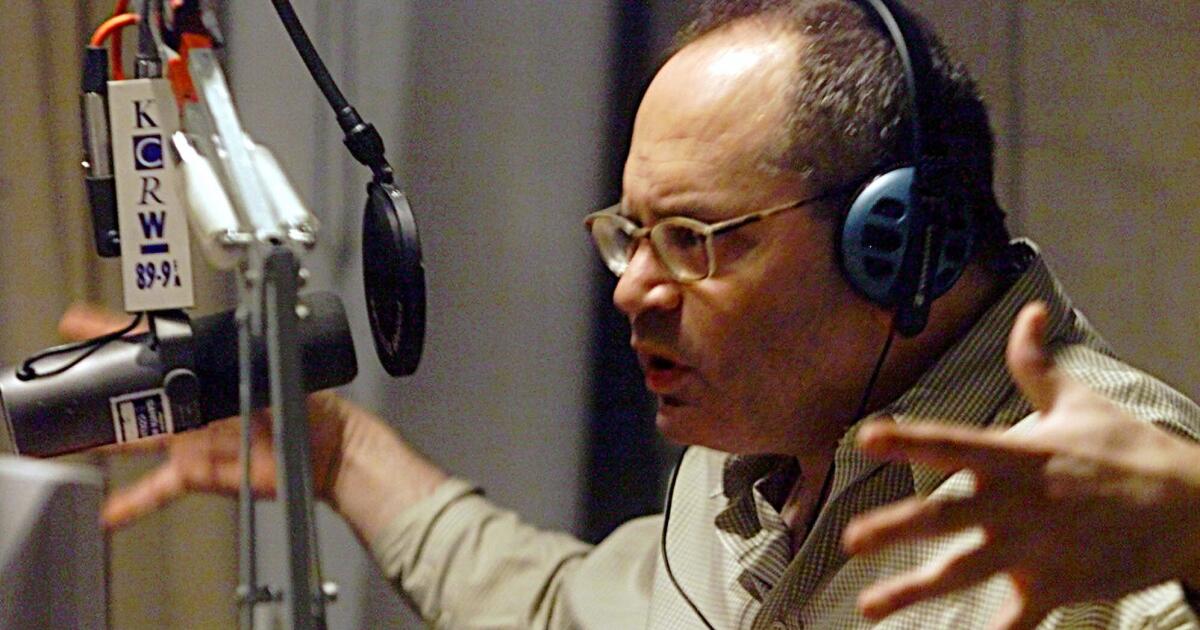
Michael Silverblatt, the longtime host of the KCRW radio show “Bookworm” — known for interviews of authors so in depth that they sometimes left his subjects astounded at his breadth of knowledge of their work — has died. He was 73.

Silverblatt died Saturday at home after a protracted illness, a close friend confirmed.

Although Silverblatt’s 30-minute show, which ran from 1989 to 2022 and was nationally syndicated, included interviews with celebrated authors including Gore Vidal, Kazuo Ishiguro, David Foster Wallace, Susan Orlean, Joan Didion and Zadie Smith, the real star of the show was the host himself, the nasal-voiced radio personality who more than once in life was told he did not have a voice for his medium.

His show represents one of the most significant archives of conversations with major literary powerhouses from the late 20th and early 21st centuries.

But Silverblatt knew that he was as much a character as the people he interviewed.

“I’m as fantastical a creature as anything in Oz or in Wonderland,” he said during a talk in front of the Cornell University English department in 2010. “I like it if people can say, ‘I never met anyone like him,’ and by that they should mean that it wasn’t an unpleasant experience.”

Born in 1952, the Brooklyn native learned to love reading as a child when he was introduced to “Alice’s Adventures in Wonderland.” Neighbors would see him walking the streets of Brooklyn with his head in a book and would sometimes call his parents out of fear he might get hurt.

But until he left home for the University at Buffalo, State University of New York, at the age of 16, Silverblatt has said, he had never met an author.

His college, however, was filled with such famous authors as Michel Foucault, John Barth, Donald Barthelme and J.M. Coetzee, who were all working as professors.

Silverblatt was shy and too embarrassed to speak during class because of his inability to clearly pronounce the letter “L,” which appears three times in his own name. Yet he considered the authors to be his friends, even if they did not know it yet, he said during the Cornell talk.

He would approach them after class to speak about their work.

Despite his interest in literature, Silverblatt’s parents wanted him to become a mail carrier, he said. The summer after his freshman year, Silverblatt worked a New York City mail route, delivering letters to the mayor’s mansion on an Upper East Side route that took him past numerous old bookstores and used-books shops. During that job, he said in the Cornell talk, he purchased the complete works of Charles Dickens.

Silverblatt moved to Los Angeles after college in the mid-1970s and worked in Hollywood in public relations and script development.

Like many young writers in Los Angeles, he wrote a script that never got made.

It was in Los Angeles that Silverblatt met Ruth Seymour, the longtime head of KCRW.

Seymour had just returned to the United States from Russia and was at a dinner party where everyone was discussing Hollywood. There, she and Silverblatt became immersed in a one-on-one discussion of Russian poetry.

“He’s a great raconteur and so the rest of the world just vanished,” Seymour told Times columnist Lynell George in 1997. “Afterward I just turned and asked him: ‘Have you ever thought about doing radio?’”

For the next 33 years, that’s exactly what he thought about.

“Michael was a genius. He could be mesmerizing and always, always, always brilliant,” said Alan Howard, who edited “Bookworm” for 31 years.

“It’s an extraordinary archive that exists, and I don’t think anyone else has ever created such an archive of intelligent, interesting people being asked about their work,” Howard said. “Michael was very proud of the show. He devoted his life to the show.”

Silverblatt once dreamed of being on the other side of the microphone, as a writer in his own right, Howard said. But he faced bouts of writer’s block through his 20s and gave up writing.

“Eventually, he came to find peace with the reality of that,” Howard said.

Instead of writing, he became an accumulator of a vast amount of other writers’ work — in his library as well as the repository in his head. He had an incredible memory for the books he read.

Silverblatt converted the apartment next to his Fairfax apartment into a library where he kept thousands of books, Howard said.

“It was heaven,” he said. “It was a fabulous library.”

“He was such a singular person,” said Jennifer Ferro, now the president of KCRW. “He had a voice you would never expect would be on radio.”

Alan Felsenthal, a poet who considered Silverblatt a mentor, called Silverblatt’s voice “sensitive and tender.”

Felsenthal said the show was about creating a space of “infinite compassion,” where writers could share things they might not share in everyday conversation.

“Michael was one of a kind, truly singular. And his voice is too,” Felsenthal said.

One of the most important tenets of Silverblatt’s approach was that he not only read the book he was discussing on his show that day, but also read the entire oeuvre of the authors he interviewed.

“A significant writer would come in and be bowled over by Michael’s depth of vision of the work at hand,” Howard said.

David Foster Wallace, in one interview, said he wanted Silverblatt to adopt him.

Silverblatt said he strove to read an author’s entire body of work, but he never claimed to have read it all if he hadn’t.

“In general I try to read the author’s complete work. … That’s not always true, and I never say it if it isn’t true. But more often than not, I have, at least, read the majority of the work. And sometimes it’s a superhuman challenge,” he said in the 1997 Times column.

The voracious reader said that the best books, those that brought him happiness, were not the ones that ease our way in this strange and difficult world.

“The books I love the most made it harder for me to live,” he said.

Silverblatt is survived by his sister, Joan Bykofsky.
Source link

Winter Olympics: The ‘genius’ coach behind Ilia Malinin’s quad axel

He raised up the Quad King. He refined the jump that defined the Quad God.

From a sprawling ice facility in Irvine, Rafael Arutyunyan could just be the “Quad Maker.”

The 68-year-old figure skating coach is renowned as one of the best technicians in the world. He trained Olympic champion Nathan Chen starting when the “Quad King” was 10 years old. Four years after Chen became the first U.S. man to win singles Olympic gold since 2010, Arutyunyan could have a second consecutive pupil on top of the Olympic podium.

Ilia Malinin, who has worked with Arutyunyan part time since 2021, is the only person in the world to land a quad axel and is the overwhelming favorite for men’s gold at the Milan-Cortina Olympic Games.

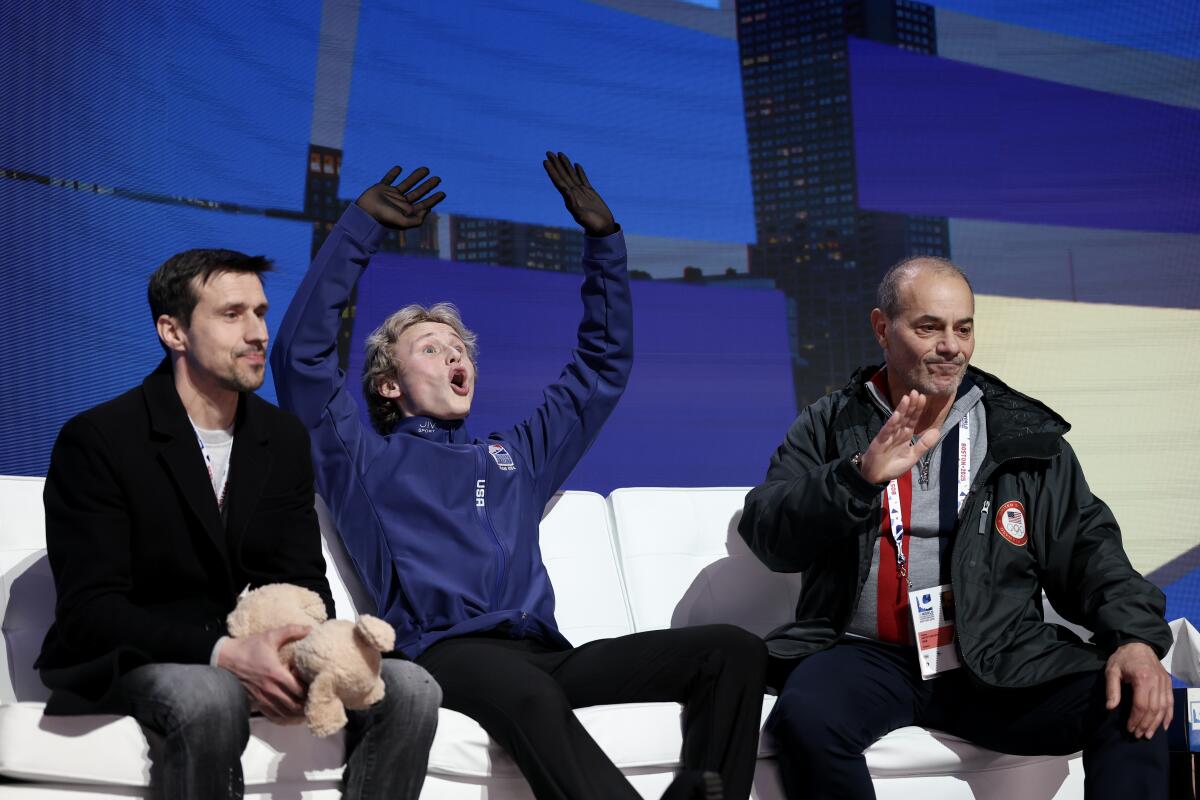
American Ilia Malinin celebrates with his coaches during the world skating championship in March 2025.

American Ilia Malinin celebrates with his coaches, including Rafael Arutyunyan to the right, during the world skating championship in March 2025.

(Maddie Meyer / Getty Images)

The walls in Arutyunyan’s office at Irvine’s Great Park Ice, where he is the head coach of the high performance team, are plastered with photos of stars including Chen, Michelle Kwan, Adam Rippon and Ashley Wagner. They each came to his door with dreams of perfecting their performances, making it to the Olympics or, in some cases, revolutionizing the sport. They scribbled messages over their pictures saying: “I couldn’t have done it without you.”

“Rafael is more like the dream maker,” said Rippon, the 2016 U.S. champion and 2018 Olympic team bronze medalist. “… Rafael is able to take each of his students’ individual goals on a case-by-case basis, and he’s able to help the athletes go after whatever that goal is they’re trying to achieve.”

Malinin came with a lofty goal. Even his father Roman Skornikov — an Olympian for Uzbekistan who coaches his son with his wife, Tatiana Malinina — thought the idea of doing four-and-a-half revolutions in one jump was crazy.

Arytyunyan assured him Malinin could do the quad axel.

The coach of nearly 50 years just looked at the 5-foot-9 Malinin and could tell. It was his slender body type, natural athleticism and strong technique that made Arutyunyan know the jump many thought was impossible could be done. They discussed small technical tweaks to Malinin’s entry. A short two to three months later, Malinin, who trains primarily with his parents in his native Virginia, sent a video of him landing the quad axel in practice.

“The way he explains is really good. And he explains in like, metaphors and analogies that you’re surprised to hear,” said Malinin, who debuted the quad axel in 2022 when he was 17. “They work really well because it helps you get a different perspective on a technique or how he explains.”

Arutyunyan instructed Malinin to think of himself as a slingshot while approaching his jumps. Skaters know to gain power from deep edges that carve circles into the ice, but Artutyunyan describes it like a person riding a motorcycle: The rider tilts side to side just like a skater’s blade glides over the ice. Over time as he gets more familiar with a skater, Arutyunyan communicates through hand signals to show how their blades are interacting with the ice. Learning to manipulate the blade with Arutyunyan made Rippon feel as if he truly learned how to skate.

“He is a genius,” said Mariah Bell, a 2022 Olympian and U.S. champion.

Nathen Chen celebrates with his coach Rafael Arutyunyan.

Nathen Chen celebrates with coach Rafael Arutyunyan after competingin the 2020 U.S. Figure Skating Championships Greensboro, N.C.

(Matthew Stockman / Getty Images)

With the exception of Chen, many of Arutyunyan’s students came to him later in their careers. It takes a special eye and tenacity for a coach to rewire decades of bad habits, Bell said.

Arutyunyan loves it.

“I am emergency room for skaters,” he said. “Many people comes to me as emergency and I start to fix it.”

Arutyunyan is equipped to solve the most dire skating situations because after nearly 50 years as a coach, he’s seen it all already. Arutyunyan, who began coaching in his native Armenia, was first trained in the Soviet style that relied on biomechanics and physiology to unlock efficient jumping techniques. European and American teachings focused more on compulsory figures, the basic patterns skaters would trace across the ice that give the sport its name.

Arutyunyan, who came to the United States in 2000 from Russia, blended both into a signature style that has top skaters traveling from all corners of the globe seeking his help.

“Why I think he’s one of the best coaches in the world,” Rippon said, “is that he’s never not learning.”

After a promising juniors career in which he was named junior national champion in 2015 and competed at the 2020 world junior championships, Andrew Torgashev knew he had competitive ability and presentation. But wanting to step up his senior career, Torgashev, 24, knew he needed to tame his wild technique. Performing his programs felt like “going to the casino,” Torgashev said.

“Red or black,” Torgashev said with a smile, “who knows what’s going to happen?”

Since relocating to California from Colorado in 2019, Torgashev, a Florida native whose parents were both elite international figure skaters, reworked every aspect of his skating with Arutyunyan. He was always skating on his toes when he should have been on his heels. They changed his three-turn — one of the first things skaters learn when skating on one foot — to find more power. They tinkered with his crossovers and his camel spin.

It took years. Much of it was disheartening.

“I felt like, ‘what’s the point of this? I’m losing jumps, he’s ruining me,’” Torgashev said. “But he always has a method to his madness.”

The method finally yielded results after two years. Injuries kept Torgashev out of competition for two seasons. But he finished second at the 2023 Eastern Sectional Championships and ahead of the 2023 U.S. championships, he was performing his programs more consistently than ever in practice.

After finishing on the podium at U.S. championships in three of the last four years, including two consecutive silver medals, Torgashev will make his Olympic debut in Milan.

“He’s forced me to be very resilient and independent and trust myself, trust what I’ve learned from him, and try to take that with me to competition,” Torgashev said. “I think it’s the best move I made in my life.”

Arutyunyan’s ability to take established, struggling skaters and put them into the podium conversation is how he believes he first started getting respect in the United States. When he emigrated from Russia, he was searching simply for freedom, he said.

He never thought it would turn into a hall of fame career.

Arutyunyan was inducted into the U.S. Figure Skating Hall of Fame in January at the U.S. Championships. At the induction ceremony in St. Louis, Arutyunyan waved toward a packed crowd and bowed his head. He looked forward to the ceremony because it was a chance to see his students again. What thrilled him most was getting to rub elbows with other Hall of Famers such as Brian Boitano, Dorothy Hamill and Scott Hamilton. The Olympic and world champions were Arutyunyan’s idols, he said giddily.

After 50 years of helping skaters achieve their dreams, the man who was always behind the scenes got to live his.

Source link