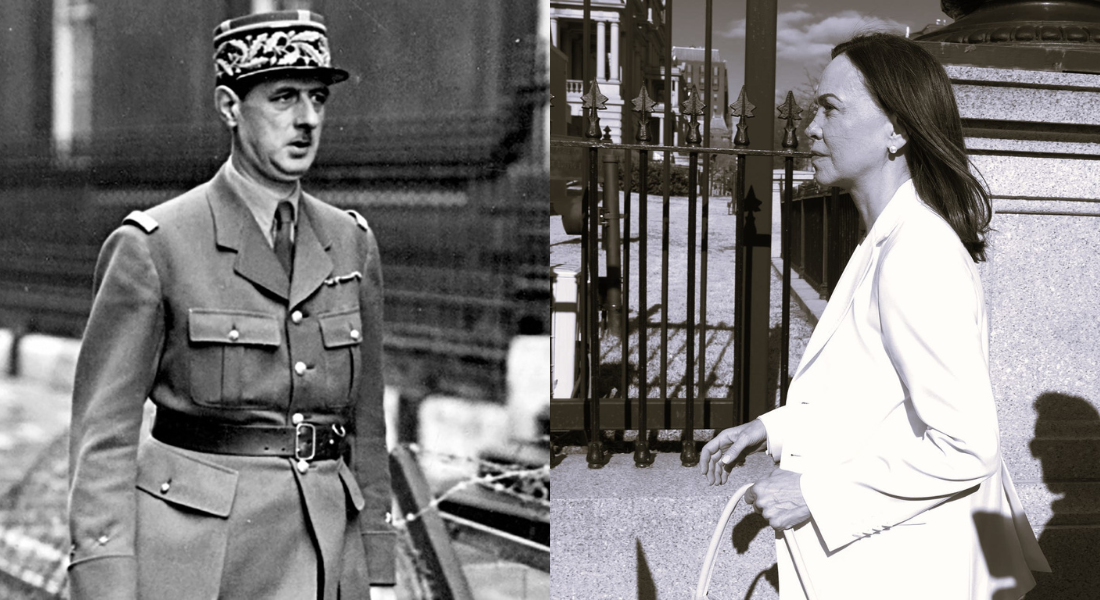
De Gaulle vs. María Corina: Resisting Great-Power Tutelage
There is a familiar critique of María Corina Machado. That she is too rigid, not particularly interested in adjusting to the diplomatic realities surrounding Venezuela’s political crisis, and not especially inclined toward compromise.
The argument is straightforward. Moments like this are supposed to require flexibility, negotiation, and a willingness to adapt. From that perspective, her style can seem poorly suited to the situation.
But that reading is at best incomplete. It assumes a level of intransigence that is not always reflected in how she has actually operated, particularly in her dealings with international actors. More importantly, it assumes that Venezuela is going through a conventional political transition, one where the main challenge is to manage an orderly redistribution of power.
That is not quite what is happening.
Because in deeper national crises, the issue is not only how power changes hands, but whether the country still sees itself as a functioning political community. And in those moments, the tension is not simply between rigidity and pragmatism, but between adaptation and the risk of political dilution.
This is not a new tension. During World War II, Charles de Gaulle was widely seen by his allies as arrogant, inflexible, and almost impossible to work with. Franklin D. Roosevelt dismissed him as a prima donna who “thinks he is France.” Winston Churchill, more begrudgingly, called him “the heaviest cross I have to bear,” and both struggled with what they saw as his refusal to behave like the leader of a defeated country.
Preserving the idea of France as a nation, even in defeat, required a certain political stubbornness, one that inevitably generated friction with allies focused on managing the war.
Between them, Churchill and FDR sketched a portrait of a man too rigid, too proud, too self-appointed to be useful, and yet too symbolically indispensable to ignore.
De Gaulle, after all, had no real army at the outset, no territory, and no state apparatus behind him. Yet he insisted on speaking, and acting, as if France still existed as a sovereign political force.
From the outside, that posture often looked unreasonable, even counterproductive. From the French perspective, it was something else. De Gaulle understood that if the leader who claimed to represent France began to behave primarily as a dependent actor, the country itself risked being seen that way. Preserving the idea of France as a nation, even in defeat, required a certain political stubbornness, one that inevitably generated friction with allies focused on managing the war. At the same time, De Gaulle was careful to express gratitude for the support France depended on, even as he resisted being defined by it. The challenge was not to reject alliances, but to avoid being politically reduced by them. It was precisely that balance, difficult and often uncomfortable, that later allowed him to reappear not just as a political figure, but as the embodiment of France’s return.
There is a long tradition in political history of what the French call l’homme providentiel, the idea that, in moments of acute national crisis, certain figures come to embody more than a political program. They are read, sometimes reluctantly, as necessary to the resolution of the crisis itself. Charles de Gaulle was often described in those terms, not because he sought to cultivate that image, but because the collapse of the French state created a vacuum that only a figure with that kind of symbolic authority could fill.
In a very different context, María Corina Machado’s role in this most recent chapter of Venezuela’s history has taken on a similar tone. Not as a conventional political leader, but as a figure onto whom broader expectations about national recovery have been projected. That does not resolve the practical challenges of the moment, but it does complicate the assumption that she can simply be treated as another actor within the process.
More recently, Volodymyr Zelenskyy has faced a similar tension. Ukraine’s survival depends heavily on Western support, particularly from the United States, yet his relationship with Washington, especially under Donald Trump, has often been marked by visible strain. At times, Zelensky has had to absorb public criticism, adjust his tone, and even appear deferential in ways that, from the outside, can look uncomfortable. But that is only part of the picture. He has also been careful to consistently express gratitude for American support, acknowledging that it has been essential in sustaining Ukraine’s defense, even as he continues to press for more assistance and assert Ukraine’s strategic value. The result is not a simple posture of defiance or submission, but something more complex. A constant negotiation between dependence and dignity.
Machado is operating within that same tension. Venezuela’s political crisis is often framed as a negotiation problem, one that can be managed through calibrated concessions, international mediation, and gradual normalization. But that framing misses something more fundamental. For a large part of the country, the issue is not simply how power is redistributed, but whether the outcome reflects the democratic mandate that has already been expressed. In that context, a leadership style that appears inflexible from the outside may in fact be responding to a different constraint altogether, the need to sustain the idea that Venezuela has not accepted its political condition as final.
Political processes can be negotiated, structured, and even externally supported, but they cannot fully stabilize without a sense that they reflect the will of the society they claim to reorder.
If there is a lesson in De Gaulle’s trajectory, it is not simply that difficult leaders can prove indispensable, but that political arrangements built around figures who lack legitimacy tend to remain fragile. Over time, systems that attempt to bypass the actors who embody a country’s political mandate often find themselves circling back to them, not out of preference, but out of necessity.
Something of that dynamic is beginning to surface in Venezuela. The events of early January created a sense, however fleeting, that a political opening might finally take shape. That expectation has not materialized in a way that is broadly felt, and the gap between anticipation and outcome is beginning to generate visible frustration. What is emerging instead is a more ambiguous configuration, a transition that gestures toward change without fully convincing that it has arrived.
In that context, the question is not whether María Corina Machado is a comfortable actor within the process, but whether a process that unfolds without her can secure broad social buy-in. The instinct to view her primarily as a destabilizing force risks missing a more basic point. In moments like this, the leaders who carry political legitimacy are often the ones systems struggle to accommodate, even as they become increasingly difficult to exclude. Winston Churchill, who had once found De Gaulle exasperating, would later acknowledge as much: “Here was a man who, though not elected, though not even accepted by all Frenchmen, nevertheless represented France… He was the spirit of France.”
That may be the uncomfortable reality of moments like this. Political processes can be negotiated, structured, and even externally supported, but they cannot fully stabilize without a sense that they reflect the will of the society they claim to reorder. The difficulty is that the figures who embody that will are rarely the easiest to incorporate.
They are, more often than not, the ones who insist on speaking as if the country they represent has not yet accepted its condition as final.