frank gehry

10 iconic Frank Gehry buildings around the world

Frank Gehry, who died Friday at 96, challenged the notion that buildings needed to behave themselves — creating artful, strange, kinetic combinations of structure, material, form and light, and transforming cities in the process. Here are 10 of his most famous structures that pushed the boundaries of architecture, culture, taste and technology.

Guggenheim Museum Bilbao, Bilbao, Spain, 1997

Guggenheim Museum in Bilbao, Spain.

Curves and angles mix in this section of the Guggenheim Museum in Bilbao.

(Javier Bauluz / Associated Press)

While only one piece of a much larger urban transformation, this uproarious structure, perched at the edge of the Basque city’s industrial waterfront, utterly transformed its image, giving birth to the overused phrase “Bilbao Effect.” Its curving, ever-changing titanium facade — with offset panels catching the light and wowing millions of visitors — became a symbol of a new era of baroque, digitally-driven architecture. (Gehry and his team worked with CATIA, a software formerly employed by aircraft designers.) Inside, a dizzying atrium ties together a fluid series of galleries, all sized for contemporary art’s expanding scale. “I didn’t mean to change the city, I just meant to be part of the city,” Gehry told the design magazine Dezeen in 2021. The project would achieve the former, and transform the field of architecture in the process.

Walt Disney Concert Hall, Los Angeles, 2003

The Walt Disney Concert Hall is a visual anchor in downtown Los Angeles.

The Walt Disney Concert Hall is a visual anchor in downtown Los Angeles.

(Al Seib / Los Angeles Times)

Dreamed up by Walt Disney’s widow, Lillian, in 1987, the project wouldn’t be completed until 2003. But it was worth the wait. Now the cultural and visual anchor of downtown Los Angeles, Disney’s riot of steel sails reflect rippling waves of music, Gehry’s love of sailing, fish scales and other nautical themes, and the frenetic city around it. Inside, the boat-like, wood-clad hall has an intimate, vineyard-style seating arrangement, with its superb acoustics shaped by Yasuhisa Toyota. Don’t forget the 6,134-pipe organ, which resembles a box of exploding French fries. Lillian Disney, a connoisseur of flowers, would die before the hall was finished, but its hidden rear garden is centered around the “Rose for Lilly” fountain, composed of thousands of broken blue and white Delft china pieces.

Fondation Louis Vuitton, Paris, 2014

The "Fondation Louis Vuitton" in the "Bois de Boulogne" in Paris.

The “Fondation Louis Vuitton” has 3,600 glass panels that form its 12 sails.

(Frederic Soltan / Corbis via Getty Images)

Commissioned by LVMH Chief Executive Bernard Arnault, the Fondation Louis Vuitton, set in Paris’ Bois de Boulogne, is wrapped in 12 massive, curved glass sails, hovering above a white concrete “iceberg.” The museum’s billowing forms, which help lighten its considerable scale, were realized via head-spinning structural complexity: None of its 3,600 glass panels are the same, while each timber and steel supporting beam is curved uniquely. Inside and out, Gehry orchestrates a meandering gallery of paths and multistory overlooks that frame both art and landscape. While marooned on Paris’ western edge, the spectacular building has nonetheless become a cultural icon in a city where that’s very hard to achieve.

Vitra Design Museum, Weil am Rhein, Germany, 1989

Vitra Design Museum in Weil am Rhein, Germany.

Frank Gehry’s Vitra Design Museum helped inspire other inventive buildings on the campus.

(Education Images / Universal Images Group via Getty)

While tame in comparison to his later work, Vitra marked Gehry’s transition from rough-edged, industrial bricolage to sculptural spectacle. Its tumble of white plaster forms — cubes, cylinders, sweeping curves — seem to freeze mid-collision, as if the gallery had been torn apart by seismic forces. (Just a year before, Gehry had been included in MoMA’s “Deconstructivist Architecture” exhibition, but he always rejected that label.) The structure also helped launch a string of impressive experiments on the Vitra campus, including buildings by Zaha Hadid, Tadao Ando, Nicholas Grimshaw, Álvaro Siza, Herzog & de Meuron and more.

8 Spruce (formerly New York by Gehry), New York, 2011

The 8 Spruce apartment building in Manhattan.

8 Spruce in Manhattan has 76 stories.

(Don Emmert / AFP via Getty Images)

Gehry’s first skyscraper, 8 Spruce, reimagined the Manhattan high-rise as a kind of gleaming, pleated fabric, its shifted stainless steel panels rippling downward, catching daylight in a constantly shifting display. A buff brick base contains a public school and retail frontages, activating the street and helping establish the financial district as a legit residential neighborhood. Inside, apartments are far more rational, organized around generous windows that frame the city. Only 30 of the building’s 76 floors had been constructed when the Great Recession hit. For a time, the developer, Forest City Ratner, considered cutting the building’s height in half. But by 2010, the structure was back on.

Dancing House (Fred and Ginger), Prague, 1996

Dancing House.

The Dancing House stands out amid Prague’s 19th century facades.

(Insights / Universal Images Group via Getty Images)

Designed with Czech architect Vlado Milunić, the building — a major step forward for Gehry, who increasingly dabbled in digital design — pits a leaning glass tower against an upright, solid partner, creating a kinetic duet that instantly earned the nickname “Fred and Ginger.” The complex’s opaque tower is clad in cream-colored concrete panels, stepping rhythmically with protruding windows that drift off-center. Its frenetic steel-ribboned crown, which stands out amid 19th century facades along Prague’s Vltava River, is nicknamed “Medusa.” The glass tower — emerging from a cluster of angled columns — cinches inward at its waist, bulging outward again as it rises, like a figure leaning into a twirl. Traditionalists panned the project when it first opened, but it’s now core to the city’s identity.

Stata Center, Cambridge, Mass., 2004

People walk past the Ray and Maria Stata Center on the campus of the Massachusetts Institute of Technology.

The Ray and Maria Stata Center on the campus of the Massachusetts Institute of Technology stands out for its form — and the lawsuit the university filed over leaks and cracks, which was settled amicably.

(Steven Senne / AP)

The Stata Center tilts, twists and fractures, its brick towers — referencing traditional Cambridge architecture — leaning into planes of glass, mirrored steel, aluminum, titanium, corrugated metal and plywood. The village-like building’s spatial looseness was part of a concerted effort to encourage chance encounters and interdisciplinary exchange at the school. The fragmented forecourt echoes the building around it, with skewed paving patterns, angled retaining walls and unpredictable sight lines. In 2007, MIT filed suit against Gehry’s firm and the general contractor Skanska USA, alleging persistent leaks, cracking masonry, poor drainage and sections where ice and snow slid off the building. The lawsuit was “amicably resolved” in 2010, but it represented one of several instances in which Gehry’s ambition would butt up against practical realities.

Weisman Art Museum, Minneapolis, 1993

The Weisman Art Museum on the University of Minnesota campus.

The Weisman Art Museum.

(Raymond Boyd / Getty Images)

Perched on a bluff above the Mississippi River at the University of Minnesota, the museum was a trial run for Bilbao and Disney, without the help of advanced digital tools. Its stainless steel facade unfurls toward the river in faceted, reflective forms that contrast with the building’s campus-facing facade, a series of various-sized cubes wrapped in earth-toned brick, matching the rest of campus. Inside, a series of flexible galleries support changing exhibitions. The museum is named for Frederick R. Weisman, a Minneapolis-born entrepreneur, art collector and philanthropist who broke sharply with conventional wisdom to support a Gehry-designed building that would loudly announce the arts and become an artwork in its own right.

Jay Pritzker Pavilion, Chicago, 2004

The Jay Pritzker Pavilion

The Jay Pritzker Pavilion stands out in the center of Millennium Park. The main stage can accommodate a full orchestra and 150-person chorus.

(Andia / Universal Images Group via Getty Images)

The centerpiece of Chicago’s wildly successful Millennium Park, the bandshell’s billowing 120-foot proscenium, supported by a web of aluminum arms, is fronted by dozens of torqued stainless steel ribbons, which exuberantly frame the stage. The ribbons connect to an overhead trellis of crossed still pipes that house lights and speakers, while the stage itself is sheathed in warm Douglas fir, and includes a colorful light projection system (first planned for Disney Hall, but scuttled for budget reasons) that transforms the pavilion’s face. Seating 4,000, the Pritzker envelops a “Great Lawn,” with room for another 7,000.

DZ Bank Building, Berlin, 2000

DZ Bank Building in Berlin, interior.

Curves abound in the DZ Bank Building.

(Henri-Alain Segalen/Gamma-Rapho via Getty Images)

A stone’s throw from the Brandenburg Gate, DZ’s stone facade aligns seamlessly with its blocky neighbors on Pariser Platz, providing little hint of its shocking interior. A curved stainless steel conference hall, clad inside with a riot of warm wood panels, resembles an angry sea creature, its humpbacks, saddles, bulges, tucks and pinches creating one of the most kinetic building forms this author has ever seen. The piece dominates a soaring atrium, capped with a curved, crystalline glass roof. Locals nicknamed the split-personality building the “Whale at the Brandenburg Gate.” It remains one of the architect’s most underrated masterpieces.

Source link

Contributor: Frank Gehry wanted to show you everything you could become

Frank Gehry taught students at our nation’s most prestigious private universities, and at California’s most underresourced public schools, that their signatures were invaluable. He had them compare and contrast theirs with their classmates’: It was a simple but profound lesson in personal expression, in the importance of both knowing oneself, and holding on to that knowing throughout one’s life.

Frank’s life was his work — in architecture, in teaching, in public life. His art-making was vivifying. He wanted more years, more time to create, to apply the signature he had refined for nearly a century, until his death on Friday at 96.

Frank was a true master. He aspired to master the craft of architecture. For him it was a fine art, as it was for the Romans and the Greeks, not the bloodless work of engineers and applied math. He apprenticed himself to the great artists, ancient and modern. Frank invented an architecture born of his signature; he dreamed primordial designs that he translated technically. He drew the humane world he desired, and inspired others to do so as well.

Frank wanted to be understood, to be felt, and he expressed himself through the disciplined mastery of his craft, but perhaps more profoundly through the painstaking study of himself. His life quest was a dynamic and visceral continuation and celebration of what he found moving in art, sculpture and classical music. He designed fantastic yet intimate cathedrals for the worship of artistic disciplines, volumes to hold sacred aesthetic time, magnificent vessels for personal emotional experience.

A master inspires devotion, and this is why people worldwide make pilgrimages to experience his creations, to be entranced by his artistry, to be uplifted by the ethereal signature of Frank Gehry — prominent here in Southern California, from his own home in Santa Monica (the Gehry Residence) to the Walt Disney Concert Hall in downtown L.A. to the Grand LA on Bunker Hill.

Frank’s work was about feelings. He knew that art had the power to transform, to unite, to engender empathy. Frank’s office has a large picture of the bronze “Charioteer of Delphi” from 500 BC. He saw it initially in Greece with Ed Moses, on their own artistic pilgrimage. Frank said of the experience: “I looked at it and looked at it, and I started crying. The thought that somebody 2,500 years ago working in an inert material could transmit feelings across the ages to somebody, that’s my North Star. If I can do that, if I can make a building that makes people feel something and transmit feeling through inert materials, then that’s my job. And that’s hard to talk about.” Frank Gehry said in stone, and titanium, and glass, what was and is beyond words. His creativity surmounted the quotidian constraints of public commissions. His passionate apprenticeship transcended even his own expectations.

Frank was esteemed, but above all he fulfilled the goal he had set for himself, and like the unknown sculptor of the Charioteer, his work emanated emotion through the inert materials of his craft. He enlivened concrete, illuminated chain link, made cardboard fluid. Frank’s creative process was a kind of learned reverence. He exemplified an understanding of the mind’s role in guiding the self toward the apex of its spiritual journey, the heart toward the soul’s ultimate purpose, navigating obstacles with unwavering loyalty to one’s true self, fearless and steadfast.

Frank has finally completed his physical journey, and we are left with his wondrous signature, his eternal essence communicated in form. I believe this is why he supported arts education, because he knew that without his own, he might not have discovered his singular soul’s purpose. He wanted to show you everything you could become. He wanted more than anything to be known, deeply seen, and he wanted that for all young people.

Venturing into the unknown of each artistic project enabled Frank to rediscover a pure faith in himself. This was a facet of his greatness, the great master founding and funding Turnaround Arts California, an arts education nonprofit out of his offices. Not glamorous, but glorious was his intention to serve others, to support creative opportunities for children who benefit the most, and too often receive the least.

It is inescapable that people have most focused on Frank’s sculptural, curvilinear forms, his luminous exterior surfaces, and yet what I find most profound about his architecture is how he enchanted and enlivened space. He drew shapes that contain and express something sacred, eternal, venues for values he held dear. He cared about people. I witnessed him change children’s lives through play, sensitive listening and art making.

The composer Gustav Mahler, revered by Frank, said, “all that is not perfect down to the smallest detail is doomed to perish.” Frank’s perfectionism was fastidious, fine tuning every angle, each undulating curve, but it was also intentionally emotional, about the felt communal experiences for the inhabitants of his worlds — another inheritance from Mahler, who once described writing a symphony as “building a world.” Frank’s own world was composed as a symphony: His “orchestras” united Palestinians and Israelis in Berlin, marginalized students with maestros, modern musicians with compositions across centuries and genres. He was a deconstructionist jazz master of liminal space.

Our architectural charioteer was a boy sorcerer from Canada, a student and teacher of wisdom, a shooting star from the far north, he was a gift for our pale and profane world of careless creation and disdain. He was a magician, a linguist who reinvented and built his own emotional vernacular.

A rabbi once told Frank’s parents that their son had “golden hands.” Those hands drew beauty across our planet, and they worked their magic for close to a century. His hands held ours, in creating art that linked us together; his walls did not divide, but invited you in. Like Matisse in old age, drawing from his bed, Frank’s protean creativity, his legacy of mastery is everlasting. He blessed us with his prolific body of work, an enduring inheritance of towering temples in space and time, to transform and inspire us. He left us with creations within which we would find and feel our own best selves.

Malissa Shriver is the president and co-founder, with Frank Gehry, of Turnaround Arts California.

Source link

Appreciation: Frank Gehry was the architect who changed music

The street was very quiet. The moon, full. The ocean in the background, calm. All the lights inside were on as I walked by a Santa Monica house, when I thought I heard the famous theme from Bach’s “Goldberg Variations.” Bach wrote this for a certain Herr Goldberg seeking serenity to put him to sleep.

The music was in my head or, if you are willing to get spiritual about it, in an unidentifiable ether. Inside the house, another Mr. Goldberg, one who changed his name to Frank Gehry as a striving young architect having moved from Toronto to Los Angeles, lay dying, leaving the realm he had remade like no one else in our time. Gehry died on Friday at age 96 following a brief respiratory illness.

The “Goldberg Variations” was Gehry’s favorite work. He loved its otherworldliness and its worldliness. He loved its invitation to dance and to dream. He loved its astonishing sense of design, complex yet flowing with the ocean’s grace, its depth and its inviting surface. He loved that it was unfathomable. All things that have come to describe Gehry.

I once spent a day in Gehry’s office where we had takeout salads for lunch and talked for several hours about the “Goldbergs.” He had been asked by Princeton University Press to contribute to a book in which 26 artists and writers wrote about a piece that meant something special to them. But Frank — he was Frank to all Angelenos — couldn’t put it in words. He only agreed if it could be a discussion.

Everything for Frank was a discussion — an ongoing discussion between a building and its place, between a building and all who saw it and used it. And the discussion between Frank’s buildings and music was on an exalted level. He will be well-lauded around the globe for his art and architecture, but beyond all that, Frank Gehry did more than any other single individual in the 21st century to benefit music.

Walt Disney Concert Hall, which was built for and by the Los Angeles Philharmonic and opened in 2003 was, of course, his crowning achievement. I watched it go up from the old Times building downtown, which offered a perfect view, and witnessed how attitudes changed as people who had thought this was some kind of crazy thing started to fall head over heels for it. Attending daily orchestra rehearsals the summer before the hall opened, I discovered for the first time the essence of great architecture: Simply walking into a building made you feel good.

We’ve just had no better example of how that has never gone away with the Dodgers’ World Series victory parade on Grand Avenue last month. It was not Dodger Stadium, not City Hall, certainly not L.A. Live, that was chosen for the city’s first occasion of collective joy this difficult year.

Disney is the most spectacular example of what Gehry’s halls have meant for music. But every one has made a huge difference to the art form, to music and musicians and audiences, to our youth and to our institutions. His buildings are meant for imagination while amplifying tradition. They guide us to the next step.

When it comes to Disney, that has been incomparable. In the mid 1990s, when fundraising had stalled, the city all but gave up on the hall. Esa-Pekka Salonen, then-L.A. Phil music director, decided to step down. But he was convinced to stick it out for a bit longer by the orchestra’s visionary head, the late Ernest Fleischmann, who was a close friend of Gehry and who had connived a mostly hostile Music Center board into choosing Gehry over more conventional name architects. Through more conniving, the hall got built.

Disney, with stunning acoustics, proved both a place of modernity for a new millennium and one of the world’s most acoustically engaging venues. It is very new and very traditional, and the best of both worlds. Its promise helped bring Deborah Borda to the orchestra as Fleischmann’s successor, and she and Salonen created in it the most vibrant, progressive and successful major orchestra in this country and beyond.

Disney then became the place where Gustavo Dudamel could grow into the venturesome conductor he has become. Dudamel would have become great wherever he landed, but it was Disney where he had the greatest opportunity for adventure. For Gehry, Salonen and Dudamel became family (Dudamel dubbed him “Pancho”). Of all his buildings, other than his home, Disney is the one Gehry spent the most time in, regularly attending concerts.

This is a story told to some degree wherever Gehry built for music. His hall at Bard College became a venue for the most imaginative summer music festival in country. Education, in fact, has been at the heart of Gehry’s musical activities (when it came to music, he considered himself a student to the end). He turned an abandoned bank and burger joint into the celebrated Beckmen YOLA Center in Inglewood and was eager to build more (all pro bono). The Pierre Boulez Saal in Berlin was his gift to Daniel Barenboim’s West-Eastern Divan Orchestra, bringing together young musicians from Israel and Arab countries.

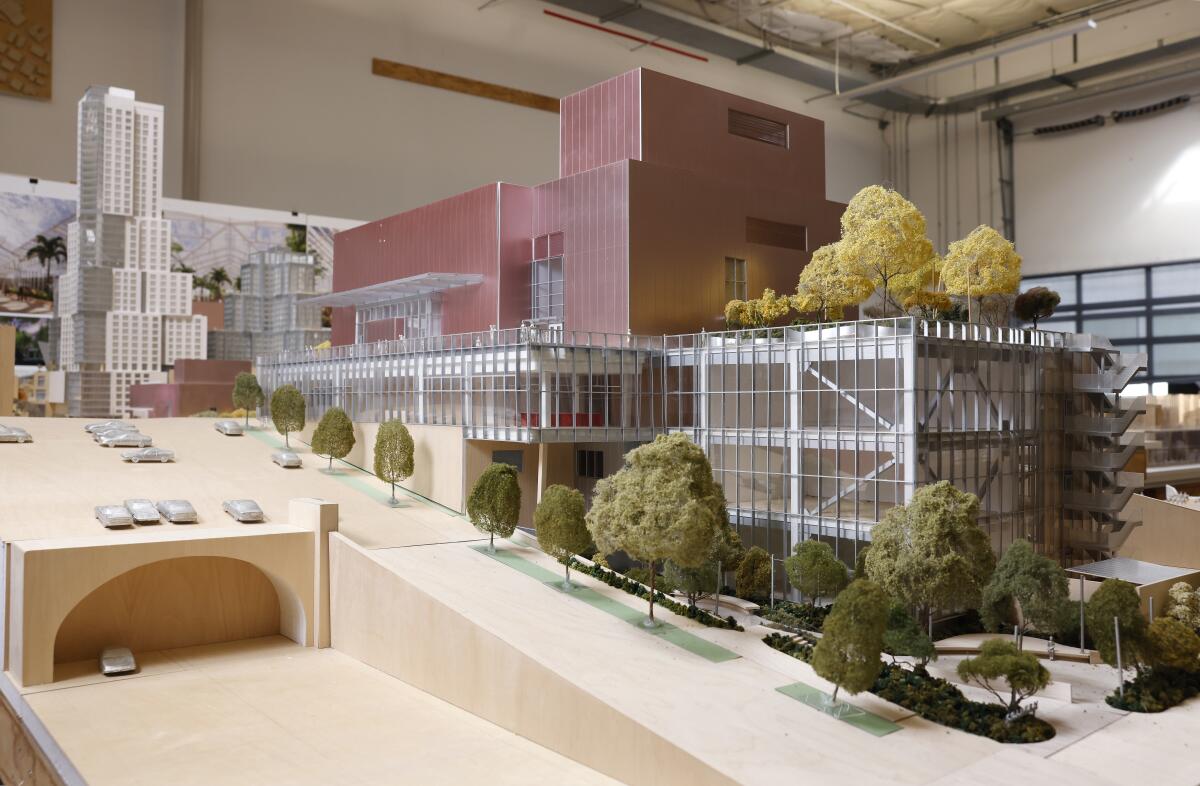
Gehry’s latest musical masterpiece, the 1,000-seat Colburn Center, is currently going up across the street from Disney. After taking a hard-hat tour of it last month, I excitedly called Frank and predicted it would be a game changer for downtown. He then took a hard-hat tour and happily agreed.

There is much that Gehry was not able to realize. He had more plans for Disney, the Music Center and Grand Avenue. He has designed an opera house for Abu Dhabi, and wherever in the world he was building he was also asking about abandoned warehouses he could inexpensively turn into a YOLA center.

But the revolution Gehry began in creating spaces where music can be made and re-imagined and brought to life in ever new ways has caught on. Every concert hall that gets built these days, whether in Moscow or Munich, has to think about these things. In the meantime, let’s all listen to the “Goldbergs” to honor, full moon or crescent, our great and lasting Goldberg of music.

Source link