Features

Ukraine’s patience with US peace push wears thin as Russia skirts pressure | Russia-Ukraine war News

Ukraine expressed frustration with its ongoing peace talks with Russia and the United States this week, saying US pressure was too one-sided against it.

“As of today, we cannot say that the outcome is sufficient,” Zelenskyy told Ukrainians in a Wednesday evening video address.

Before Wednesday’s talks in Geneva had begun, Zelenskyy told Axios news service that ceding the remaining one-fifth of the eastern Donetsk region that Russia doesn’t control, as Moscow has demanded, would not be accepted by Ukrainians.

“Emotionally, people will never forgive this. Never. They will not forgive … me, they will not forgive [the US],” Zelenskyy said, adding that Ukrainians “can’t understand why” they would be asked to give up additional land.

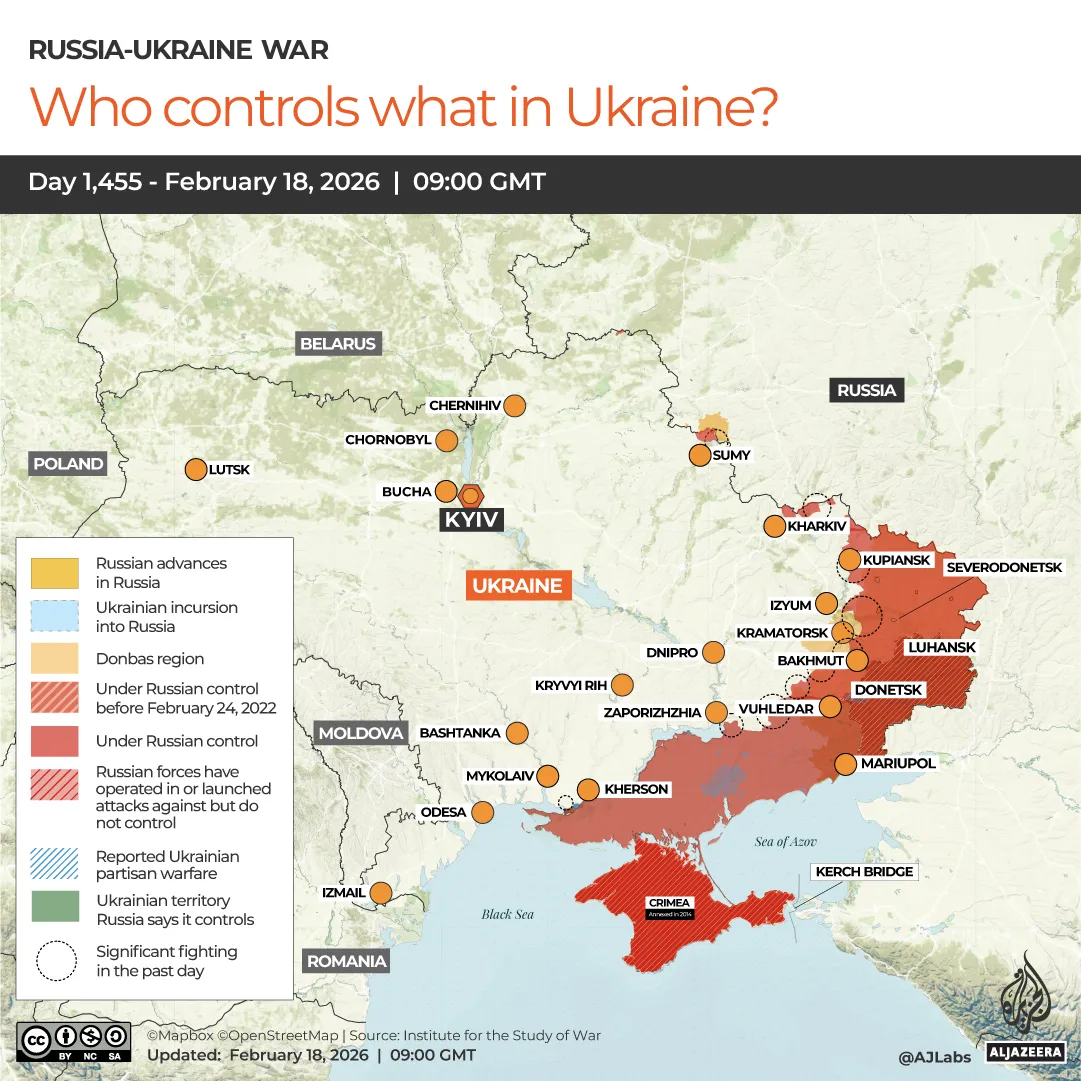
Russia currently controls about 19 percent of Ukraine, down from 26 percent in March 2022.

INTERACTIVE-WHO CONTROLS WHAT IN UKRAINE-1771420401

Last month, 54 percent of surveyed Ukrainians told the Kyiv International Institute of Sociology they categorically reject transferring the whole of the Donetsk region to Russian control, even in return for strong security guarantees, with only 39 percent accepting the proposal.

Two-thirds of respondents also said they did not believe the current US-sponsored peace negotiations would lead to lasting peace.

Instead of ceding land now, Zelenskyy favours freezing the current line of contact as a pretext for a ceasefire and territorial negotiations.

“I think that if we will put in the document … that we stay where we stay on the contact line, I think that people will support this [in a] referendum. That is my opinion,” he told Axios.

Blaming Ukraine

US President Donald Trump told Reuters last month that Ukraine, not Russia, was holding up a peace deal.

But Zelenskyy said it was “not fair” that Trump was putting public pressure on Ukraine to accept Russian terms, adding, “I hope it is just his tactics.”

US senators visiting Odesa last week agreed with him, saying they want their government to put more pressure on Russia.

“Nobody, literally nobody, believes that Russia is acting in good faith in the negotiations with our government and with the Ukrainians. And so pressure becomes the key,” said Senator Sheldon Whitehouse of Rhode Island.

Russia unleashed a barrage of 396 attack drones and 29 missiles on Ukraine’s energy infrastructure on the day of the Geneva talks, its second large-scale blow in six days. On February 12, another attack had left 100,000 families without electricity, and 3,500 apartment buildings without heat in Kyiv alone.

“Russia greets with a strike even the very day new formats begin in Geneva – trilateral and bilateral with the United States,” said Zelenskyy in a video address. “This very clearly shows what Russia wants and what it is truly intent on.”

Zelenskyy has repeatedly asked Western allies to stop Russian energy sales that circumvent sanctions, and to stop exporting components to third countries, which re-export them to Russia’s armaments industry.

Russia is believed to be using a shadow fleet estimated at between 400 and 1,000 oil tankers to carry and sell its crude oil. France has seized two of those tankers, and the US seized a second tanker on Monday.

The US Senate has held off voting on a sanctions bill that has 85 percent support because of opposition from Trump. The bill would impose secondary sanctions on buyers of Russian oil – notably India and China.

Kyiv
Workers repair a pipe at a compound of Darnytsia Thermal Power Plant, which was heavily damaged by Russian missile and drone strikes in Kyiv, Ukraine, on February 4, 2026 [File: Valentyn Ogirenko/Reuters]

Can Russia take Donetsk anyway?

Russia has fought since 2014 to seize the two eastern regions of Ukraine, which triggered its invasion – Luhansk and Donetsk – where it claimed a Russian-speaking population was being persecuted by the government in Kyiv.

Late last year, Russia managed to seize all of Luhansk, but analysts believe it is doubtful that it could take the remainder of Donetsk without serious losses, because Ukraine has heavily fortified a series of cities in the western part of the region.

That task has now become even harder, according to observers, since Russia this month lost access to Starlink terminals, which helped it communicate, fly its drones and coordinate accurate counter-battery fire.

As Russian ground assaults have faltered, Ukraine has seized the initiative to make gains in Dnipropetrovsk, said Ukrainian military observer Konstantyn Mashovets.

Ukrainian forces gained 201sq km of territory from Russian occupation forces between February 11 and 15, according to observers, reportedly their fastest advance since a 2023 counteroffensive.

INTERACTIVE-WHO CONTROLS WHAT IN EASTERN UKRAINE copy-1771420406

Russia has been trying to replace Starlink using stratospheric balloons, reported Ukrainian Defence Ministry adviser Serhiy “Flash” Beskrestnov.

Russia would likely take six months to replace Starlink, said a Ukrainian unmanned systems commander, offering Ukrainian forces a window to roll back Russian advances.

It also suffered 31,680 casualties in January, estimated Ukraine’s General Staff – a sustainable number given Russian recruitment levels of about 40,000 a month. But those numbers would rise in the event of a major assault on the remainder of Donetsk, experts say.

“Our goal is to have at least 50,000 confirmed enemy losses every month,” said Ukrainian Minister of Defence Mykhailo Fedorov on February 12, echoing a goal set by Zelenskyy last month.

Fedorov has set out to increase the production of remote-control FPV drones used on the front lines, which Ukraine says are now responsible for 60 percent of all Russian casualties.

As part of that effort, joint drone production facilities are planned in several European countries. The first started operating on February 13 in Germany, Zelenskyy told the Munich Security Conference, and nine more are planned.

In addition, Ukraine’s European allies pledged 38 billion euros ($44.7bn) in military aid this year during a Ramstein format meeting – the alliance of more than 50 countries which plans military aid for Ukraine – including 2.5 billion euros ($2.9bn) for Ukrainian drones – “one of the most successful ‘Ramsteins’,” Fedorov said.

The European Union has additionally voted to borrow 90 billion euros ($106bn) to give to Ukraine in financial aid this year and next.

The US stopped being a donor of military and financial aid to Ukraine after Trump was sworn in as president in January 2025.

Against Trump’s wishes, the US Senate voted to spend $400m in each of the next two years as part of the Ukraine Security Assistance Initiative, which pays US companies for weapons for Ukraine’s military. Europeans have pledged to spend at least 5 billion euros ($5.8bn) on US weapons this year.

Europe would also be the main contributor to a “reassurance force” policing the line of contact after a ceasefire, and on Ukraine’s insistence, US representatives also met with British, French, German, Italian and Swiss representatives before the talks in Geneva.

INTERACTIVE-WHO CONTROLS WHAT IN SOUTHERN UKRAINE-1771420404

Source link

Deadly tower collapse has locals in Lebanon’s Tripoli asking: Are we next? | Infrastructure

Tripoli, Lebanon – Hossam Hazrouni points underneath a concrete staircase to the exposed foundation of the building where he lives.

“Inside, there, look,” the 65-year-old says. “The interior pillars are all broken. It’s covered in water. Everything inside is wet.”

Recommended Stories

list of 3 itemsend of list

A few metres away lies a pile of smashed concrete blocks and twisted metal. It is the rubble of a building that collapsed on February 8, killing at least 15 people.

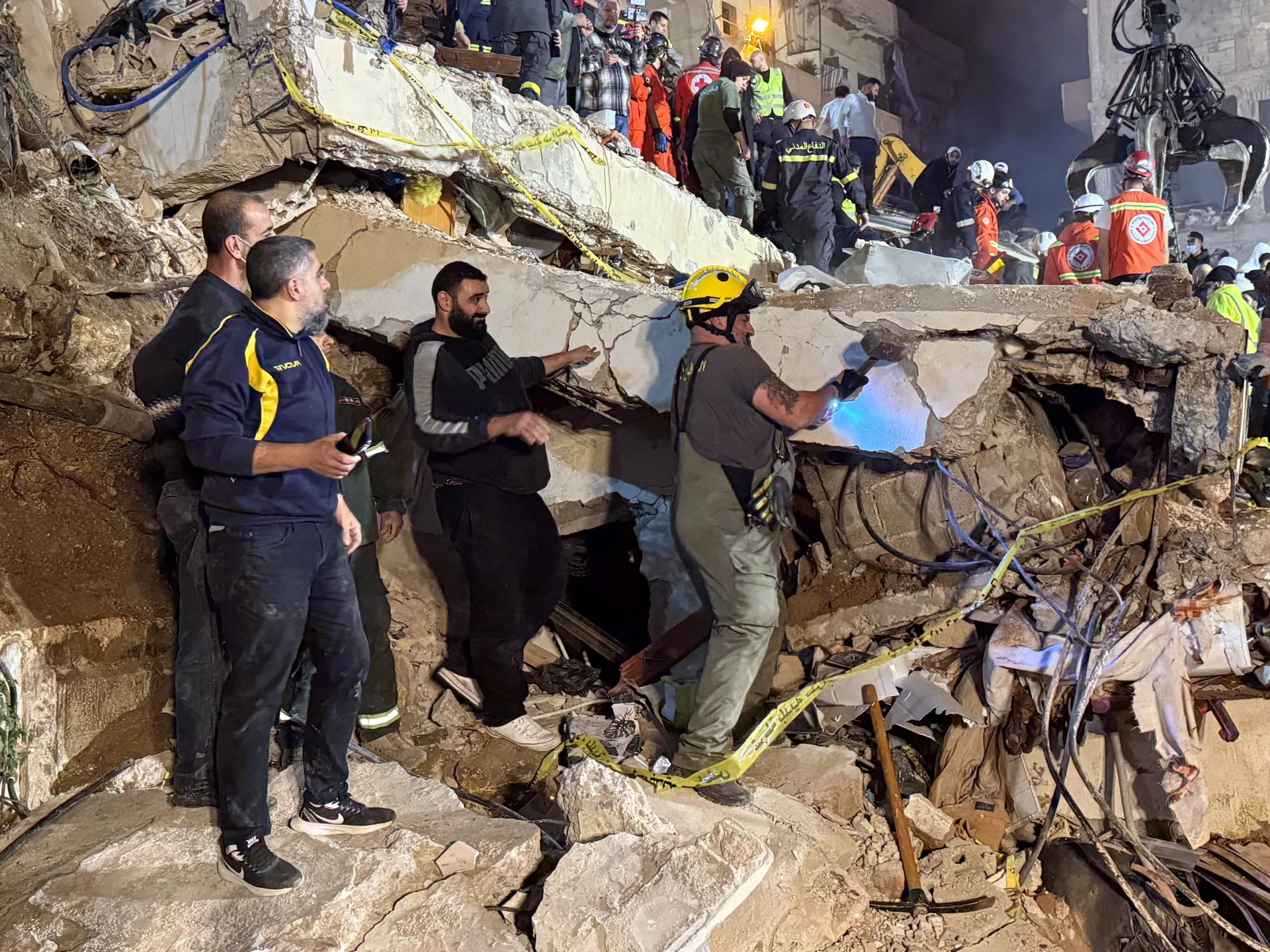
In Tripoli, collapsed buildings are fast becoming common. This is the fourth building to collapse this winter alone. Today, hundreds of buildings are at risk of collapse due to a lethal combination of ageing infrastructure, unregulated construction, Lebanon’s 2019 economic crisis, the 2023 earthquake that fractured much of the local infrastructure’s foundation, and a relatively heavy rain season.

Locals like Hazrouni are afraid their buildings will be next.

“They told us that you should evacuate and you shouldn’t stay, but how are we supposed to leave when we are in a bad situation?” he asked, raising his palms to the sky. “Where are we supposed to go?”

Collapsing structures

In the 1950s, Tripoli, Lebanon’s second-largest city and the largest in the country’s north, was a hub for trade and shipping in the region. But in the intervening years, its status has fallen to become one of the poorest cities on the Mediterranean Sea.

It is also a city of massive disparity. Multiple billionaires live in Tripoli, including the former Prime Minister Najib Mikati and former Minister of Finance Mohammad Safadi, while about 45 percent of the city’s population lives in poverty, according to a 2024 World Bank report.

Over the years, most of Tripoli’s middle- and upper-class residents have moved to the southern edge of the city, leaving behind its impoverished classes to inhabit the decaying old city. Many of the poor know their concrete buildings are ageing and in poor condition, but have little means to fix them.

“The first problem is that the structures are old,” Fayssal al-Baccar, an engineer, told Al Jazeera from a restaurant in southern Tripoli. Al-Baccar is also the founder of the Tripoli Emergency Fund, a private initiative started in response to the collapsing building issue that has been fundraising to help the city.

“The lifespan of concrete is between 50 to 80 years,” al-Baccar explained, and in many of the buildings in central Tripoli, that lifespan is coming to an end. On a sheet of white paper with a blue pen, he drew a model of a building’s foundation.

“Through time, the pH [level] of the concrete will become more and more acidic,” he said, sketching lines around the base of his drawn wall. “Then it will corrode the steel – the steel will self-destruct – and the building will collapse.”

The issue has been exacerbated by a few incidents in particular. When a 2023 earthquake devastated northern Syria and southern Turkiye, it was widely felt in Tripoli as well. Local officials say that it damaged much of the infrastructural foundations of older buildings, many of which have had irregular or unregulated floors added to them, making them weaker. The area has also suffered from neglect and a lack of infrastructure for years, even before the 2019 economic and banking crisis.

Lastly, there is the issue of water damage. This year, Lebanon has received more rainfall than in the last couple of years. And in the days leading up to the collapsed building on February 8, it rained multiple times. “Water is infiltrating into the concrete and is also making the steel worse,” al-Baccar said.

That is why al-Baccar has recruited whom he described as some of the city’s “best and most successful” to help fill governmental gaps.

One of those people is Sarah al-Charif, the Tripoli Emergency Fund’s spokesperson and fundraising committee member. She is also the Lebanon director for Ruwwad Al Tanmeya, a nonprofit focused on youth and disenfranchised communities, and was appointed vice president of Tripoli’s Port Authority last year.

“You’re talking about areas where most, if not all, of the buildings are old and dilapidated, some of which are actually on the verge of collapse,” al-Charif said from her office at Ruwwad Al Tanmeya’s office in Bab al-Tabbaneh, less than a kilometre (0.62 miles) away from where the building collapsed on February 8.

“The fact that the problem is so big reflects decades of accumulated neglect by a state that hasn’t fulfilled its obligations towards this city,” she said.

Al-Charif said she doesn’t hold the current government – which took office a year ago – responsible, but that historically, “people who were in positions of power didn’t do anything, they weren’t fulfilling their duties”.

“There’s also a part that falls on the landlord, a part that falls on the tenant, and a part that falls on the merchants who are the builders. Maybe they’re using substandard materials,” she said. “So everyone has to take their share of the responsibility.”

Historical neglect

Standing on the street, Wissam Kafrouni, 70, points to the top floor of a building just a few doors down from the structure that collapsed on February 8. A crack runs zig-zagging down the building’s side, in the pattern of descending stairs. His nephew rents the top-floor apartment, he says, but the landlord is claiming that repairs are the responsibility of the tenant.

Locals in this neighbourhood say that many officials have visited the site in recent days, including Prime Minister Nawaf Salam. They also say that they’ve been told for years that the local municipality has plans to fix the infrastructure, but that little has come about from it.

The local government has known about the issue for years, but until now, little has been done. Deputy Mayor Khaled Kabbara is part of a new municipal government elected in 2025.

“The issue of cracked buildings is a very old issue in the city of Tripoli, and unfortunately, it has not been dealt with in previous periods,” he told Al Jazeera from Tripoli’s municipality headquarters. But this new municipal government that was elected in 2025, he said, has “raised its voice”.

Kabbara also said that Tripoli has been historically ignored by Beirut “since independence” in the 1940s, but that the current government was working with the local government to find solutions.

“Honestly, this is the first time that we feel that someone is listening and there is someone who is working with us,” he said.

A group of engineers are currently inspecting buildings around the city to decide if damaged buildings can be repaired or must be evacuated and demolished. Evacuation warnings have been issued for 114 buildings, though that number is expected to rise substantially.

Families that evacuate should receive a one-year shelter allowance to secure alternative housing. Religious institutions have opened their doors to evacuees, while Turkiye has also promised to donate about 100 prefabricated houses.

A call centre has also been set up for residents to report suspected issues with their buildings. The hotline has so far received reports on approximately 650 different buildings, Kabbara said.

One of the buildings previously reported to the call centre was the building that collapsed on February 8. Locals had heard a creaking sound coming from the building.

Kabbara acknowledged that the report was received and that the residents were afraid. However, he said, the engineers had not inspected it before it collapsed because nothing in the report indicated it needed an urgent inspection.

What comes next?

Back in Bab al-Tabbaneh, numerous locals expressed frustration and fear. They said many officials and associations have visited the site, but few have delivered on promises to help them.

“We’ve been told there is a plan to fix the infrastructure since the Siniora government,” Samir Rajab, 56, said, referring to Fouad Siniora, the prime minister of Lebanon from 2005 to 2009. “But nothing happens.”

Next to the destroyed building site, Mustapha al-Abed, 54, repaired a broken washing machine out of a small workshop. He said his work was not very fruitful lately, as poverty forced many in this area with broken appliances to wash their laundry by hand.

He looked over at the site where the building had gone down just days earlier. “The problem is not here any more. These people are already dead,” he said. He then pointed across the street to a bustling neighbourhood, where people were doing their Ramadan shopping.

“The problem is all the other buildings.”


Source link

Gaza death toll exceeds 75,000 as independent data verify loss | Israel-Palestine conflict

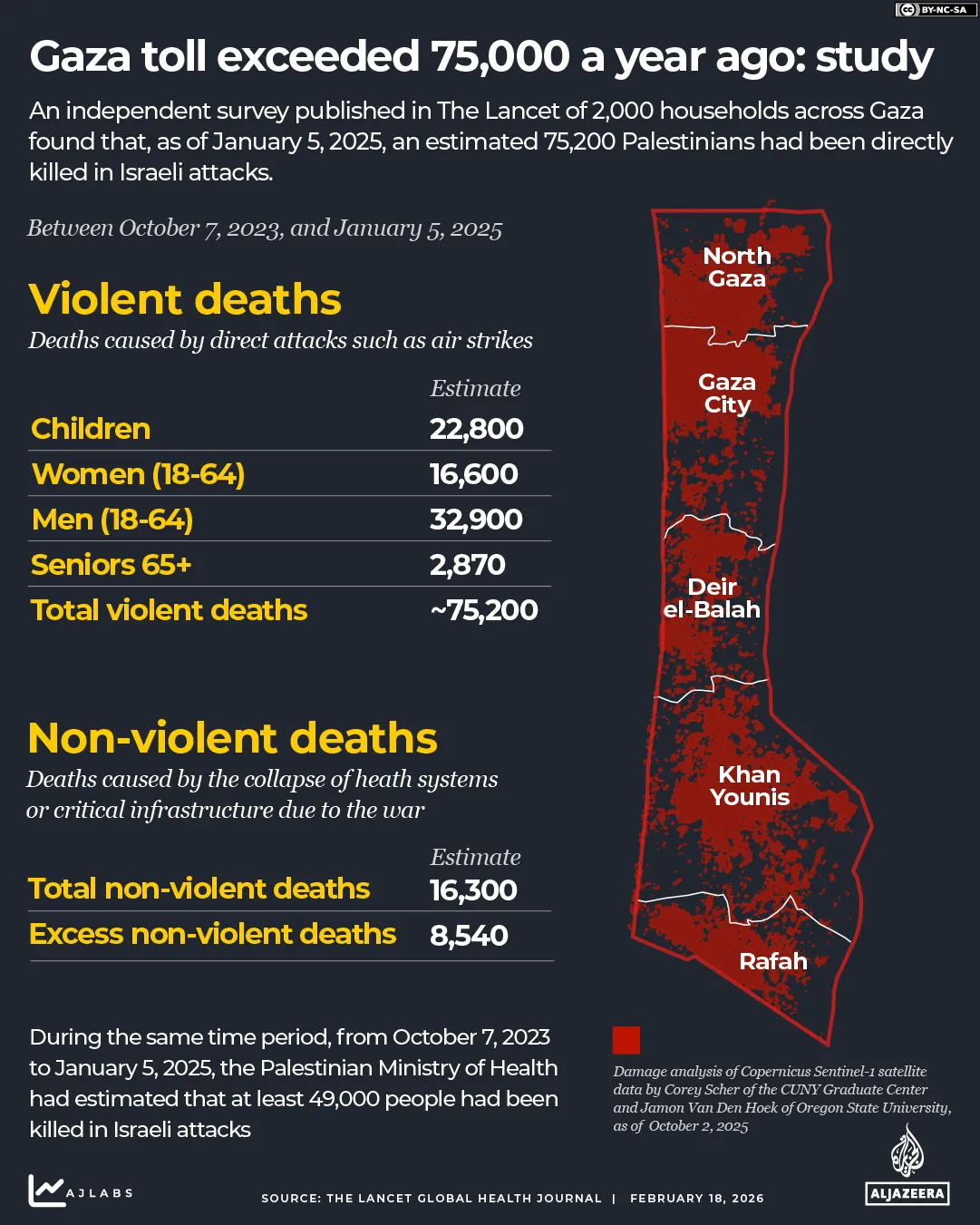
The true human cost of Israel’s genocidal war on the Gaza Strip has far exceeded previous official estimates, with independent research published in the world’s leading medical journals verifying more than 75,000 “violent deaths” by early 2025.

The findings, emerging from a landmark series of scientific papers, suggest that administrative records from the Gaza Ministry of Health (MoH) represent a conservative “floor” rather than an overcount, and provide a rigorous bedrock to the scale of Palestinian loss.

The Gaza Mortality Survey (GMS), a population-representative household study published in The Lancet Global Health, estimated 75,200 “violent deaths” between October 7, 2023 and January 5, 2025. This figure represents approximately 3.4 percent of Gaza’s pre-conflict 2.2 million population and sits 34.7 percent higher than the 49,090 “violent deaths” reported by the MoH for the same period.

The Gaza Health Ministry estimates that as of January 27 this year, at least 71,662 people have been killed since the start of the war. Of those, 488 people have been killed since the declaration of a ceasefire in the Gaza Strip on October 10, 2025.

Israel has consistently questioned the ministry’s figures, but an Israeli army official told journalists in the country in January that the army accepted that about 70,000 people had been killed in Gaza during the war.

Despite the higher figure, researchers noted that the demographic composition of casualties – where women, children, and the elderly comprise 56.2 percent of those killed – remains remarkably consistent with official Palestinian reporting.

INTERACTIVE - Gaza death toll exceeds 75000 Lancet study-1771400778
(Al Jazeera)

Scientific validation of the toll

The GMS, which interviewed 2,000 households representing 9,729 individuals, provides a rigorous empirical foundation for a death toll.

Michael Spagat, a professor of economics at Royal Holloway University of London and the study’s lead author, found that while MoH reporting remains reliable, it is inherently conservative due to the collapse of the very infrastructure required to document death.

Notably, this research advances upon findings published in The Lancet in January 2025, which used statistical “capture-recapture” modelling to estimate 64,260 deaths during the war’s first nine months.

While that earlier study relied on probability to flag undercounts, this report shifts from mathematical estimation to empirical verification through direct household interviews. It extends the timeline through January 2025, confirming a violent toll exceeding 75,000 and quantifying, for the first time, the burden of “non-violent excess mortality”.

According to a separate commentary in the same publication, the systematic destruction of hospitals and administrative centres has created a “central paradox” where the more devastating the harm to the health system, the more difficult it becomes to analyse the total death toll.

Verification is further hindered by thousands of bodies still buried under rubble or mutilated beyond recognition. Beyond direct violence, the survey estimated 16,300 “non-violent deaths”, including 8,540 “excess” deaths caused directly by the deterioration of living conditions and the blockade-induced collapse of the medical sector.

Researchers highlighted that the MoH figures appear to be conservative and reliable, dispelling misinformation campaigns aimed at discrediting Palestinian casualty data. “The validation of MoH reporting through multiple independent methodologies supports the reliability of its administrative casualty recording systems even under extreme conditions,” the study concluded.

A decade of reconstructive backlogs

While the death toll continues to mount, survivors face an unprecedented burden of complex injury that Gaza’s decimated healthcare system is no longer equipped to manage. A predictive, multi-source model published in eClinicalMedicine quantified 116,020 cumulative injuries as of April 30, 2025.

The study, led by researchers from Duke University and Gaza’s al-Shifa Hospital, estimated that between 29,000 and 46,000 of these injuries require complex reconstructive surgery. More than 80 percent of these injuries resulted from explosions, primarily air attacks and shelling in densely populated urban zones.

The scale of the backlog is staggering. Ash Patel, a surgeon and co-author of the study, noted that even if surgical capacity were miraculously restored to pre-war levels, it would take approximately another decade to work through the estimated backlog of predicted reconstructive cases. Before the escalation, Gaza had only eight board-certified plastic and reconstructive surgeons for a population exceeding 2.2 million people.

The collapse of the health system

The disparity between reconstructive need and capacity is exacerbated by what researchers describe as the “systematic destruction” of medical infrastructure. By May 2025, only 12 of Gaza’s 36 hospitals remained capable of providing care beyond basic emergency triage, with approximately 2,000 hospital beds available for the entire population, down from more than 3,000 beds before the war.

“There is little to no reconstructive surgery capacity left within Gaza,” the research concluded, warning that specialised expertise like microsurgery is almost absent. The clinical challenge is further compounded by Israel’s use of incendiary weapons, which produce severe burns alongside blast-related fractures.

The long-term effect of these injuries is often irreversible. Without prompt medical treatment, patients face high risks of wound infection, sepsis, and permanent disability. The data indicate that tens of thousands of Palestinians will remain with surgically addressable disabilities for life unless there is a huge international increase in reconstructive capacity and aid.

Interactive_TwoYearofGaza_HOSPITALS_DESTROYED_DAMAGED

The ‘grey zone’ of mortality

Writing in The Lancet Global Health, authors Belal Aldabbour and Bilal Irfan observed a growing “grey zone” in mortality where the distinction between direct and indirect death becomes blurred. Patients who die of sepsis months after a blast, or from renal failure after a crushing injury because they cannot access clean water or surgery, occupy a space that risks understating the true lethality of military attacks.

Conditions have only deteriorated since the data collection periods. By late 2025, forced evacuations covered more than 80 percent of Gaza’s area, with northern Gaza and Rafah governorates facing full razing by Israeli forces. Famine was declared in northern Gaza in August 2025, further reducing the physiological reserve of injured survivors and complicating any surgical recovery.

This series of independent studies serves as an urgent call for accountability and an immediate cessation of hostilities. “The healthcare infrastructure in Gaza is being repeatedly decimated by attacks despite protection by international humanitarian law,” researchers stated. They underscored that the only way to prevent the reconstructive burden from growing further is an immediate end to attacks against civilians and vital infrastructure.

Source link

Fears of ‘slow, certain death’ stalk Tigray amid rumblings of renewed war | Conflict News

Tigray, Ethiopia – Saba Gedion was 17 when the peace deal that ended the conflict in her homeland of Tigray in northern Ethiopia was signed in 2022.

She hoped then that fighting would be a thing of the past, but the last few months have convinced her that strife is once again looming, and she feels paralysed with despair.

Recommended Stories

list of 3 itemsend of list

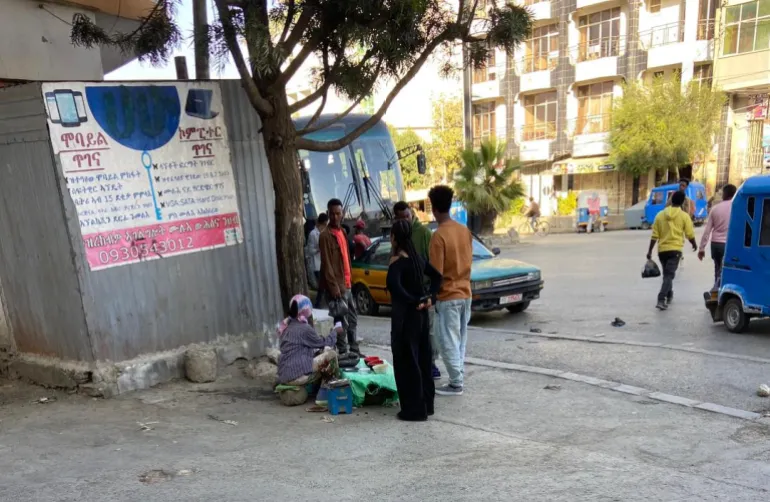
“Many people are leaving the region in droves,” Gedion told Al Jazeera as she sat under the shade of a tree, selling coffee to the occasional customer in an area frequented by internally displaced people (IDPs) in Tigray’s capital, Mekelle.

Gedion – herself a displaced person – is from the town of Humera, a now-disputed area with the Amhara region that witnessed heavy clashes during the 2020-2022 war between Ethiopia’s federal government and the Tigray People’s Liberation Front (TPLF).

The now-21-year-old remembers the horrors she witnessed. Some of her family were killed, while others were abducted into neighbouring Eritrea, she says. She has not heard from them since.

Though she made it out alive, her life was turned upside-down when she was forced to flee to Mekelle for safety.

Years later, Gedion sees similar patterns as people leave Tigray – most headed to the neighbouring Afar region – once again looking for the safety that has become elusive at home.

“Recurring conflict and civil war have made us zombies rather than citizens,” she told Al Jazeera.

In recent weeks, enmity between Ethiopia and Eritrea has escalated amid separate accusations by both sides.

Speaking to Ethiopia’s parliament in early February, Prime Minister Abiy Ahmed addressed his landlocked country’s access to the sea, saying “the Red Sea and Ethiopia cannot remain separated forever”. This has led to accusations by Eritrea that Addis Ababa is seeking to invade its country and trying to reclaim the Red Sea Assab seaport, which it lost in 1993 with the independence of Eritrea.

Ethiopia, meanwhile, has accused Eritrean troops of occupying its territory along parts of their shared border, and called for the immediate withdrawal of soldiers from the towns of Sheraro and Gulomakada, among others. Addis Ababa also accuses Eritrea of arming rebels in the vast Horn of Africa country.

Observers say the heightening tensions point to an impending war between the two countries – one that could once again involve Tigray.

Tigray
Saba Gedion, 21, sells coffee on a street in Tigray [Zantana Gebru/Al Jazeera]

Unhealed scars of war

In Tigray’s capital, a once-booming city of tourism and business, most streets are quiet.

The young people who previously frequented cafes are now often seen applying for visas and speaking with smugglers in the hope of leaving Tigray.

Helen Gessese, 36, lives in a makeshift IDP camp on the outskirts of Mekelle. She worries about what will become of the already struggling region should another conflict erupt.

Gessese is an ethnic Irob, a persecuted Catholic minority group from the border town of Dewhan in the northeastern part of Tigray.

During the Tigray war, several of her family members were kidnapped, she said, as Eritrean troops expanded their hold of the area.

As the war intensified, she fled to Mekelle, about 150km away, looking for safety. Her elderly parents were too frail to join her on foot, so she was forced to leave them behind. Like Gedion, she has not heard from them or the rest of her family since 2022.

“My life has been held back, not knowing if my elderly parents are still alive,” she told Al Jazeera, the stress of the last few years making her seem much older than she is.

In Mekelle, it is not uncommon to meet people who are anguished or frustrated – some by the renewed tensions, and many by the trauma of the previous conflict.

More than 80 percent of hospitals were left in ruins in Tigray during the war, according to humanitarian organisations, while sexual violence that defined the two-year conflict is still a recurring issue. Hundreds of thousands of young people are still out of school, foreign investment that created jobs in the past has in large part evaporated, and the economy remains crippled after years of war.

Meanwhile, nearly four years later, the federal government’s decision to withhold foreign funds meant for the region is deepening a humanitarian crisis. The bulk of the public service in the region, for instance, has not been paid for months.

The Ethiopia-Eritrea relationship has also deteriorated in recent years.

The longstanding foes had waged war against each other between 1998 and 2000, but in 2018, they signed a peace deal. They then became allies during the 2020-2022 civil war in Tigray against common enemy, the TPLF.

But the relationship between Ethiopia and Eritrea has been in sharp decline since the signing of the 2022 accord that ended the Tigray war – an agreement that Asmara was not party to.

FILE - A destroyed tank is seen by the side of the road south of Humera, in an area of western Tigray, annexed by the Amhara region during the ongoing conflict, in Ethiopia, May 1, 2021. (AP Photo/Ben Curtis, File)
A destroyed tank is seen by the side of the road south of Humera, in an area of western Tigray, annexed by the Amhara region during the Tigray war [File: Ben Curtis/AP]

‘Acts of outright aggression’

Earlier this month, Ethiopia’s Minister of Foreign Affairs Gedion Timothewos wrote an open letter acknowledging the presence of Eritrean troops loitering on the Ethiopian side of the border and calling for them to leave.

“The incursion of Eritrean troops …” he wrote, “is not just provocations but acts of outright aggression.”

Asmara continues to deny the presence of its troops on the Ethiopian side, and Eritrean Minister of Information Yemane Gebremeskel has called such accusations “an agenda of war against Eritrea”.

As a sign of the worsening of the relationship between the two neighbours, Ethiopia’s Abiy, in his address to lawmakers early in February, also accused Eritrean troops of committing atrocities during the Tigray war. The accusation was a first from the prime minister, following repeated denials by his government about reported mass killings, looting and the destruction of factories by Eritrean troops during the Tigray conflict.

Eritrea’s government rejected Abiy’s claims about atrocities, with Gebremeskel calling them “cheap and despicable lies”, noting that Abiy’s government had until recently been “showering praises and state medals” on Eritrean army officers.

As the tensions escalate, many observers say war between the two is now inevitable and have called for dialogue and the de-escalation of the situation.

“The situation remains highly volatile and we fear that it will deteriorate, worsening the region’s already precarious human rights and humanitarian situation,” the United Nations Human Rights spokesperson, Ravina Shamdasani, said this month.

Kjetil Tronvoll, a professor of peace and conflict studies at Oslo New University College, told Al Jazeera a new war would have “wide-reaching implications for the region” – regardless of the outcome.

He believes the looming conflict between Ethiopia and Eritrea could take the shape of a new civil war, positioning Addis Ababa against Tigray’s leadership yet again.

From Ethiopia’s side, he argues the objective would be regime change in both Asmara and Mekelle, noting that “regime change in Eritrea may lead to Ethiopia gaining control of Assab”. For Asmara and Mekelle, the aim would also be regime change in Addis Ababa, he suggests.

“If it erupts, it will be devastating for Tigray,” Tronvoll said. “The outcome of such a war will likely fundamentally alter the political landscape of Ethiopia and the Horn [of Africa],” he warned, pointing out that regional states could also be pulled into a proxy war.

Tigray
People in Tigray are afraid renewed tensions may bring another war [Zantana Gebru/Al Jazeera]

Fears for the future

For many in Tigray, memories of massacres committed during the 2020-2022 war are still fresh.

Axum, a UNESCO World Heritage site in the central zone of the Tigray region, is known for its tall obelisk relics of an ancient kingdom. But for 24 hours in November 2020, the city was the site of killings carried out by the Eritrean army. “Many hundreds of civilians” were killed, rights group Amnesty International said.

While the killings were denied by both the Eritrean and Ethiopian governments for many years, this month Abiy acknowledged they had taken place.

However, despite speaking of “mass killings” in Axum, he has been silent about the fact that the Ethiopian and Eritrean armies worked together openly as allies during that war.

Marta Keberom, a resident in her forties who hails from Axum, says very few people in her hometown have not been touched by violence in the last five years.

“The killings that happened during the war wasn’t just a conflict, it had the hallmark of a genocide where whole families were murdered without a cause,” she said of the killings that targeted Tigrayans.

“To relive that,” Keberom said, speaking at an IDP centre in Mekelle, would be “something I can’t begin to comprehend.”

Waiting for customers at her coffee stand in the city, Gedion is also afraid of what might come next.

She once aspired to be an engineer, but since being uprooted from her village, she now dreams of a future far away from Ethiopia.

She has already contacted a smuggler to help her leave, she says, through Libya and on towards the Mediterranean Sea – despite the extreme risks of such a journey.

“I would rather take a chance than die a slow, certain death with little future prospects,” she said.

Source link

‘Quid pro quo’: How Indian firms fund parties whose governments help them | Politics

When India’s top court banned a controversial scheme in February 2024 that allowed individuals and corporates to make anonymous donations to political parties through opaque electoral bonds, many transparency activists hailed the judgement as a win for democracy.

Between 2018, when Prime Minister Narendra Modi’s government introduced the electoral bonds, and when they were scrapped in 2024, secret donors funnelled nearly $2bn to parties.

More than half of that went to Modi’s Hindu majoritarian Bharatiya Janata Party (BJP), which has held India’s central government since 2014, and also governs at least 20 Indian states and federally controlled territories, either directly or in coalition with allies.

In striking down the scheme, the Supreme Court said that “political contributions give a seat at the table to the contributor” and that “this access also translates into influence over policymaking”.

But two years later, data shows that big business continues to pump in millions of dollars in funding to political parties, with the BJP retaining its position as the biggest beneficiary, frequently raising serious concerns over a quid pro quo with donors.

The donors have returned to an older funding mechanism: electoral trusts. Introduced in 2013 by the Manmohan Singh government led by the Congress party that preceded Modi, the trusts, unlike bonds, require the donors to disclose their identities and the amount of money being given.

But that relative transparency is not dissuading companies from major mega-donations to parties directly positioned to benefit them through policies and contracts, an analysis of recent political funding by Al Jazeera reveals.

Ashwini Vaishnav, Union Minster of Railways, Communications and Electronics & Information Technology and N. Chandrasekaran, Chairman, Tata Sons hold bricks during the foundation stone laying ceremony for India's First AI-enabled Semiconductor Fab manufacturing facilities in Dholera, Gujarat, India, March 13, 2024. REUTERS/Amit Dave
Ashwini Vaishnaw, federal minister for railways, information and broadcasting, electronics and information technology, and N Chandrasekaran, chairman of Tata Sons, hold bricks during a foundation stone-laying ceremony for a  semiconductor manufacturing facility in Dholera, Gujarat, India, on March 13, 2024 [Amit Dave/ Reuters]

‘Money determines access’

In 2024-25, nine electoral trusts donated a total of $459.2m to political parties, with the BJP receiving $378.6 million — 83 percent of it. The main opposition Congress party got about $36m (8 percent), while other parties received the remaining amount.

This data is sourced from disclosures made during the first full year after the Supreme Court ban on bonds.

Two major corporations stood out, due to their significant financial scale and policy influence:  The Tata Group, founded in 1868 by Jamsetji Nusserwanji Tata, is a global conglomerate with more than 30 companies spanning steel, IT, automobiles, aviation, and more. Its aggregate revenue for FY 2024-25  exceeded $180bn. The Murugappa Group, founded in 1900 by A M Murugappa Chettiar as a money-lending business in Burma (now Myanmar), is a prominent Indian conglomerate with 29 businesses in engineering, agriculture, financial services and beyond. Its turnover stood at $8.53bn in 2024-25.

Documents submitted to the Election Commission of India in 2024-2025 show that the Progressive Electoral Trust, backed by 15 companies belonging to the Tata Group conglomerate, distributed approximately $110.2m to 10 political parties in the run-up to the 2024 general election.

The BJP received about $91.3m – again roughly 83 percent of the total fund – while the Congress got $9.31m, with smaller sums going to several regional parties. Tata made its contribution on April 2, 2024, while Murugappa did so on March 26, 2024.

India’s general elections began on April 19 and concluded on June 1, 2024.

The timing and scale of these donations are significant, say experts. Tata’s donations came within weeks of the government approving two semiconductor projects worth more than $15.2bn announced by the Tata Group in Gujarat and Assam – both BJP-ruled states.

The Modi government also provided additional support of about $5.3bn under India’s plans to promote semiconductor development.

Meanwhile, in February 2024, the Indian government approved a semiconductor assembly and testing facility proposed by CG Power and Industrial Solutions Ltd, a Murugappa Group company. The project, to be set up in Sanand, Gujarat, with an investment of approximately $870m, also received central and state government incentives.

In the same financial year, disclosures showed that yet another trust called Triumph Electoral Trust received $15.06m from Tube Investments of India Ltd, another Murugappa Group company. The entire money went to the BJP, with no contribution by Triumph to other parties.The scale of these donations surprised observers as the Murugappa Group had been a modest political donor over the previous decade.

“Electoral trusts may be legal, but they normalise a system where money determines access, policy, and electoral success,” Parayil Sreerag, a political strategist, told Al Jazeera. Sreerag argued that such a mechanism “favours the ruling party, marginalises smaller movements, and erodes democratic competition and public trust”.

To be sure, corporate funding in India has a long history.

The Birla group of companies was a major financier of Mahatma Gandhi in the years leading up to independence in 1947. Since then, other companies and parties have continued the practice.

“Business houses have traditionally supported ruling political parties,” G Gopa Kumar, former vice chancellor of the Central University of Kerala and a political strategist, told Al Jazeera.

India’s legal framework governing corporate donations to political parties has evolved alongside political shifts. The Companies Act, 1956, first regulated such contributions, barring government companies and young firms, while mandating disclosure of donations. Corporate funding was later banned in 1969 under Prime Minister Indira Gandhi. The ban was lifted in 1985.

A major overhaul came in 2013 with the introduction of Electoral Trusts and the Companies Act, 2013. The new law capped corporate donations at 7.5 percent of average net profits, required board approval, and mandated disclosure, marking a significant attempt at regulation and transparency.

But while the Modi-era electoral bonds between 2018 and 2024 drew the bulk of the criticism over electoral finance from transparency activists, the return to electoral trusts has coincided with what is, in effect, an increase in corporate funding for parties. Between 2018 and 2024, the electoral bonds led to an average of under $350m in total donations per year.

Trusts – to which corporates turned after the bonds were scrapped – donated more than $450m by contrast, in 2024-25.

“Left unchecked, it [soaring corporate funding] risks creating a duopoly between political power and corporate capital,” Sreerag said.

Al Jazeera reached out to the Tata Group, the Murugappa Group and the Election Commission of India for their responses to concerns over links between donations and influence, but it has not yet received any response.

Activists of Communist Party of India (Marxist) protest in Hyderabad, India, against the State Bank of India seeking more time to disclose details of “electoral bonds” to the Election Commission of India, Monday, March 11, 2024. India’s Supreme Court had last month struck down “electoral bonds”, a controversial election funding system that allowed individuals and companies to send unlimited donations to political parties without the need to disclose donor identity. (AP Photo/Mahesh Kumar A)
Activists of the Communist Party of India (Marxist) protest in Hyderabad, India, seeking compliance with a Supreme Court order against a controversial electoral bonds scheme, on Monday, March 11, 2024 [Mahesh Kumar/AP Photo]

Uncovering corruption in election funding

Transparency activists argue that the surge in corporate funding, especially for the ruling party, both reveals the access and influence enjoyed by major firms and sheds light on the disadvantages faced by smaller parties and independent candidates.

Shelly Mahajan, a researcher at the Association for Democratic Reforms (ADR), a prominent Indian election watchdog, said unequal access to private donations undermines political participation and electoral competition.

“Despite decades of reform proposals, the nexus between money and politics persists in India due to weak enforcement and inadequate regulation,” she told Al Jazeera.

To many, the electoral bonds scheme came to epitomise that dark and cosy “nexus”.

In December, Nature magazine published a study on alleged corruption under the scheme, authored by academics Devendra Poola and Vinitha Anna John.

The authors found that newly incorporated companies made unusually large donations soon after their formation, pointing to expectations of gains from the government. In several cases, firms accused of tax evasion or other financial crimes donated after raids by India’s enforcement and investigating agencies, raising concerns of coercive political pressure: 26 entities under investigation bought bonds worth $624.7m, including $223.3m after raids by investigating agencies.

Bond purchases peaked around election cycles. That timing – around elections and after raids – was “significant”, Poola told Al Jazeera. “That sequencing is analytically difficult to dismiss as coincidence.” While the data cannot establish legal intent, Poola stressed that the pattern points to an “institutionalised quid pro quo ecosystem enabled by opacity”.

Yet critics say transparency alone does not resolve the link between public policy and political funding – as the data since the ban on electoral bonds shows.

S Mini during her campaign in 2024 April
S Mini, a candidate from the SUCI party, during her campaign for India’s national elections in April 2024. She had hardly any funding and secured just 1,109 votes. She questioned what she — and others — have described as an uneven playing field [Rejimon Kuttappan/ Al Jazeera]

‘What kind of democracy is this?’

Mahajan, the ADR researcher, said that in its decision to strike down the electoral bonds, the Supreme Court invoked the 2013 law on electoral trusts to reimpose a 7.5 percent cap on corporate donations based on their net profits.

Companies were ordered to disclose both the amounts and the recipients, creating greater scope for public scrutiny and detailed analysis. But that is not happening. Abhilash MR, a Supreme Court lawyer, said large corporate donations raise serious concerns, particularly under Article 14 of the Constitution of India, which guarantees political equality and administrative fairness.

He said there is mounting evidence of generous government incentives followed by large corporate donations.“When policy decisions appear calibrated to facilitate corporate funding, the very idea of a welfare state is undermined,” he told Al Jazeera, adding that proving corruption in courts remains extremely difficult.

“Temporal proximity between policy benefits and donations rarely meets the evidentiary threshold needed to trigger an independent judicial inquiry,” he said. “In such situations, accountability shifts from courtrooms to the public domain.”

Mini S, a politician from the Socialist Unity Centre of India (Communist) party, had hoped for that shift among voters when she contested the 2024 national elections from Thiruvananthapuram, the capital of the southern Kerala state.

She couldn’t fund air-conditioned vehicles, so her campaign during India’s notorious summer moved through neighbourhoods on hired motorbikes and autorickshaws. She hoped to unseat Shashi Tharoor, a former UN diplomat and politician from the opposition Congress party, who had been representing Thiruvananthapuram in parliament since 2009. When the votes were counted, Mini secured just 1,109 votes, while Tharoor won by a landslide. She also forfeited her $275 security deposit.

But for Mini, the outcome was less a personal defeat than an indictment of how Indian elections are fought. Her entire campaign ran on $5,500, she said, an amount much lower than the $105,000 limit set by the Election Commission of India on expenditure by a parliamentary candidate.

“India likes to call itself the world’s largest democracy, but it’s not,” Mini told Al Jazeera. “When corporate money openly funds mainstream parties – through electoral bonds and trusts, often in clear quid pro quo arrangements – and the Election Commission stays silent, what kind of democracy is this?”

In such a scenario, Mini said, government policies “serve corporate interests, not the constitution”.

“Ordinary people are sidelined, and the marginalised are pushed further into the margins. With money of this scale in elections, anyone without corporate backing, like us, is effectively locked out of politics,” she said.

Source link

In Argentina, locals are taking loans to buy food | Debt

Buenos Aires, Argentina: Diego Nacasio, 43, works full time as a salesman at a large hardware store in Florencio Varela, a city in the greater Buenos Aires area. He says he doesn’t need a calendar to know what day of the month it is. By the time his salary and that of his wife, who also works full time in a shop, run out, it is around the 15th.

From then on, they look for extra jobs, find things to sell, use their credit cards, and get small loans to pay for basics, including food, until the next paycheques arrive.

“I have never experienced anything like this,” Nacasio told Al Jazeera. “Over the past 25 years, we have worked hard, and our jobs allowed us to build a house from scratch, buy a car and give our 17-year-old son a decent life. Now, we have better jobs than we did then, and still cannot even afford food for the whole month.”

“Living on credit puts you in a very dangerous cycle. It’s very easy to fall behind with payments, and then it is a matter of chasing your own tail. Most people I know are in the same situation. We are living in a constant state of stress and anxiety, and it feels like there’s no way out.”

Nacasio’s story has become increasingly common in Argentina, where nearly half of the people say they are using savings, selling belongings or borrowing money from banks or relatives to cover basics, according to a report by Argentina Grande based on the latest official figures available. Another report, from Fundacion Pensar, found that 63 percent of Argentines have cut down on activities or services to make ends meet.

“The current situation in Argentina is extremely concerning. It is particularly worrying to see that even people who have one or several jobs are getting loans not to buy a house, a car or white goods [appliances], but to buy food,” Violeta Carrera Pereyra, sociologist and researcher at the Argentina Grande Institute and one of the authors of the report, told Al Jazeera.

A tale of two cities

Argentina’s President Javier Milei, who took office in December 2023, says his austerity economic plan, based on achieving fiscal balance while building up reserves of United States currency through drastic cuts to public spending, has revitalised the economy and lifted millions of people out of poverty. He is backed by the International Monetary Fund, which, despite Argentina’s record levels of foreign loans, projects an economic growth of four percent in 2026 and 2027.

Diego Nacasio works full time as a salesman at a large hardware store in Florencio Varela in Argentina
Diego Nacasio works full time as a salesman at a large hardware store in Florencio Varela, but needs to take loans to make ends meet [Patricio A Cabezas/Al Jazeera]

But a closer look at the figures shows a different, more sombre, picture.

While economic activity in Argentina has increased overall, growth has been uneven. In November 2025, the most recent month for which data is available, sectors such as banking and agriculture saw growth, but manufacturing and commerce experienced sharp declines, with many factories and shops closing due to falling demand. Consumption, particularly of food, has been falling, with a 12.5 percent drop reported by independent food retailers.

Then there’s inflation, a key variable that in Argentina needs to be kept at bay in order to access essential foreign credit.

While Milei’s shock economic plan managed to significantly reduce inflation from record-high figures when he first took office in late 2023, experts say his administration has taken some controversial measures to keep it low. This includes forcing salaries to remain stagnant and under the rate of inflation, and opening the country up to cheaper imports. These policies have left many without money to spend and forced thousands of factories and small businesses to close.

Critics also say inflation figures are not representative of real price fluctuations. The tool used to measure inflation in Argentina, a sample basket of goods people consume, was developed in 2004 and does not reflect current consumption patterns, including the percentage that items like electricity and fuel – two areas that have seen price hikes considerably higher than inflation – represent in people’s real spending habits.

Carrera Pereyra says that figures also show that the rapid changes in Argentina’s economy have widened inequalities.

“On the one hand, we see that some sectors are able to consume more, so we see a rise in the sales of properties, cars, motorbikes, some as a result of the opening of imports,” she said. “But on the other hand, items like food and medicines are decreasing. So, some people can buy more things than before, while others are struggling to put food on the table.”

An obstacle course

Many Argentines who spoke with Al Jazeera said that making ends meet has become nothing short of an obstacle course. Juggling multiple demanding jobs, selling used items such as clothing, borrowing from relatives, seeking shark loans and bargain hunting have become a regular part of daily life.

“Shopping for food has become a job in itself,”  said Veronica Malfitano, 43, a teacher and trade unionist, whose salary was cut by a quarter when Milei slashed public spending. “I team up with relatives or people I work with, and we buy in bulk. I use my credit card or get small loans. This month, for the first time, I have only paid the credit card’s minimum, something I had never done before. It’s all very stressful. Everybody I know is in the same situation.”

Research confirms Malfitano is not alone. Nearly half of supermarket purchases in Argentina are paid with credit cards, a record, according to recent official data.

A street advertisement in Argentina offering loans outside the banking system with very high interest rates
A street advertisement in Argentina offers loans – one sign of the proliferation of informal lenders, which experts say has created a ‘dangerous situation’ [Patricio A Cabezas/Al Jazeera]

Both borrowing and default rates have increased. It is estimated that around 11 percent of personal loans are unpaid, the highest rate since the Central Bank of Argentina began keeping records in 2010, according to Central Bank data.

Griselda Quipildor, 49, who lives with her husband, two daughters and two grandchildren, says that even though several people in her family work, money usually runs out by the 18th of every month and they have to start taking loans.

“At the start of the month, we pay debts, the bills and then the money runs out and we have to start borrowing again. It’s an endless vicious circle, one that is very difficult to get away from. We borrow from people we know and people we don’t know. It wasn’t like this before.”

Lucia Cavallero, an analyst, economics expert, and member of Movida Ciudad, told Al Jazeera that even though Argentina’s economic problems are longstanding, their impact on people’s homes is worsening.

“Debt has long been a serious problem in Argentina, and it has now become a crisis,” she said. “The proliferation of informal lenders has created a dangerous situation, leaving many people with no other options.”

In response, a political party has proposed a bill that would help people in lower-income sectors unify their loans and apply for a long-term payment plan at lower rates.

Cavallero says there are some positive aspects to the initiative, but that it largely misses the central point.

“It is good to see the political class recognising that debts are a serious problem for people,” she said. “However, this approach follows the logic of borrowing to pay off debt. While it may provide temporary relief, deeper structural changes are needed.

“Just as banks are bailed out, we are calling for families to be supported. A more sustainable solution is for wages to keep pace with the cost of the basic basket, so that people do not have to go into debt just to afford food,” Cavallero told Al Jazeera.

Despite all the challenges he and his family face, Nacasio says many people like himself still count themselves lucky.

“At least we own our house,” he said. “If we didn’t and we had to pay rent, I don’t know what we would do. I just need things to change, for us and for everybody. Things cannot continue like this.”

Source link

‘Rats run over our faces’: Gaza’s displaced forced to live on infested land | Israel-Palestine conflict

The smell hits you before you even see the tents. In the al-Taawun camp, wedged between Yarmouk Stadium and al-Sahaba Street in central Gaza City, the line between human habitation and human waste has been erased.

Forced to flee their homes by Israel’s genocidal war in Gaza, 765 families have set up makeshift shelters directly on top of and adjacent to an enormous solid waste dump. Here, amid mountains of rotting garbage, they are fighting a losing battle against disease, pests and the psychological horror of living in filth.

Fayez al-Jadi, a father who has been displaced 12 times since the war began, said the conditions are stripping them of their humanity.

“The rats eat the tents from underneath,” al-Jadi told Al Jazeera. “They walk on our faces while we sleep. My daughter is 18 months old. A rat ran right over her face. Every day, she has gastroenteritis, vomiting, diarrhoea or malnutrition.”

Al-Jadi’s plea is not for a luxury accommodation, just a mere 40 to 50 metres (130ft to 164ft) of clean space to live in, he said. “We want to live like human beings.”

Fayez al-Jadi, a Palestinian father displaced 12 times by the war, says rats run over his children's faces while they sleep in their tent atop a solid waste dump in Gaza City. [Screengrab/Al Jazeera]
Fayez al-Jadi, a Palestinian father displaced 12 times by the war, says rats run over his children’s faces while they sleep in their tent near a solid waste dump in Gaza City [Screengrab/Al Jazeera]

‘We wake up screaming’

The sanitary crisis has unleashed a plague of skin infections among the 4,000 residents of the camp. With no running water or sewage system, scabies has spread like wildfire.

Fares Jamal Sobh, a six-month-old infant, spends his nights crying. His mother points to the red, angry rashes covering his small body.

“He doesn’t sleep at night because of the itching,” she said. “We wake up to find cockroaches and mosquitoes on him. We bring medicine, but it’s useless because we are living on trash.”

Um Hamza, a grandmother caring for a large extended family, including a blind husband and a son suffering from asthma, said shame is no longer compounding their suffering.

“We’ve stopped being ashamed to say my daughter is covered in scabies,” she told Al Jazeera. “We’ve used five or six bottles of ointment, but it’s in vain.”

She added that the collapse of Gaza’s healthcare system has left them with nowhere to turn. “The hospitals, like al-Ahli, have started turning us away. … They write us a prescription and tell us to go buy it, but there is no medicine to buy.”

Six-month-old Fares Sobh suffers from severe skin infections and asthma caused by the unsanitary conditions at the al-Taawun camp in Gaza City, where displaced families are forced to live atop a solid waste dump. [Screengrab/Al Jazeera]
Six-month-old Fares Jamal Sobh suffers from severe skin infections and asthma caused by the unsanitary conditions at the al-Taawun camp in Gaza City, where displaced families are forced to live atop a solid waste dump [Screengrab/Al Jazeera]

A city drowning in waste

The conditions at al-Taawun are a microcosm of a citywide collapse. Hamada Abu Laila, a university lecturer who helps administer the camp, warned of an “environmental catastrophe” exacerbated by the lack of sewage networks and drinking water across Gaza City.

But the problem goes deeper than a lack of aid. According to Husni Muhanna, spokesperson for the Gaza Municipality, the crisis is man-made. Israeli forces have blocked access to the Gaza Strip’s main landfill in the east, forcing the creation of hazardous temporary dumps in populated areas like Yarmouk and the historic Firas Market.

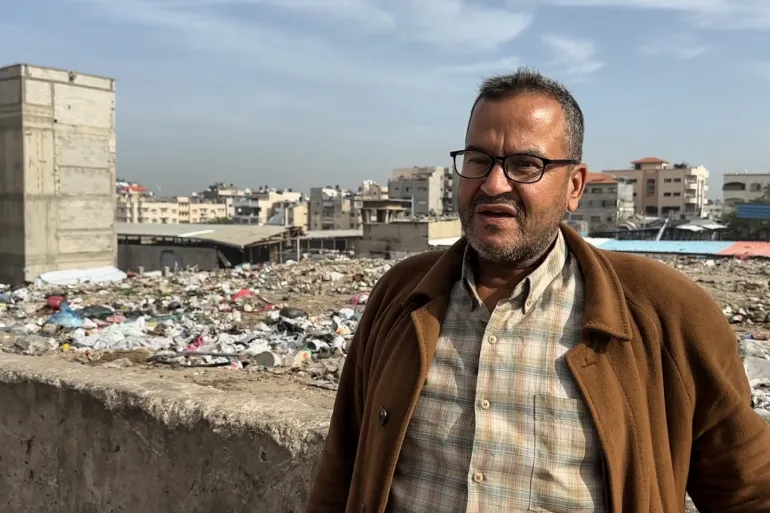
“More than 350,000 tonnes of solid waste are piling up inside Gaza City alone,” Muhanna told Al Jazeera in January.

He explained that the municipality is paralysed by a “complex set of obstacles”, including the destruction of machinery, severe fuel shortages and constant security risks. With interventions limited to primitive means, the municipality can no longer manage waste in accordance with health standards, leaving thousands of displaced families to sleep atop a toxic time bomb.

Sleeping next to a tank shell

The dangers in al-Taawun are not just biological. Rizq Abu Laila, displaced from the town of Beit Lahiya in the north, lives with his family next to an unexploded tank shell that lies among the rubbish bags and plastic sheets.

“We are living next to a dump full of snakes and stray cats,” Abu Laila said, pointing to the ordnance. “This is an unexploded shell right next to the tents. With the heat of the sun, it could explode at any moment. Where are we supposed to go with our children?”

His daughter, Shahd, is terrified of the pack of wild dogs that roam the dump at night. “I’m afraid of the dogs because they bark,” she whispered.

Widad Sobh, another resident, described the nights as a horror movie. “The dogs bang against the tent fabric. … They want to attack and eat. I stay up all night chasing them away.”

For Um Hamza, the daily struggle for survival has reached a breaking point.

“I swear by God, we eat bread after the rats have eaten from it,” she said, describing the desperate hunger in the camp. “All I ask is that they find us a better place, … a place away from the waste.”

Source link

Europe’s growing fight over Israeli goods: Boycott movements mushroom | Israel-Palestine conflict News

One afternoon late August in a quiet Irish seaside town, a supermarket worker decided he could no longer separate his job from what he was seeing on his phone.

Images from Gaza, with neighbourhoods flattened and families buried, had followed him to the checkout counter.

Recommended Stories

list of 4 itemsend of list

At the time, Israel’s genocidal onslaught had killed more than 60,000 Palestinians.

His first act of protest was to quietly warn customers that some of the fruit and vegetables were sourced from Israel. Later, as people in Gaza starved, he refused to scan or sell Israeli-grown produce.

He could not, he said, “have that on my conscience”.

Within weeks, Tesco supermarket suspended him.

He requested anonymity following advice from his trade union.

In Newcastle, County Down, a town better known for its summer tourists than political protest, customers protested outside the store.

The local dispute became a test case: Can individual employees turn their moral outrage into workplace action?

Facing mounting backlash, Tesco reinstated him in January, moving him to a role where he no longer has to handle Israeli goods.

“I would encourage them to do it,” he said about other workers. “They have the backing of the unions and there’s a precedent set. They didn’t sack me; they shouldn’t be able to sack anyone else.

“And then, if we get enough people to do it, they can’t sell Israeli goods.”

“A genocide is still going on, they are slowly killing and starving people – we still need to be out, doing what we can.”

From shop floors to state policy

Across Europe, there is labour-led pressure to cease trade with Israel.

Unions in Ireland, the UK and Norway have passed motions stating that workers should not be compelled to handle Israeli goods.

Retail cooperatives, including Co-op UK and Italy’s Coop Alleanza 3.0, have removed some Israeli products in protest against the war in Gaza.

The campaigns raise questions about whether worker-led refusals can lead to state-level boycotts.

Activists say the strategy is rooted in history.

In 1984, workers at the Dunnes Stores retail chain in Ireland refused to handle goods from apartheid South Africa. The action lasted nearly three years and contributed to Ireland becoming the first country in Western Europe to ban trade with South Africa.

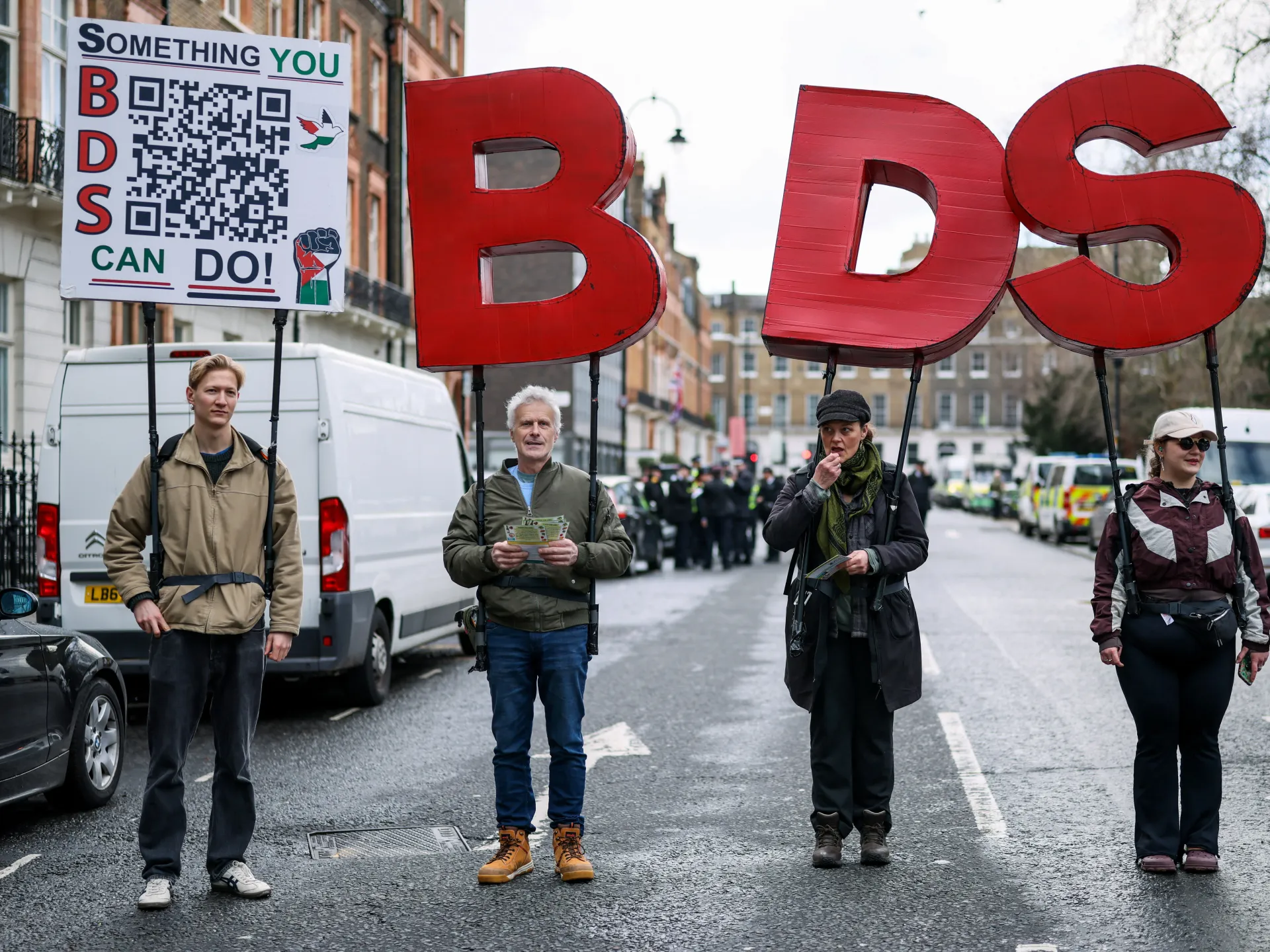
“The same can be done against the apartheid, genocidal state of Israel today,” said Damian Quinn, 33, of BDS Belfast.

The Boycott, Divestment and Sanctions (BDS) movement is a Palestinian-led campaign launched in 2005 that calls for economic and cultural boycotts of Israel until it complies with international law, including ending its occupation of Palestine.

“Where the state has failed in its obligation to prevent and punish the crime of genocide, citizens and workers across the world must refuse Israel and apply pressure on their governments to introduce legislation,” said Quinn.

That pressure, he said, takes the form of boycotting “complicit Israeli sporting, academic and cultural institutions”, as well as Israeli and international companies “engaged in violations of Palestinian human rights”.

The movement also seeks to “apply pressure on banks, local councils, universities, churches, pension funds and governments to do the same through divestment and sanctions”, he added.

Supporters argue that such pressure is beginning to shape state policy across Europe.

Spain and Slovenia have moved to restrict trade with Israeli settlements in the occupied West Bank following sustained public protests and mounting political pressure. In August 2025, Slovenia’s government banned imports of goods produced in Israeli-occupied territories, becoming one of the first European states to adopt such a measure.

Spain followed suit later that year, with a decree banning the import of products from illegal Israeli settlements. The measure was formally enforced at the start of 2026.

Both countries’ centre-left governments have been outspoken critics of Israel’s conduct during the war, helping create the political conditions for legislative action.

In the Netherlands, a wave of pro-Palestinian campus protests and public demonstrations in 2025 shifted political discourse. Student demands for academic and trade disengagement became part of broader calls for national policy change.

Later that year, members of the Dutch parliament urged the government to ban imports from illegal Israeli settlements.

Meanwhile, Ireland is attempting to advance its Occupied Territories Bill, first introduced in 2018, which would prohibit trade in goods and services from illegal settlements in occupied Palestinian territory, including the West Bank.

Progress, however, has stalled despite unanimous backing in the lower house of Ireland’s parliament, the Dail.

Paul Murphy, an Irish pro-Palestine member of parliament who, in June, attempted to cross into Gaza, told Al Jazeera the delay amounts to “indirect pressure from Israel routed through the US”. He accused the government of “kicking the can down the road” as it seeks further legal advice.

Pro-Israel organisations are working to oppose initiatives that aim to pressure Israel economically.

B’nai B’rith International, a US-based group that says it strengthens “global Jewish life”, combats anti-Semitism and stands “unequivocally with the State of Israel”, decries the BDS movement. In July 2025, it submitted an 18-page memorandum to Irish lawmakers, warning the bill could pose risks for US companies operating in Ireland.

The memorandum argued that, if enacted, the bill could create conflicts with US federal anti-boycott laws, which prohibit US companies from participating in certain foreign-led boycotts – particularly those targeting Israel.

B’nai B’rith International also “vehemently condemns” the United Kingdom’s recognition of Palestinian statehood and has donated 200 softshell jackets to Israeli military personnel.

Critics say interventions of this kind go beyond advocacy and reflect coordinated efforts to influence European policymaking on Israel and Palestine from abroad.


While lobby groups publicly press their case, leaked documents, based on material from whistleblower site Distributed Denial of Secrets, suggest the Israeli state has also been directly involved in countering BDS campaigns across Europe.

A covert programme, jointly funded by the Israeli Ministries of Justice and of Strategic Affairs, reportedly hired law firms for 130,000 euros ($154,200) on assignments aimed at monitoring boycott-related movements.

Former Sinn Fein MEP Martina Anderson, who supports the BDS movement, previously accused Israeli advocacy organisations of attempting to silence critics of Israel through legal and political pressure.

According to the leaked documents cited by The Ditch, an Irish outlet, Israel hired a law firm to “investigate the steps open to Israel against Martina Anderson”.

She told Al Jazeera she stood by her criticism.

“As the chair of the Palestinian delegation in the European Parliament, I did my work diligently, as people who know me would expect me to do.

“I am proud to have been a thorn in the side of the Israeli state and its extensive lobbying machine, which works relentlessly to undermine Palestinian voices and to justify a brutal and oppressive rogue state.”

Pushback across Europe

In 2019, Germany’s parliament, the Bundestag, adopted a non-binding resolution condemning the BDS movement as anti-Semitic, calling for the withdrawal of public funding from groups that support it.

Observers say the vote has since been used to conflate criticism of Israel with anti-Semitism.

The European Leadership Network (ELNET), a prominent pro-Israel advocacy organisation active across the continent, welcomed the move and said its German branch had urged further legislative steps.

Meanwhile, in the UK, ELNET has funded trips to Israel for Labour politicians and their staff.

Bridget Phillipson, now secretary of state for education, declared a 3,000-pound ($4,087) visit funded by ELNET for a member of her team.

A coworker of Wes Streeting named Anna Wilson also accepted a trip funded by ELNET. Streeting himself has visited Israel on a mission organised by the Labour Friends of Israel (LFI) group.

ELNET’s UK branch is directed by Joan Ryan, an ex-Labour MP and former LFI chair.

During the passage of a bill designed to prevent public bodies from pursuing their own boycotts, divestment or sanctions policies – the Labour Party imposed a three-line whip instructing MPs to vote against it. Phillipson and Streeting abstained.

The Economic Activity of Public Bodies (Overseas Matters) Bill was widely seen as an attempt to block local councils and public institutions from adopting BDS-style measures.

A vocal supporter of the legislation was Luke Akehurst, then director of the pro-Israel advocacy group, We Believe in Israel. In a statement carried by ELNET, he said it was “absurd” that local councils could “undermine the excellent relationship between the UK and Israel” through boycotts or divestment.

“We need the law changed to close this loophole,” he said, arguing that BDS initiatives by local authorities risked “importing the conflict into communities in the UK”.

The legislation was ultimately shelved when a general election was called in 2024. It formed part of broader legislative efforts in parts of Europe to limit BDS-linked boycotts.

Akehurst has since been elected as Labour MP for North Durham, having previously served on the party’s National Executive Committee.

Source link

Inside Sydney Sweeney’s bid to turn sex symbol status into £1bn brand just like rival Kim K

SHE’S got her showbiz career nailed, but will it be boom or bust for Sydney Sweeney as she takes on Kim Kardashian in the lingerie business?

It is the big question in Hollywood following Syd’s very ambitious move to rival Kim’s Skims brand with her own label, Syrn.

Sydney Sweeney has launched her own lingerie label SyrnCredit: SYRN.com
Sydney is rivalling Kim Kardashian’s Skims labelCredit: Instagram/Skims

Last month, Sydney finally launched her highly anticipated range of undies with $1billion of support from a fund backed by Amazon ­billionaire Jeff Bezos.

And this week, she upped the ante with a cheeky promo video, which sees her raiding a local store with a gang of pals flashing their bras.

It is a ballsy scheme for a relative rookie who, despite cementing herself as a leading lady in the acting world, has yet to prove she has the business acumen to “do a Kim” and turn her sex symbol status into a corporate, billion-dollar brand.

Since co-launching her shapewear company Skims in 2019, Kim, 45, has defied the odds, making it a global lifestyle behemoth worth $5billion.

read more on Sydney Sweeney

MIDNIGHT SNACK

Sydney Sweeney shimmies and shakes in just a bra and underwear for Syrn ad


SMASHER SYD

Sydney Sweeney shows off curves in figure-hugging dress as she receives gong

She’s also launched a new partnership with sportswear giant Nike to create the NikeSkims label.

From where we are sitting, Kim’s a tough act to beat.

‘CALCULATED PLOT’

But evidently, Sydney, 28, isn’t one to be deterred — and why should she be when she’s got the world’s fourth-richest man on her side, injecting big bucks into her new venture?

Syrn, pronounced “siren”, is a ­lingerie line that promises to offer inclusive sizing, up to a 42DDD.

So far, the inventory is limited, with a handful of sexy bras, corsets, thongs and knickers offered on its online store, mostly priced at around $100 (£73) or under.

But sales have already been sky- high, with the “Seductress” collection going out of stock almost immediately.

Like Kim, Sydney has chosen a platform to stand on.

While Skims’ remit focuses on inclusivity — with shapewear sold in nine skin colours and in a large range of sizes — Syrn includes bigger-breasted women, who might not otherwise be catered for by traditional retailers.

It is a clever move, positioning the actress and her own famously ample chest front and centre, with the underlying message that she has something innovative to offer.

According to sources close to Sydney, the Euphoria star’s new business isn’t a half-baked move.It is a ­calculated plot to elevate her to the big leagues and prove she can more than keep up with the Kardashians.


Sydney wants to dethrone Kim — she knows she has the potential to make enormous money and turn Syrn into a multi- billion-dollar company, like Skims


Sweeney insider

“Sydney is extremely competitive and knows she has the potential to reach the very top of the fashion industry,” an insider exclusively tells The Sun.

“That’s exactly why she launched her lingerie brand.

“Syrn is one of her biggest dreams, and she is fully committed to doing whatever it takes to turn it into a major success and compete with top brands like Skims.

“She isn’t afraid of anything.

“She’s aware that Kim Kardashian and her team aren’t happy about her entering the lingerie space, and she was warned by several people not to do it, including friends close to Kim.

“But she never cared about Kim’s opinion, and she never lets others influence her business ideas.”

The insider adds: “Sydney wants to dethrone Kim — she knows she has the potential to make enormous money and turn Syrn into a multi- billion-dollar company, like Skims.

Sydney’s ‘Seductress’ sold out almost immediatelyCredit: SYRN.com
Since launching Skims in 2019, Kim has made it a global lifestyle behemoth worth $5billionCredit: Instagram/ Kim Kardashian

“She sees this as a competition and she loves that challenge.”

Sydney showed her rebellious streak — and got her brand some extra publicity — with a video in which she and her production crew scaled the Hollywood sign in Los Angeles, before hanging Syrn bras across the famous letters.

Some hailed her a cheeky rabble-rouser.

Others dismissed it as a PR stunt.

Either way, it got Sydney noticed and made her brand a ­talking point — especially after the Hollywood Chamber of Commerce, which owns and licenses the sign, slammed the actress, saying she did not have prior authority.

So could Sydney go to jail thanks to her zest and zeal for selling big-sized bras to the world?

No. But for an actress who knows the power of a good performance, she put on one hell of a show.

According to brand and culture expert Nick Ede, the stunt was in keeping with Sydney’s bold approach, which hinges on her unapologetically selling her biggest asset: herself.

She is not afraid to stick two ­fingers up to propriety to make her mark — and money.

‘STUNT MAVERICK’

Nick says: “While Kim is all about being wanted and admired, and always making sure everyone loves her, Sydney doesn’t care.

“She knows that people want to buy into the brand, and she is being maverick with her stunts.

“We didn’t know much about the lingerie line until a few weeks ago, but she’s stepped it up in a strategic way to cut through other celebs with huge brands and endorsement deals.

“Look at Meghan Markle — she had so much around her when she launched her brand.

“She had her TV show and her status, but Sydney has cut through all that in a punky way.

“In Euphoria, she’s a little bit messy as her character Cassie, and she’s a little bit messy as an actual celebrity.

“She’s sticking with her persona, which works well as a brand.”

Fans and critics will remember the chaos last year over Sydney‘s American Eagle ads, which boasted that she “has great jeans”.

Critics suggested the line was racist, claiming it ­promoted white supremacy.

Sydney has curves that match her confidenceCredit: Getty

But ­Sydney proved that sex plus controversy sells.

The clothing brand duly reported a massive spike in sales, plus a stock surge of 25 per cent.

Initially, Sydney refused to discuss the controversy.

However, in December, she said: “I’m against hate and divisiveness.

“In the past, my stance has been to never respond to negative or positive press, but I have come to realise that my silence regarding this issue has only widened the divide, not closed it.”

That said, she didn’t regret the ads, nor the impact they made.

And she’s not about to moderate her behaviour . . . not when she’s got her own brand to promote.

As Nick explains, the actress knows what her assets are, with curves that match her confidence, and she’s putting both on display.

“Sydney’s selling and creating a fantasy,” he explains.

‘SULTRY SELFIE’

It’s very ‘old Hollywood’ in many ways, but it’s gritty, too, and that’s why there is such huge appeal.

“She will become a mega-brand in the future.”

As for Kim, it is no surprise her nose has apparently been put out of joint over the Sydney uprising.

While she often gets models and celeb brand ambassadors to model her Skims wear, the week of the Syrn launch in January saw Kim post her own sultry selfie to Instagram, posing in her brand’s lacy lingerie.

Fans could not help but notice the timing of her decision to model a sexy Skims set, hot on the heels of Sydney’s own saucy ­campaign, also on social media.

As one follower said: “Kim said, not today, Sydney Sweeney,” while another weighed in: “Is this the Sweeney fight back?”

Ramping it up, Kim this week called in little sister Kylie Jenner to model a bra and knicker set from her “Everyday Cotton” Skims range in a bid to reel in younger fans.

Obviously, when it comes to the Hollywood pool of superficial friendships, Kim and Sydney are on decent terms, having rubbed ­shoulders last year at Jeff Bezos and Lauren Sanchez’s wedding.

Needless to say, having a mutual pal like Jeff will keep them civil — on the surface at least — as they have too much to lose if they fall out and put him in the middle.

Kim has also spoken about expanding into the beauty space with SkimsCredit: Getty

But, according to insiders, Kim feels particularly irked by Sydney’s apparent bid to claim some of her global spotlight.

The Kardashian beauty is used to being the most talked-about woman in any room, but — since Sydney became a pop culture phenomenon — she’s been pulling eyes away.

The fact that she is now launching this lingerie line feels a little too close to home for Kim, especially since it has been reported that Sydney has also filed to trademark the Syrn name for cosmetics and beauty care products.

Coincidentally — or maybe not so — Kim has also spoken about expanding into the beauty space with Skims.

Now, she has ­reportedly been complaining to friends that Sydney is nothing more than a “copycat”.

Still, as Nick tells us, the pair actually have more to gain from this rivalry than meets the eye, as “it’s all about the amount of column inches and publicity they can get”.

‘REBELLIOUS STREAK’

Kim is hardly naive when it comes to the art of publicity.

This is the woman who “broke the internet” in 2014 after exposing her very famous bum to the world on the cover of Paper magazine.

She is hardly going to blush at the thought of engaging now in some performative bra wars with Sydney, as she knows full well that the oxygen for any successful brand is attention and visibility.

So who will ultimately triumph?

Well, Kim’s obviously got a tremendous head start.

She steered her brand to global domination, proving that — despite her internet-breaking derriere — she does nothing half-arsed.

But, like Kim, Sydney understands the power of harnessing one’s sex symbol status to achieve fame and fortune, combining that with business-minded savvy and sizeable investments to create a brand with real selling power.

Add to that her rebellious streak and she could be on to a winner with Syrn.

Whether she overshadows Kim remains to be seen, but one thing remains clear.

In the big, bad world of bra- selling celebs, this storm in a D cup will run and run.

SYD’S GEAR

The Show Off plunge bra: £65Credit: SYRN
String You Along low-rise thong: £14Credit: SYRN
The Showpiece basque: £72Credit: SYRN

SYDNEY SWEENEY

AGE: 28.

WEALTH: £30million.

FAMOUS FOR: Starring in The White Lotus, Euphoria and 2025 film The Housemaid.

CONTROVERSIAL MOMENTS: Her American Eagle clothing ad, with the tagline “Sydney Sweeney has great jeans”, which saw her accused of promoting genetic supremacy.

Plus having her bath water used to make a soap range in 2025.

RELATIONSHIPS: Dated businessman Jonathan Davino from 2018 to 2025.

Began dating controversial music executive Scooter Braun in 2025.

BRANDS: As well as Syrn, ­Sydney has her own production company, Fifty-Fifty Films.

She has also collaborated with Armani Beauty, Kerastase haircare, Laneige skincare, Ford motors and Miu Miu fashion.

KIM’S GEAR

Unlined Demi Bra: £104Credit: SKIMS
Silk Lace String Thong: £52Credit: SKIMS
Tie Front Cami: £72Credit: SKIMS

KIM KARDASHIAN

AGE: 45.

WEALTH: £1.4billion.

FAMOUS FOR: Reality shows including Keeping Up With The Kardashians.

CONTROVERSIAL MOMENTS: Leaking of a sex tape starring Kim and Ray J in 2007, “breaking the internet” with her 2014 cover of Paper magazine, and a 72-day marriage to Kris Humphries.

RELATIONSHIPS: Married music producer Damon Thomas at 19 and split after three years; Kris Humphries, married and split after 72 days, 2011; Kanye West, married 2014, split 2021.

She is now dating Lewis Hamilton.

BRANDS: KKW Beauty (2017-2021), SKKN By Kim – skincare brand from 2022, Kardashian Kloset – resale site for TV family’s clothes.

Skims has also launched collaborations with Nike, Dolce & Gabbana and Fendi.

Source link

As Sudanese city returns to life after two-year siege, drone threat lingers | Sudan war News

Markets reopen in Dilling, South Kordofan’s second largest city. Yet residents face critical medical shortages and persistent aerial attacks.

Life is cautiously returning to the streets of Dilling, the second largest city in South Kordofan state, after the Sudanese army broke a suffocating siege that had isolated the area for more than two years.

For months, the city had been encircled by the paramilitary Rapid Support Forces (RSF) and the Sudan People’s Liberation Movement-North (SPLM-N), cutting off vital supply lines and trapping civilians in a severe humanitarian crisis.

Recommended Stories

list of 4 itemsend of list

While the lifting of the blockade has allowed goods to flow again, local authorities and residents said the city remains under the threat of drone attacks.

Al Jazeera Arabic’s Hisham Uweit, reporting from Dilling, described a city “recovering slowly” from the economic strangulation.

“For over two years, heavy siege conditions were imposed on the city. Movement disappeared, goods vanished and livelihoods narrowed,” Uweit said.

“Now the eyes of buyers pick through the few available goods … as if the market itself is announcing its recovery at a leisurely pace, drawing determination from the patience of its residents.”

Markets return to life

The immediate impact of the army’s advance is visible in the local markets, which were largely shuttered during the blockade. Fresh produce, absent for months, has begun to reappear in stalls.

“The market and vegetables have all returned,” a local trader told Al Jazeera. “Before, the market didn’t exist. Now we have okra, potatoes, sweet potatoes, chillies and lemons. Everything is with us, and the market has returned to normal.”

However, the resumption of trade masks deep scars left by the isolation. The blockade devastated the local economy, stripping residents of their savings and leaving infrastructure in disrepair.

‘The price of isolation’

While food supplies are improving, Dilling’s health sector remains in critical condition. The city’s main hospital is struggling with a severe lack of equipment and essential medicines, a shortage that has had life-altering consequences for the most vulnerable.

Abdelrahman, a local resident suffering from diabetes, paid a heavy price for the siege. During the months of encirclement, insulin supplies ran dry. His condition deteriorated rapidly, ultimately leading to the amputation of both his legs.

“He had a medical appointment after a month, but the month closed off his check-ups,” a relative of Abdelrahman said. “He is suffering severely. He is missing his insulin. There is a shortage of food, and he is tired. His health has declined sharply.”

‘Chased like locusts’

Despite the Sudanese army asserting control over access routes, the security situation in Dilling remains precarious. Authorities said the city is subjected to almost daily drone strikes launched by the RSF and SPLM-N, targeting infrastructure and residential areas.

For Maryam, a mother displaced multiple times by the conflict, the breaking of the siege has not brought peace. She described the terror of the unmanned aerial vehicles that hover over their homes.

“Now the drones bombard and chase us. They chase us like locusts,” Maryam said. “When they come, we just run to hide. When they hover over us, they burn the thatch [roofs], start fires and force you to leave your home.”

She added that the constant threat of aerial bombardment makes normal life impossible: “If you are having a meal, like porridge, … the moment you see them, you leave it.”

Uweit said that while the lifting of the siege is a “glimmer of hope” and a first step towards recovery, the dual challenge of rebuilding a shattered health system and fending off persistent military attacks means Dilling’s ordeal is far from over.

Source link

A pardon for a price? How Donald Trump has reimagined presidential clemency | Donald Trump News

Limits to pardon powers

But there are limits to presidential clemency, and already, Trump has brushed against them.

In December, Trump announced that he would pardon Tina Peters, a former county clerk in Colorado who supported Trump’s false claims of voter fraud during the 2020 election.

Peters, however, was also convicted of state-level crimes, after she used her office to allow an unauthorised person to access her county’s election software.

A president may only pardon federal charges, not state ones. Peters continues to serve a nine-year prison sentence. Still, Trump has sought to pressure Colorado officials to release her.

“She did nothing wrong,” Trump posted on Truth Social. “If she is not released, I am going to take harsh measures!!!”

While Trump has argued that presidents have the “complete power to pardon”, legal experts have repeatedly affirmed that clemency is not without bounds.

Pardons, for example, cannot be used to avoid impeachment or to undercut the Constitution, nor can they be used to absolve future crimes.

Still, the question remains how to enforce those limits — and whether new bulwarks should be created to prevent abuse.

Love points to the state pardon systems as models to emulate. Delaware, for example, has a Board of Pardons that hears petitions in public meetings and makes recommendations to the governor. More than half of the petitions are granted.

Like other successful clemency systems, Love said it offers public accountability.

She measures that accountability by certain standards: “Can people see what’s going on? Do they know what the standards are, and is the decider a respected and responsible decision-maker?”

Trump’s sweeping actions, however, have prompted calls for presidential pardons to be limited or eliminated altogether.

Osler cautions against doing so: It would be a “permanent solution to a temporary problem”.

“If we constrain clemency, we’ll lose all the good things that come from it,” Osler said.

Source link

Six features of Olympic skiing that you should know

p]:text-cms-story-body-color-text clearfix”>

There are two varieties of fencing: A-net and B-net.

A-net is more rigid, often permanent, and used to prevent racers from flying off the course and into dangerous areas, off cliffs, into rocks and the like.

B-net is temporary and closer to webbing that’s aimed at absorbing the kinetic energy of a falling skier. Frequently, there are multiple layers of B-net with space in between that combined to act as a catcher’s mitt.

“They put nets where you have really big fall zones and high-speed sections, places where you need that extra level of protection,” Morse said.

It isn’t like tumbling into a pit of foam blocks, though.

“The A-net is much more like hitting a trampoline,” Morse said. “The B-net is designed to come out of the ground and wrap you like a blanket. … When you go into the nets, your boot buckles, your bindings, your skis, they all get tangled in the webbing.”

So what does it feel like when you’re going 70-80 mph?

“Terrible,” he said. “It’s like you’re in a washing machine getting hit with sticks.”

Source link