Bolivia moves to amend legal coca cultivation law

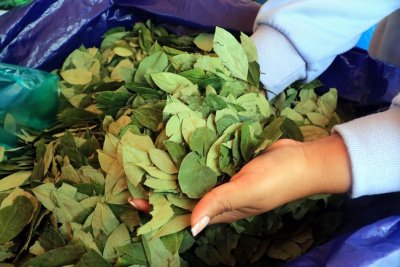
A woman shows coca leaves during an event for the National Day of Acullico (chewing of the plant) in Santa Cruz, Bolivia, in January. Then-Bolivian President Luis Arce said his countrymen have shown the world that the coca leaf ‘is not cocaine, File Photo by Juan Carlos Torrejon/EPA
Dec. 17 (UPI) — The government of President Rodrigo Paz said it will push to revise Bolivia’s legal framework for coca leaf cultivation after official data showed that planted areas exceed authorized limits and continue to expand.
According to the 2024 Coca Crop Monitoring Report by the United Nations Office on Drugs and Crime, presented in La Paz, Bolivia ended 2024 with about 34,000 hectares of coca crops, a 10% increase from the previous year.
That figure exceeds by 12,000 hectares the cap set by the 2017 General Law of Coca, which authorizes 22,000 hectares for legal cultivation.
Coca leaf is recognized in Bolivia’s Constitution for traditional, medicinal and cultural uses, but part of the production is diverted to cocaine manufacturing, the report said.
Earlier this month, the World Health Organization decided to keep coca leaf on its list of controlled substances, citing the risk to public health posed by its easy conversion into cocaine.
Against that backdrop, the Office on Drugs and Crime urged the Paz administration to strengthen control strategies, particularly in protected areas, and to update data on domestic demand for licit consumption.
Vice Minister for Social Defense and Controlled Substances Ernesto Justiniano said the government plans to amend the law, but said new parameters will depend on a fresh study to determine how much coca is needed for traditional use in Bolivia, according to local newspaper El Deber.
“Bolivia has more coca than it needs for traditional uses. Crops have not stayed at 22,000 hectares. By 2024, they were at 34,000, and in the next report, we will probably be close to 40,000 hectares because very little was eradicated this year — barely 1,700 hectares,” Justiniano said.
He said he recalled a study released in 2013 estimated that 14,700 hectares were sufficient for legal consumption, but that the limit was raised to 22,000 hectares in 2017 — a decision the new government now questions as lacking “technical justification,” the outlet ERBOL reported.
At the same time, the government said the eradication of illegal coca crops will again become a central pillar of its anti-drug strategy, with a focus on what it calls surplus production feeding drug trafficking.
To prepare the new study on domestic demand for coca leaf, authorities said they will invite representatives from coca-growing groups, academic institutions and other sectors to ensure transparency of the data.
Officials expect that once the findings are released, negotiations will begin with coca growers from the Chapare, a coca-producing region in central Bolivia.
Justiniano said farmers there blocked eradication efforts this year, mainly in the tropical Cochabamba region, an area widely regarded as the political stronghold of former President Evo Morales.