establishes

Israel launches new raids in Syria’s Quneitra, establishes checkpoints | Conflict News

Syrian state television denounces the Israeli incursion as another violation of the nation’s sovereignty.

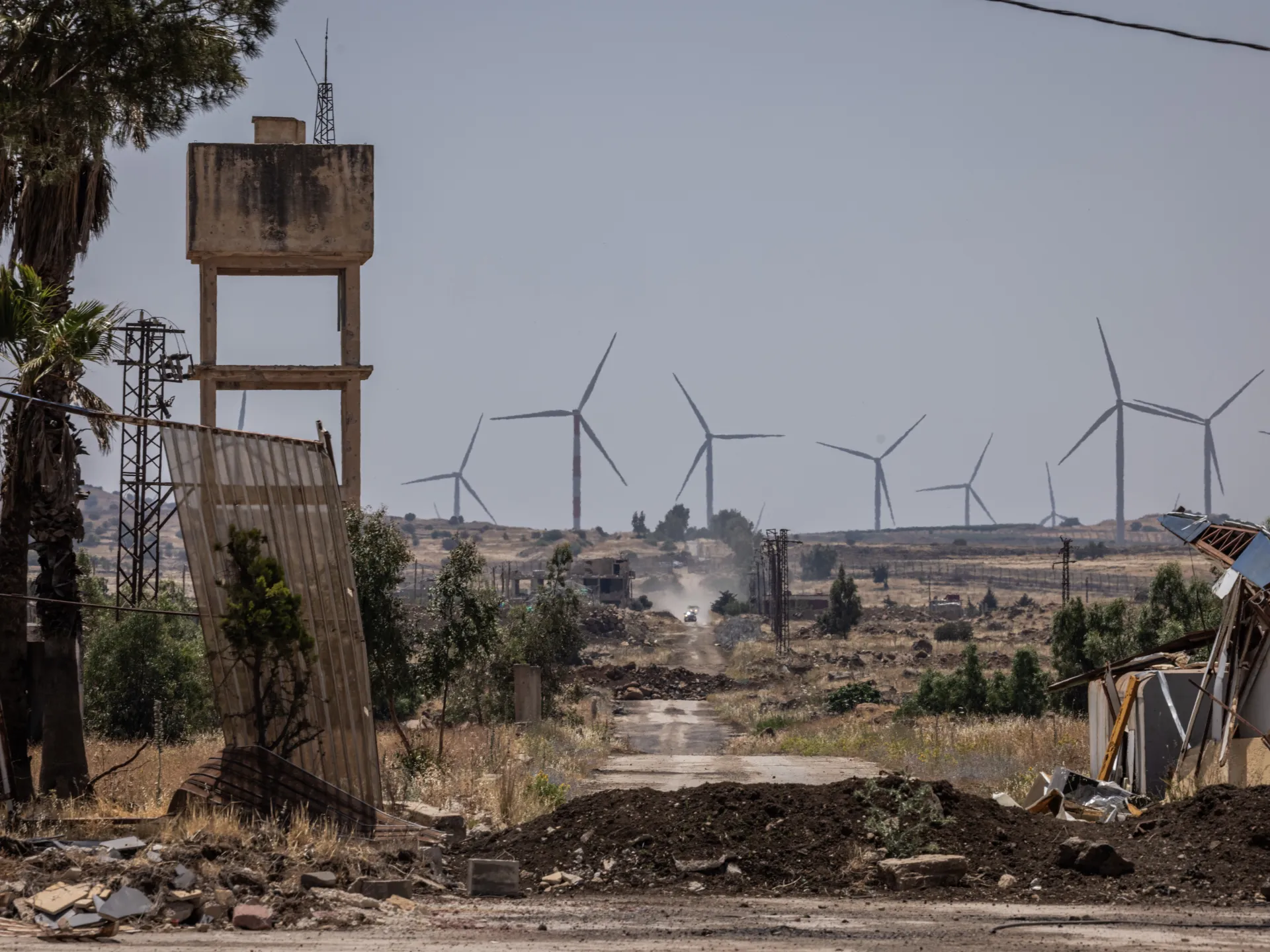
Israeli forces have advanced into the Quneitra area of Syria’s occupied Golan Heights and set up two military checkpoints, an Al Jazeera correspondent on the ground reports.

The Israeli military operation on Saturday took place in the villages of Ain Ziwan and al-Ajraf in the southern part of the country.

Recommended Stories

list of 4 itemsend of list

For months, Israeli forces have conducted near-daily incursions into southern Syria, particularly in the Quneitra governorate, carrying out arrests, erecting checkpoints, and bulldozing land, all of which have prompted growing public anger and unrest.

Syrian state television said the Israeli incursion was a violation of Syrian sovereignty, noting that the army used five military vehicles to set up the checkpoint in Ain Ziwan.

The latest raid comes one day after Israeli forces advanced towards the towns of al-Asha, Bir Ajam, Bariqa, Umm al-Azam and Ruwayhina in the southern Quneitra countryside, according to the Syrian News Agency (SANA).

Dozens of Syrians on Friday protested the Israeli incursion in the city of al-Salam in the Quneitra Governorate, condemning the ongoing Israeli attacks against citizens and their properties.

The demonstrators, part of a group called “Syrians with Palestine”, held banners denouncing what they stated were repeated Israeli violations of Syrian lands.

Despite a reduction in direct military threats, the Israeli army continues to carry out air raids that have caused civilian casualties and destroyed Syrian army sites and facilities.

Over the past year, Israel has launched more than 600 air, drone or artillery attacks across Syria, averaging nearly two attacks a day, according to a tally by the Armed Conflict Location and Event Data (ACLED).

Israeli military incursions have become more brazen, more frequent and more violent since Israel expanded its occupation of southern Syria following the ousting of President Bashar al-Assad in December 2024.

Disengagement accord

After al-Assad’s fall, Israel declared the 1974 Disengagement Agreement – brokered after the 1973 war, in which Syria failed to regain the occupied Golan Heights – void.

The agreement had established a UN-patrolled buffer zone, which Israel has since violated, advancing deeper into Syrian territory.

Citing al-Assad’s flight, Israel says the accord no longer applies, while carrying out air raids, ground incursions, reconnaissance flights; setting up checkpoints; and arresting or disappearing Syrians. Syria has not responded with attacks.

In September, Syrian President Ahmed al-Sharaa stated that Israel had conducted more than 1,000 air attacks and more than 400 ground incursions in Syria since al-Assad was overthrown, describing the actions as “very dangerous”.

Syrians believe that the continuation of these violations hinders efforts to restore stability in the region and undermines attempts to improve the economic situation in southern Syria.

Al Jazeera visited Quneitra in recent weeks and spoke to Syrians about Israeli incursions and abductions there, which have stoked fears.

Syria and Israel are currently in talks to reach an agreement that Damascus hopes will secure a halt to Israel’s air raids on its territory and the withdrawal of Israeli troops who have pushed into southern Syria.

In the background, the United States has been pushing diplomatic efforts to restore the 1974 deal.

Source link

FIFA establishes new World Cup ticket tier with $60 prices

FIFA announced an affordable admission pricing tier for every nation that’s qualified for the 2026 World Cup co-hosted by the U.S., Canada and Mexico. The supporter entry tier will make tickets available at a fixed price of $60 for every match, including the final, for each nation’s participating members associations.

The new tier comes after supporters’ groups from Europe called out FIFA on the dynamic pricing of tickets, which changes the value based on the popularity of the teams playing in each match.

“In total, 50% of each PMA allocation will fall within the most affordable range, namely supporter value tier (40%) and the supporter entry tier (10%),” FIFA said in a statement on Tuesday. “The remaining allocation is split evenly between the supporter standard tier and the supporter premier tier.”

FIFA will also waive the administrative fees for fans who secure participating member association tickets, but their teams do not advance and they seek refunds.

Tickets sales were rolled out by FIFA in phases, with a third of the tournament’s inventory claimed during the first two phases. The third phase started on Dec. 11 and will go through to Jan. 13. During this period, fans have the opportunity to allocate tickets for a match based on a random selection draw.

Before the new tier was introduced, the cheapest ticket for the World Cup final in MetLife Stadium in New Jersey would cost fans more than $4,000. The high prices raised concerns among European supporters.

“The prices set for the 2026 World Cup are scandalous, a step too far for many supporters who passionately and loyally follow their national sides at home and abroad,” the FSA, an organization of supporters for England and Wales, said in a statement posted on its website on Dec. 12. “Everything we feared about the direction in which FIFA wants to take the game was confirmed — Gianni Infantino only sees supporter loyalty as something to be exploited for profit.”

FIFA previously stated it adopted the variable pricing because it was common practice for major North America sporting events.

“What FIFA is doing is adapting to the domestic market,” a FIFA official said in the conference call. “It’s a reality in the U.S. and Canada that events are being priced as per the demand that is coming in for that event.”

A FIFA official told reporters before the first tickets went on sale that world soccer’s governing body expects to make more than $3 billion from hospitality and tickets sales and is confident the tournament will break the all-time World Cup attendance record set in 1994, the last time the competition was held in the U.S.

That 1994 World Cup featured just 24 teams and 52 matches. The 2026 tournament will be twice as large, with 48 teams and 104 games.

FIFA said it received 20 million requests during the random selection draw sales.

SoFi Stadium will host eight matches, beginning with the U.S. opener against Paraguay on June 12. The Americans will finish group play in Inglewood on June 25, playing the winner of a March playoff involving Slovakia, Kosovo, Turkey and Romania. Two Group G matches — Iran vs. New Zealand on June 15 and Iran-Belgium on June 21 — also will be played in SoFi, sandwiched around a Group B match between Switzerland and the winner of another European playoff, this one featuring Wales, Bosnia and Herzegovina, Italy and Northern Ireland.

The teams for the three knockout-stage games to be played at SoFi Stadium — round-of-32 games on June 28 and July 2 and a quarterfinal on July 10 — haven’t been determined, but the possibilities include Mexico, South Korea, Canada, Spain, Austria and Algeria.

Staff writer Kevin Baxter contributed to this report.

Source link