California opposes Trump administration plan to pump more delta water
The Trump administration plans to weaken environmental protections for threatened fish in California’s Sacramento-San Joaquin River Delta and pump more water to Central Valley farmlands, according to letters obtained by the Los Angeles Times.
The letters show Gov. Gavin Newsom’s administration strongly criticizing the Trump administration plan.
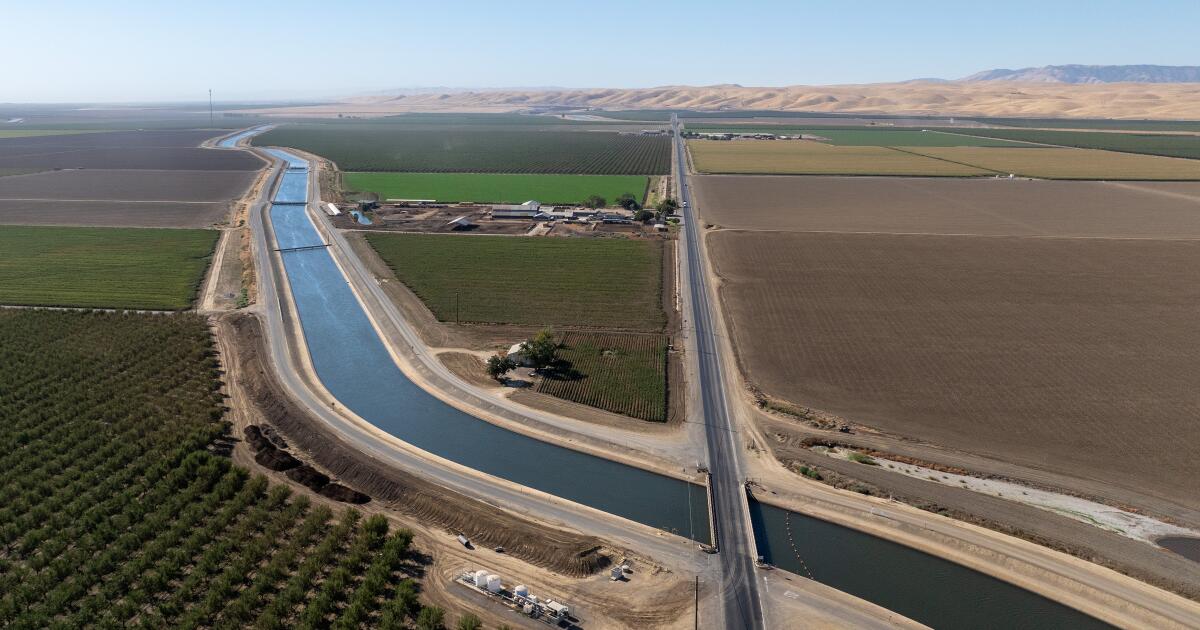
The U.S. Bureau of Reclamation recently notified California agencies that it plans to pump more water out of the delta into the southbound aqueducts of the federally operated Central Valley Project. That would send more water to farmlands and communities across the San Joaquin Valley.
The proposal advances a January executive order by President Trump and weakens protections for several kinds of fish whose populations have declined significantly in recent years.
Three state agencies objected to the plan in letters to the Bureau of Reclamation last month, signaling a new round of confrontation with the Trump administration over how California’s giant water systems should be operated.
The push to send more water to farms is supported by some growers in the Central Valley, who have long condemned state policies as harmful to agriculture. For years, drivers on the valley’s highways have seen their signs and billboards with slogans such as “Stop Dumping Our Farm Water & Jobs In the Ocean.” Trump has questioned why the state should keep more water in rivers to help “a tiny little fish” such as the delta smelt.
But California officials warned the Trump administration that pumping more water into the federal aqueducts will bring significant negative consequences for fish and the delta environment.
The federal proposal would increase water withdrawals in dry years as well as wet ones, leading to less water in the delta, which would cause “significant impacts to native fish species,” Diane Riddle, an official of the State Water Resources Control Board, said in one letter.
She said modeling estimates show that the Trump administration proposal would particularly harm fish during dry years, “when species are already stressed by dry conditions.”
State and federal pumping plants in the delta, which send water into the canals of the State Water Project and the Central Valley Project, often have to limit operation to leave enough water for threatened and endangered fish. Fish die when the massive pumps, which are powerful enough to regularly reverse the flow of water in the south delta, pull them into shallow waters, where they are easy prey for nonnative bass and other predators.
The California Department of Fish and Wildlife wrote that it is concerned about weakened protections for winter-run and spring-run chinook salmon, steelhead trout, delta smelt and longfin smelt.
Joshua Grover, deputy director of the agency’s Ecosystem Conservation Division, said what protective measures remain under the federal proposal are either vague, unworkable or not based on the “best available science.”
State officials warned that in addition to harming fish, the plan could force reductions to what the state can deliver to millions of people in Southern California cities.
The State Water Project, which delivers delta water to 27 million Californians and 750,000 acres of farmland, “could be forced to reduce water exports” because of the increased federal pumping, John Yarbrough, the Department of Water Resources’ deputy director, said in a letter.
He said that would occur because even if the federal government increases pumping, the state agency still must comply with the federal Endangered Species Act as well as the California Endangered Species Act.
The Trump administration plan brings new uncertainty for cities that depend on delta water and could upend the cooperation between state and federal water agencies that has been the norm for decades.
Yarbrough reminded Adam Nickels, the Bureau of Reclamation’s acting regional director in California, that state and federal agencies “have a long history and shared interest in working together to maximize California water supplies while also protecting the environment in a legally defensible manner.”
The disagreements between the Newsom and Trump administrations raise questions about the fate of joint state-federal efforts including the so-called voluntary agreements, a Newsom-backed plan to give water agencies more leeway in how they comply with delta water rules. If the federal government is no longer a willing partner, that would leave the plan in question.
The federal plan is called Action 5. Yarbrough urged the Trump administration “to reconsider Action 5 and comply with the legal requirements regarding environmental review, endangered species restrictions” and an agreement that for decades has guided coordination between the state and federal agencies.
Trump similarly tried to alter California water regulations and policies during his first term. But when his administration adopted water rules that weakened environmental protections in the delta, California and conservation groups successfully challenged the changes in court.
That cleared the way last year for the Biden administration, working together with Newsom’s administration, to adopt new rules for operating California’s main water delivery systems, which are among the largest in the world.
In his January executive order, Trump criticized what he called “disastrous” policies and water “mismanagement” by California, and directed federal agencies to scrap the plan that the Biden administration adopted.
Environmental and fishing groups have also condemned the Trump administration’s attempts to take more water from the delta, saying the goal is to prioritize political supporters in the agriculture industry above the needs of other water users and the health of waterways and fish.
“The Bureau of Reclamation is slashing protections for salmon and other species that are struggling,” said Barry Nelson, an advisor to the Golden State Salmon Assn., a nonprofit group that represents fishing communities.
“Some salmon runs and other species are on the brink of extinction, and commercial salmon fishing in California has been closed for three years,” Nelson said. “Cutting already weak protections further would be disastrous.”
Noting that Newsom has stood up to the Trump administration on other issues, he urged the governor to file a lawsuit “to block this clearly illegal federal decision.”