Racing community pays tribute to Kyle Busch after untimely death at 41
Kyle Busch was one of NASCAR’s biggest stars and most successful drivers.
He was Cup Series champion in 2015 and 2019 and his 234 wins in NASCAR’s top three series is an all-time record.
The driver known as “Rowdy” and “Wild Thing” may have been known for brash behavior that included post-race fights and feuds with other drivers, but he was also respected as a fierce competitor and dedicated family man.
His death Thursday at age 41 came as a shock to the racing world. No cause of death has been disclosed.
“Our entire NASCAR family is heartbroken by the loss of Kyle Busch,” NASCAR said Thursday in a statement released jointly with the Busch family and his team, Richard Childress Racing. “A future Hall of Famer, Kyle was a rare talent, one who comes along once in a generation. He was fierce, he was passionate, he was immensely skilled and he cared deeply about the sport and fans.
“Throughout a career that spanned more than two decades, Kyle set records in national series wins, won championships at NASCAR’s highest level and fostered the next generation of drivers as an owner in the Truck Series. His sharp wit and competitive spirit sparked a deep emotional connection with race fans of every age, creating the proud and loyal ‘Rowdy Nation.’”
The statement concluded: “NASCAR lost a giant of the sport today, far too soon.”
Busch is survived by his wife Samantha, son Brexton, 10, daughter Lennix, 4, parents Tom and Gaye Busch, and older brother Kurt Busch, a NASCAR Hall of Fame inductee who was the Cup Series champion in 2004.

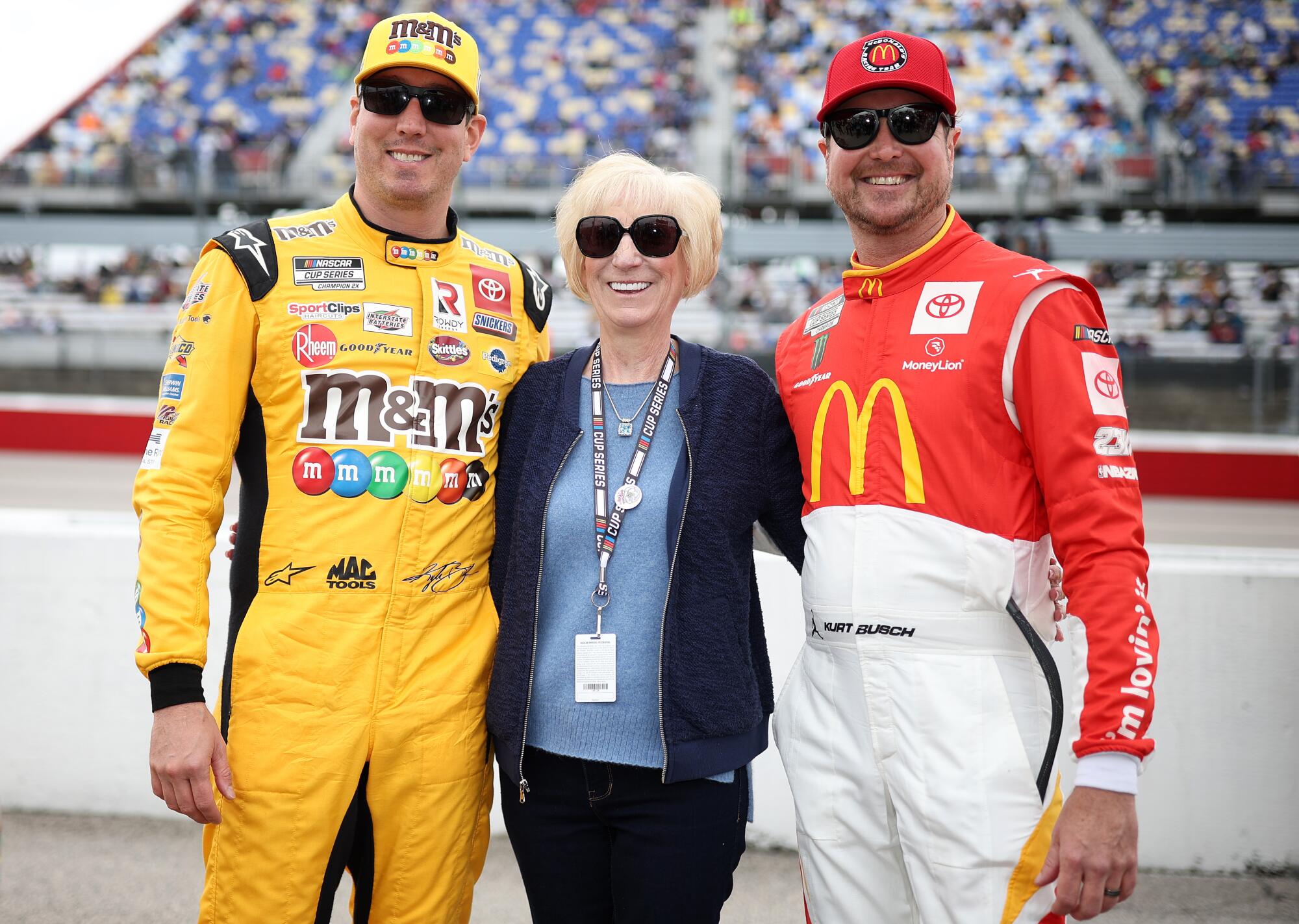
Kyle Busch, left, and Kurt Busch pose with their mother, Gaye Busch, prior to a race May 8, 2022, in Darlington, S.C.
(James Gilbert / Getty Images)
RCR announced Friday that it is suspending the use of Busch’s No. 8 and will run No. 33 in its place.
“Kyle Busch was instrumental in the design of RCR’s stylized No. 8 and it has become synonymous with Kyle and an important symbol for his fans and the NASCAR industry,” the team said in a statement. “No one can carry it forward to the level that he did. The No. 8 is reserved and ready for Brexton Busch when he is ready to go NASCAR racing.”
Busch spent the early years of his NASCAR career with Hendrick Motorsports.
“This is an incredibly painful shock for all of us and a heartbreaking loss for the NASCAR family,” team owner Rick Hendrick said in a statement. “Kyle was one of the most talented drivers I’ve ever seen and a racer in the truest sense of the word. He had a fire and competitive spirit that drove him to be great.
“I watched Kyle grow up in this sport and valued the friendship we shared long after he drove for our organization. As much as he loved to drive a race car, nothing brought him more joy than being a husband, a father and watching his son race.”
Busch won his first Cup Series race in 2005 and claimed rookie of the year honors the same year.

Jeff Gordon, left, talks with Kyle Busch prior to a race Oct. 30, 2016, in Martinsville, Va.
(Robert Laberge / Getty Images)
“Kyle was a fierce competitor who demanded the very best from himself each time he put on the helmet,” former Hendrick teammate Jeff Gordon wrote on X. “As teammates, I saw firsthand the passion and intensity he brought to the sport every single day. He was a champion and prolific racer who made a tremendous impact on NASCAR and was a lifelong advocate for all forms of motor sports.”
Fellow former Hendrick teammate Jimmie Johnson wrote on X: “Kyle Busch wasn’t just one of the fiercest competitors our sport has ever seen, he was one of the most talented race car drivers I’ve ever shared a track with. We spent years as teammates at Hendrick Motorsports, and even as competitors, there was always a deep respect for what he could do behind the wheel.
“Kyle pushed all of us to be better. His passion, intensity, and love for racing were unmatched, and his impact on this sport will be felt forever. I’ll always remember the many laughs and conversations away from the spotlight, and most importantly the way he cared so deeply about his family. …
“NASCAR lost one of its greatest talents today, and we’ve all lost a friend.”
Busch was let go by Hendrick Motorsports after the 2007 season, making room for the team to sign Dale Earnhardt Jr.
“Kyle and I had a really challenging existence for many years,” Earnhardt wrote on X. “But we luckily took the time to figure out our differences and that was something he instigated with a conversation in his bus around how we each managed our racing teams. I was super eager for us to get on better terms. But it was he who made the effort for that to be possible.”
Earnhardt added: “Kyle was one of the greatest drivers in NASCAR history. No one can deny that. But he was also a father, a husband, brother, son, and a friend to many. My heart is broken for the Busch family. I will never be able to make sense of this loss but I am thankful that we had found a way to become friends.”
Busch then moved to Joe Gibbs Racing, where he remained until 2023 and saw much of his career success.
“Kyle was a fierce competitor, an incredible teammate, and, far more importantly, a devoted husband, father, and son,” Joe Gibbs Racing said in a statement. “His impact on our organization and on the sport of NASCAR will never be forgotten.”

Kyle Busch, left, stands in the garage with Denny Hamlin before a practice Oct. 11, 2007, in Concord, N.C.
(Streeter Lecka / Getty Images)
Former JGR teammate Hamlin wrote on X: “Absolutely cannot comprehend this news. We just need to think of his family during this time. We love you KB.”
Busch was ranked 24th in the Cup Series this year, with his best finish being eighth place at Watkins Glen International in Dix, N.Y., on May 10. He also was racing part-time for Spire Motorsports in the Craftsman Truck Series. He had two victories in that series this season, including one last week at Dover Motor Speedway in Delaware.
“Simply put, he was one of the best to ever do this,” Spire Motorsports co-owner Jeff Dickerson said in a statement. “But for those closest to him, there was always another side. For years, many of us would tell people there was a softness behind the public persona they rarely saw. As much of a bad ass as he was on the track, some of us were lucky enough to experience how deeply he loved, how much he cared, and yes, how much he hurt. …
“We used to tell people about that side of him, and some would assume we were just trying to reshape public perception. No one could question it now. By now, the world has seen the incredible devotion he had to being a father to Brexton and Lennix. He loved his kids more than anything. The pride in his voice whenever he talked about them is something I will always remember with gratitude. … My heart absolutely breaks for you, Brexton and Lennix.”
Here are more tributes to Busch posted on X by members of the racing community:
— “I made him earn every victory and stole a few from him along the way,” Brad Keselowski wrote. “We took our shots at each other, in the media and on the track. But I’d like to think that somewhere deep down there was an appreciation that we pushed each other to perform at the highest level, even if neither of us would’ve admitted it. Tonight, I feel a little like the coyote with no more roadrunner to chase. His loss is all of our loss, but none more so than his family’s.”

Kyle Busch, left, and Clint Bowyer sit together in the garage during practice Sept. 21, 2007, in Dover, Del.
(Russ Hamilton / Associated Press)
— “There aren’t really words for today,” Ricky Stenhouse Jr. wrote. “I’ve raced against Kyle for a long time, and anyone who’s lined up next to him knows exactly what made him special, he gave you everything he had, every single lap, and he made all of us better for it. But more than the wins and the records, I keep thinking about Samantha, Brexton, and Lennix, and the entire Busch family right now. That’s where my heart is. Rest easy, Rowdy. The sport won’t be the same without you.”
— “I just talked to him Friday,” Clint Bowyer wrote. “In complete shock, as we all are. The devastation and sadness is beyond words. Praying for Samantha, Brexton, Lennix, his entire family and loved ones.”
— “I’m so sad and stunned to hear the news about KB,” William Byron wrote. “He meant so much to a lot of people, not just myself. Kyle was the best mentor you could ever have. He was incredibly unselfish, cared about his people and his family deeply. And helped shaped my career to what it is. I’m heartbroken.”