diocese

In O.C., a Jesus artifact becomes a theme-park-like attraction

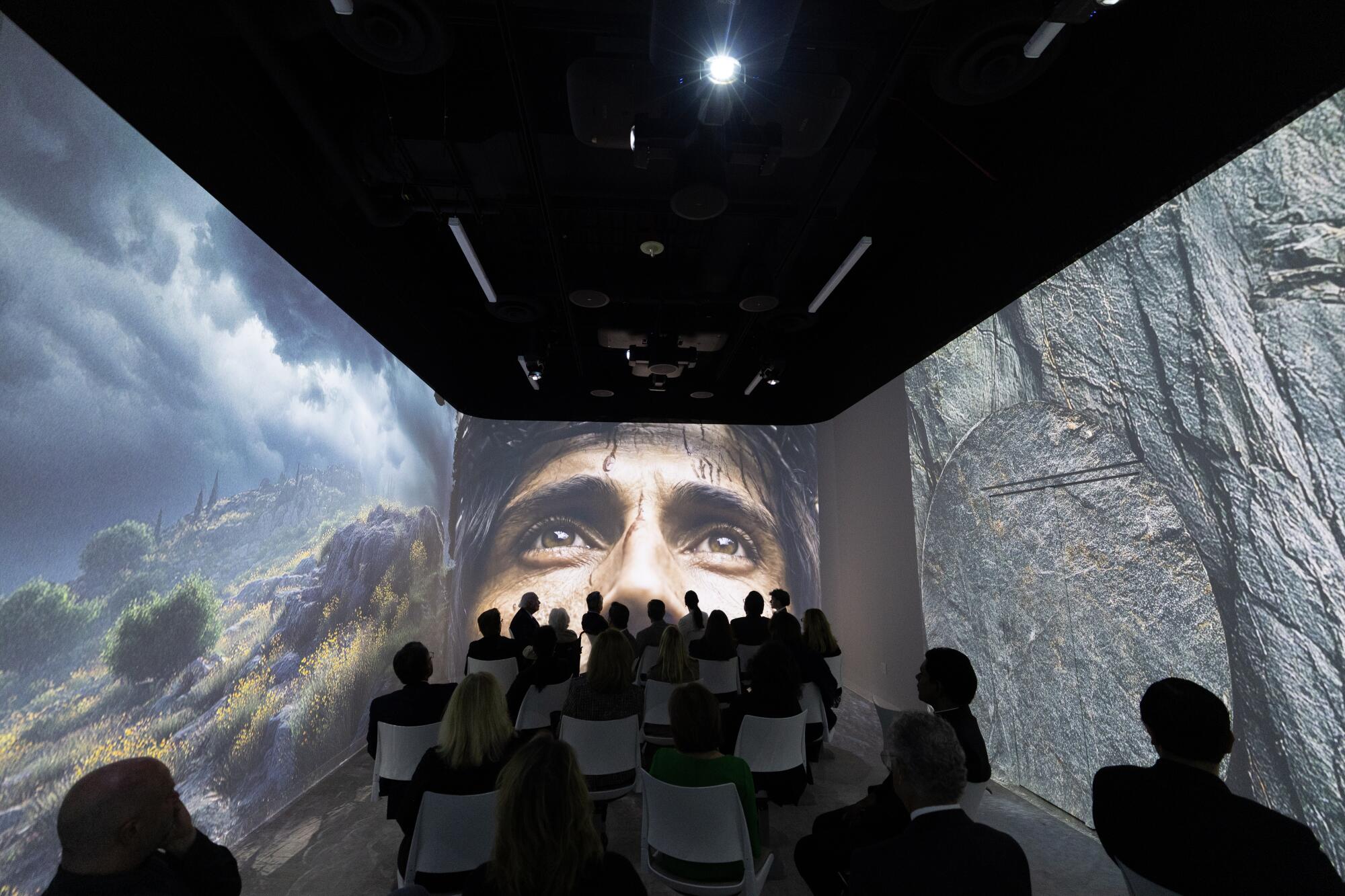
On the second floor of a cultural center at Christ Cathedral in Orange County, an AI-rendered depiction of Jesus, calm and smiling, fills one side of the room. Breaking a piece of flatbread in two, he passes it to the 12 similarly enlarged men projected on all four walls around him. On the ground are images of heaping plates of food — roast lamb, vegetables, olives and dips.

“Take and eat,” the AI Jesus says. “This is my body.”

In the center of the room, real-life visitors arrayed on 26 swivel chairs turn their heads back and forth to take in the supersized Last Supper occurring all around them. Already, they have been plunged into the sea of Galilee watching as Jesus walked on water and witnessed his transfiguration on a mountain top. It was all part of what’s being touted as “a museum unlike any other, where faith and forensics meet.”

Visitors view an image of Jesus on an immersive screen.

Visitors watch a 360-degree, AI-rendered video depicting the life of Jesus as told in the Gospels at the opening of the Shroud of Turin Experience at Christ Cathedral.

(Allen J. Schaben / Los Angeles Times)

Located five miles from Disneyland on the campus that once housed televangelist Robert Schuller’s Crystal Cathedral Ministries, the Shroud of Turin Experience is Orange County’s newest tourist attraction with a Christian twist. The 10,000-square-foot exhibit, which opened to the public last week, uses digital projection, artificial intelligence and special effects to introduce visitors to the life of Jesus as depicted in the Gospels with a focus on the mysterious linen burial cloth that believers say wrapped his body after the crucifixion.

“It’s a little Disney-esque, but we really want you to feel like you are in these scenes,” said Pat Powers, a financial adviser who helped raise money for the exhibit. “We want the whole experience to be visually overwhelming.”

Powered by technological advances and a consumer desire for in-person connection, immersive experiences are reinvigorating the way businesses and organizations connect with new audiences and the Catholic Church has taken note. From the viral success of Van Gogh: The Immersive Experience which arrived in L.A. in 2021 to the 360-degree entertainment at the Sphere in Las Vegas, young people in particular are seeking new and dynamic ways of interacting with their entertainment. Now, as the Catholic Church seeks to connect with a new generation of Christians who may be unfamiliar with the Biblical Jesus and the mystery of the shroud, religious and lay leaders are exploring digitally enhanced ways of bringing people to faith.

Patrons use an interactive screen.

An interactive screen at the Shroud of Turin Experience allows guests to zoom in on details of the shroud of Turin, a mysterious linen cloth which some believe covered Jesus after his death.

(Allen J. Schaben / Los Angeles Times)

“We want to speak to people the way they are used to being spoken to today and in a way they can absorb,” Powers said.

Organizers said the desire to outfit the exhibit with digital bells and whistles came directly from the top. The Diocese of Orange only agreed to sign off on the privately funded project after organizers promised it would offer interactive elements beyond text and images.

“I said no static pictures, too boring,” said Bishop Timothy Freyer, auxiliary bishop of the diocese. “Posters on the walls wasn’t going to do it.”

Now, signs around the 34-acre Christ Cathedral campus where the Diocese of Orange is located advertise “The Shroud of Turin Experience” as if it were a summer blockbuster: “Discover the blood. Uncover the mystery. Encounter the light.”

Roughly 14 feet long and three feet wide, the shroud of Turin is one of the most scientifically studied and contested religious objects in the world — a holy relic to some and a medieval forgery to others. Scarred by burn marks and water stains, the narrow sheet of linen features hundreds of blood stains consistent with the wounds Jesus suffered at the time of his death. Even more mysteriously, it bares the faint image of a bearded man that some Christians believe provides physical evidence of Jesus’ resurrection. The Catholic Church has not taken an official position on the shroud’s veracity, but the exhibit’s organizers find the evidence for its divine provenance convincing and hope others will too.

A replica of the shroud of Turin at the immersive experience.

A bronze statue of Jesus lies in front of an enlarged photo negative image of the face detail on the shroud of Turin.

(Allen J. Schaben / Los Angeles Times)

“Our position is that the shroud offers evidence of the resurrection, but not proof,” said Nora Creech, a shroud scholar who helped organize the exhibit. “The goal is to lead people in and let them go on their own journey.”

Visitors will not be able to see the actual shroud of Turin. It hasn’t left its long time home of St. John the Baptist Cathedral in Turin, Italy, for centuries. However, with the bishop of Turin’s blessing, organizers were able to procure a high-resolution, full-sized replica. Docents at the exhibit will show visitors how to change their iPhone camera settings to create what looks like a photo negative, making it easier to see the shadowy figure on the cloth.

“Kids always think that’s cool,” said Creech.

The exhibit costs $20 for adults, and organizers say visitors should budget at least 90 minutes to make their way through it. In the first of three immersive rooms, a dizzying 360-degree video introduces guests to the story of Jesus’ life from his baptism to the crucifixion — including that jumbo last supper. At the end of the 20-minute film, a projected rock rolls away from a door leading into a second room designed to look like Jesus’ tomb, complete with a prone figure lying on a stone altar, draped in a white cloth. There guests watch an 18-minute documentary detailing the scientific research on the shroud before moving on to a third “chapel” room where a video animated by AI shares stories from the Bible of sightings of Jesus after his death.

Patrons attend the opening of "The Shroud of Turin: An Immersive Experience."

Patrons view a supersized image of Christ on the cross.

(Allen J. Schaben / Los Angeles Times)

The second half of the exhibit is more traditional. Guests can examine several instruments of torture that were reportedly used to inflict pain on Jesus, including replicas of the nails used for crucifixion, the crown of thorns that adorned his head, and the double-edged blade of a Roman lance that pierced his side. Interactive features include a kiosk that digitally separates each level of the shroud so visitors can examine just the blood stains, just the burn marks or just the shadowy image. Those who want a really deep dive on the shroud can interact with a virtual Father Spitzer, president of the Magis Center on Reason and Faith and a local expert on the shroud, to hear pre-recorded answers to questions like “What evidence suggests a supernatural cause was necessary for the image formulation on the shroud” and “How do neutrons explain the shroud’s exceptional resistance to aging and solvents?”

The final room of the exhibit is designed for reflection and includes a life-sized bronze statue of Jesus created by Italian artist Luigi Enzo Matte, according to the dimensions of the image on the shroud.

Although there is a clear religious bent to the entire experience, Creech said the exhibit, expected to remain at Christ Cathedral through at least 2030, is designed to share information on the life of Jesus and the shroud, but not necessarily to convert anyone.

“I think we can convince people that the shroud is the shroud that wrapped the physical body of Jesus,” she said. “But Jesus stresses the importance of belief. To proclaim that Jesus is our lord and savior is an act of faith that everyone has to take on their own.”
Source link

Commentary: Can opposing Trump’s deportation machine help Catholic Church regain its moral mojo?

When millions of European immigrants came to the United States in the 19th century only to be scorned by mainstream society, it was the Catholic Church that embraced them, taught that keeping the customs of one’s native lands was not bad and created systems of mutual aid and education for the newcomers that didn’t rely on the government.

The 1960 election of John F. Kennedy, an Irish American Catholic, showed that the U.S. was ready to expand its definition of who could become president. Labor organizers like Cesar Chavez, Dorothy Day and Mother Jones pushed for the dignity of workers while frequently citing the woke words of Jesus — the Sermon of the Mount and the Beatitudes among the wokest — as the fuel for their spiritual fire.

Catholicism is the faith I was baptized in, the one I embraced as a teen and that’s the bedrock for my moral code of comforting the afflicted and afflicting the comfortable. My work desk covered with statues and devotional cards of Jesus, Mary and the saints is a physical testament to this.

But I’m also one of the 72% of U.S. Catholics that a Pew Research Center survey from earlier this year. found don’t attend weekly Mass, which we’re obligated to do.

I stopped going early on in my adulthood because the Church became something I didn’t recognize.

The bishops and cardinals who preached we should follow Jesus’ admonition we should tend to the least among us presided over a child sex abuse scandal in the 1990s and 2000s that cost parishioners billions of dollars in legal settlements and their ethical high ground. The obsession that too many of those same church leaders had over abortion and homosexuality — which Christ never talked about — over social justice matters during the Obama administration left me disappointed. Their continual condemnation of pro-choice Catholic Democratic politicians like Nancy Pelosi and Joe Biden for taking Communion while staying silent about Donald Trump’s constant violations of the Ten Commandments was rank hypocrisy.

The Pew Research Center found 55% of my fellow faithful voted for Trump. Key Catholics have blessed Trump’s uglier tendencies: A majority of them rules over our revanchist Supreme Court while the president’s team features a vice president who’s a convert and a rogue’s gallery of influential insiders that bear surnames from previous generations of Catholic diasporas — Kennedy, Rubio, Bovino, Homan among the worst of the worst.

Yet I remain a Catholic because you shouldn’t turn your back so easily on institutions that formed you and you don’t cede your identity to heretics. The election of Pope Leo XIV, the first American to head the Holy See, to succeed Pope Francis stirred in me the sense that things might change for the better as our country worsens.

Now, without naming him, the U.S. Catholic hierarchy has rebuked Trump on his signature issue and one close to my heart in a way that shows my hope hasn’t been in vain.

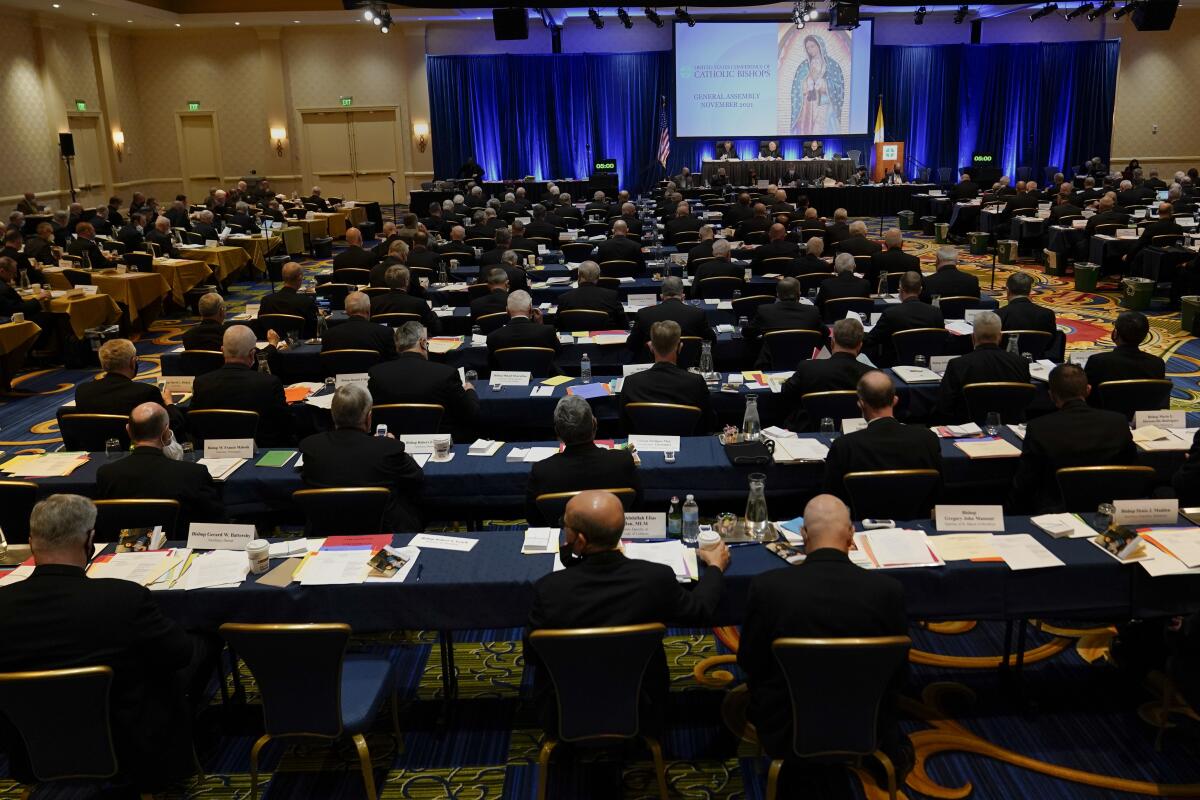
Clergy attend the Fall General Assembly meeting of the United States Conference of Catholic Bishops

Clergy attend the 2021 Fall General Assembly meeting of the United States Conference of Catholic Bishops in Baltimore, Md.

(Julio Cortez/Associated Press)

This week the United States Conference of Catholic Bishops released a so-called “special message” to blast Trump’s deportation Leviathan, decrying its “vilification of immigrants” “the, indiscriminate mass deportation of people” and how hundreds of thousands of residents have “arbitrarily lost their legal status.” Citing passages from across the Bible — the Gospel, the Old Testament, the Letters of Paul — to argue for the human worth of the undocumented and the holy mandate that we must care about them, it was the first time since 2013 that American bishops collectively authored such a statement.

Even as a majority of U.S. Catholics have gone MAGA, support for the special message was overwhelming: 216 bishops voted in favor, 5 against, and there were 3 abstentions. Their missive even concluded with a shout-out to Our Lady of Guadalupe, the brown, pregnant apparition of the Virgin Mary who’s the patroness of the Americas for Catholics.

Talk about someone who would get deported if la migra saw Her on the street.

The cruelty this administration has shown throughout its deportation campaign — families torn apart as easily as the Constitution; U.S. citizens detained; wanton federal violence that a federal judge in Chicago described as “shock[ing] the conscience” — has become one of the most pressing moral issues of our times. The call by Catholic bishops to oppose this wrong is important — so like a voice crying in the wilderness, the church must set an example for the rest of the country to follow.

This example already is being set in parishes across Southern California.

Priests and deacons have marched at rallies and prayed for those detained and deported from Orange County to downtown L.A. and beyond. Dolores Mission in Boyle Heights has let local activists stage know-your-rights workshops since Trump won last November. While L.A archbishop José H. Gomez and Diocese of Orange bishop Kevin Vann, the two most senior Catholic prelates in the region, have spoken out forcefully against immigration raids, some of their local brother bishops have pushed harder.

Diocese of San Bernardino Bishop Alberto Rojas has allowed Catholics who are afraid of la migra to skip Mass since July after immigration agents detained migrants on church property, arguing “such fear constitutes a grave inconvenience” for his flock. In San Diego, Bishop Michael Pham — who’s been in his seat for only four months — helped launch a program encouraging religious leaders to accompany migrants to immigration court to bear witness to the injustices inside and has participated himself.

Expect to hear gnashing of the teeth from the conservative side of church pews about how everyone should respect the rule of law and to render unto Caesar the things that are Caesar’s as if there ever was a Pope Donald. Already, Trump border czar Tom Homan has cried that the bishops are “wrong” for issuing their pro-immigrant letter and suggested they focus on “fixing the Catholic Church.”

But Homan’s dismissal and that of his fellow travelers doesn’t make the bishop’s admonition against Trump’s policies any more prophetic. The president’s immigration dictates are out of Herod — no less an authority than Pope Leo described them in October as “inhuman,” told a delegation of American bishops that “the church cannot remain silent” on those outrages and stated in a separate speech that such abuse was “not the legitimate exercise of national sovereignty, but rather grave crimes committed or tolerated by the state.”

The Catholic Church never will be as progressive as some want it to be. Even as the U.S. Conference of Catholic Bishops released its message, the group elected as its next president Diocese of Oklahoma City Archbishop Paul Coakley, whose public politics have so far mostly aligned with those of his deep-red state. But on the issue of dignity for immigrants during the Trump era, U.S. bishops have been on the right side of history — and God. They criticized Trump’s Muslim ban and his move to separate undocumented parents from their children during his first administration and have kept a watch on his attempt to cancel the Deferred Action for Childhood Arrivals program, which allows some people who came to this country as children to legally remain in the U.S.

We’re about to enter the Christmas season, a holiday based on the story of a poor family seeking shelter in an era when their kind was rejected by the powers that be and ultimately had to flee home. It’s the story of the United States as well, one too many Americans have forsaken and that Trump wants all of us to forget.

May Catholics remind their fellow Americans anew of how powerful and righteous standing up for the stranger is.

Source link