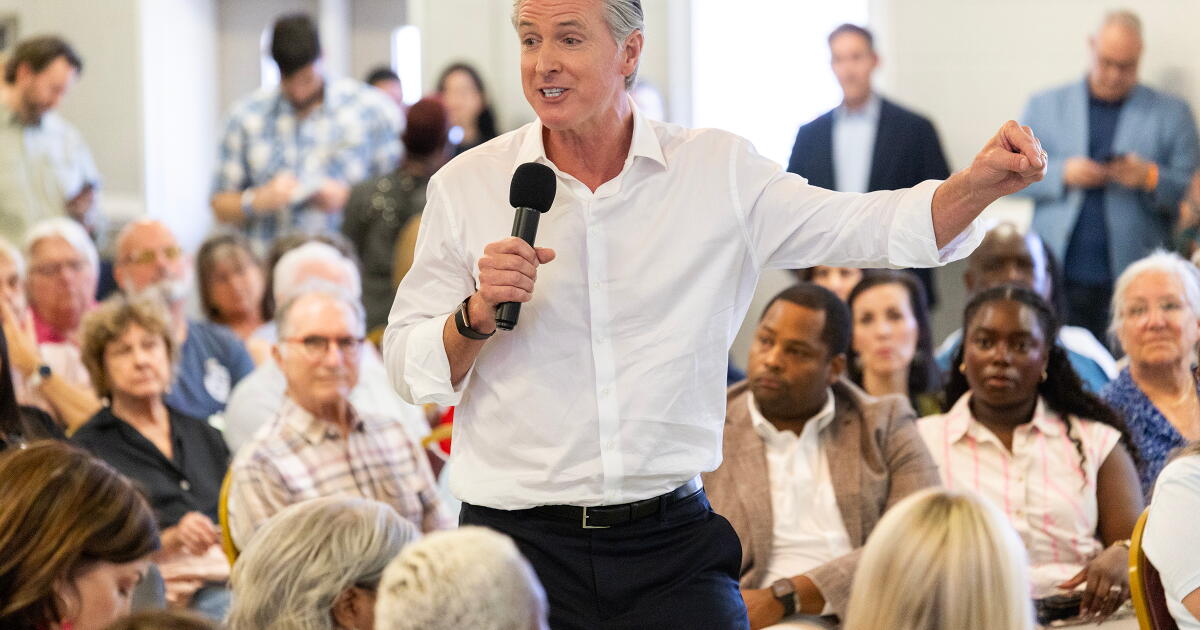
Newsom wants to empty death row. Most politicians wouldn’t bother — or dare
Courage in politics is rare.
It’s especially difficult and fraught for a politician such as Gavin Newsom, who has Oval Office ambitions and everything to lose from a misstep. Playing it safe is playing it smart.
On Thursday, Newsom took what can only be described as a courageous stand, a risky stand — commuting the death sentences of the 548 men and women condemned to die in California, and instead seeking to change their sentences to life without parole.
Many people will stop reading right now because honestly, do you care what happens to those on death row? They’ve raped, murdered, robbed, tortured — you name the heinous crime, one of them has done it. They are not the most sympathetic lot, and in truth many of us have ambivalent feelings on the death penalty.
It’s that ambivalence, that uncertainty, that makes Newsom’s move so interesting. We are in the most unlikely of moments — witnessing a self-inflicted test of political endurance from a savvy politician who didn’t need to go there. What happens in these strange days when a presidential hopeful takes an unnecessary risk simply because he believes it’s the right thing to do?
Newsom will be roasted by those claiming to be tough-on-crime types. They predictably will cry that he is circumventing the will of the people and disrespecting crime victims and juries. Some will say he cares more about criminals than victims. Fox News is going to have a field day.
Newsom has publicly pondered this decision for some time, calling it a “rocking chair” choice, one he’s likely to look back on someday to judge whether he lived up to his own ideals. He has said he is morally opposed to the state killing to prove killing is bad. As he terms out of office, he had only a couple of months left to take action on that belief before the power to end the largest death row in the Western Hemisphere slips out of his hands.
“Faithfulness to our values is measured by how we act when it’s most difficult to uphold them,” Newsom wrote in a letter to Californians announcing his decision. This, he said, was one of those moments for him.
“Americans are looking for leadership that is more principled,” civil rights attorney Bryan Stevenson told me, arguing Newsom’s move is actually in sync with the electorate. Stevenson is one of the people Newsom has talked to about the death penalty, and the founder of the Legacy Museum in Alabama, which traces the line from slavery to mass incarceration.
The shocking blue-wave midterms showed that Americans aren’t just tired of cruelty for cruelty’s sake, he said. They are tired of injustice, tired of selfish, self-serving leaders, tired of fearing that their own government might crush them simply because it can.
Across the country, voters elected political leaders who stood for something — who bucked the trends to run on their values and vision of a better America, even if it wasn’t mainstream or safe.
So whether Americans agree with Newsom’s decision to commute these sentences to life without parole or not, voters are at a moment when I suspect, as Stevenson does, that they may embrace his courage to stand for something, even if they don’t agree with what that something is.
The death penalty is the ultimate expression of that power of government to crush. Support for it has been mixed for years, even among liberals — though young people are less likely to back it. It has been banned in nearly every Western democracy including almost all of Europe, Canada and New Zealand.
Twenty-seven U.S. states either have abolished it or have gubernatorial moratoriums on it (Newsom enacted one in California a few years ago). And President Biden commuted the death sentences of most federal inmates in his final days of office, as have several other governors over the years.
There also has been a growing understanding in the U.S. that race bias is baked into how we use the death penalty. Black and brown people make up the majority of those on death row, and crimes in which the victim is white are more likely to draw the death sentence — even when we get it wrong.
More than 200 people on death row have been exonerated across the United States since the 1970s — including eight in California — meaning that for every eight people we have put to death, there has been one other who was going to be killed by the state until we figured out they were innocent.
So while there’s a moral argument to be made against the state killing people to prove killing people is wrong, there’s also a practical one: It turns out we’re really bad at imposing a lethal sentence fairly, or even correctly.
Vicente Benavides Figueroa is proof of that. After 25 years on death row, the justice system finally realized it had made a terrible error in his conviction. Figueroa wasn’t just railroaded into a lethal sentence — for the murder, rape and sodomy of a toddler — the crime itself likely never actually happened.
Figueroa was a seasonal farmworker, a Mexican immigrant with less than a high school education, who was watching his girlfriend’s kids in the Central Valley in 1991 when he lost track of the youngest, Consuelo, for 15 minutes. When he found her, she was in the front yard, unresponsive and vomiting.
One thing led to another — a “reckless” investigation, as his civil attorney Salomon Zavala, describes it; faulty translators; a mostly white jury who werefar from his peers; and erroneous medical testimony — and Figueroa was convicted. The machine of justice was so grinding that Figueroa did not understand he had been sentenced to death until he got to San Quentin.
Decades later, the doctors who claimed Consuelo was raped and sodomized would realize the injuries were likely because of trauma from medical workers attempting to insert an adult-sized catheter. They recanted. New experts, hired by the defense, theorized the child had been hit by a car, causing the extensive internal injuries that killed her. The witnesses now agreed the child never had been raped or sodomized.
Figueroa’s conviction was overturned by the state Supreme Court in 2018, citing false evidence in the original trial.
“No matter what your moral position is on the death penalty, I think we have to look at it from a standpoint of institutional responsibility,” Zavala, the lawyer, told me. “We have to really think about whether we, as a society, are comfortable with executing someone that could potentially be innocent.”
I’m of the mind that erroneously killing one person in the name of justice is one too many — that the death penalty is an unacceptable risk.
I take nothing away from, nor mean to diminish, the importance or pain of any victim, their story or their point of view. Their pain is real and enduring, and surely there will be some who feel Newsom’s decision robs them of some sort of final resolution.
But pain cannot define justice.
It’s easy to forget that Newsom is married to a survivor of violent crime, and knows as well as anyone how complicated and difficult and personal the journey to recovery is, and how that suffering affects not just victims, but also families and communities.
But whether or not the state should be in the business of killing has to be a bigger decision that we consider collectively in moments when we are not in distress.
Newsom’s decision does that, seeking to go beyond “these performative sentences that just represent a lot of fear and anger,” Stevenson said, and move our justice system toward one that lives up to the ideal of promoting safety and fairness over vengeance. And even then, the state Supreme Court will have a say in the majority of these clemencies, since Newsom needs their approval in cases where there are repeat felonies.
But it’s a can of worms he didn’t have to open — the clearest statement we’ll ever get of who Newsom is as a leader.
And it’s a welcome reminder that sometimes, occasionally, values still have a place in politics.