European markets drop, drink stocks sink after Trump tariff threat
Published on
•Updated
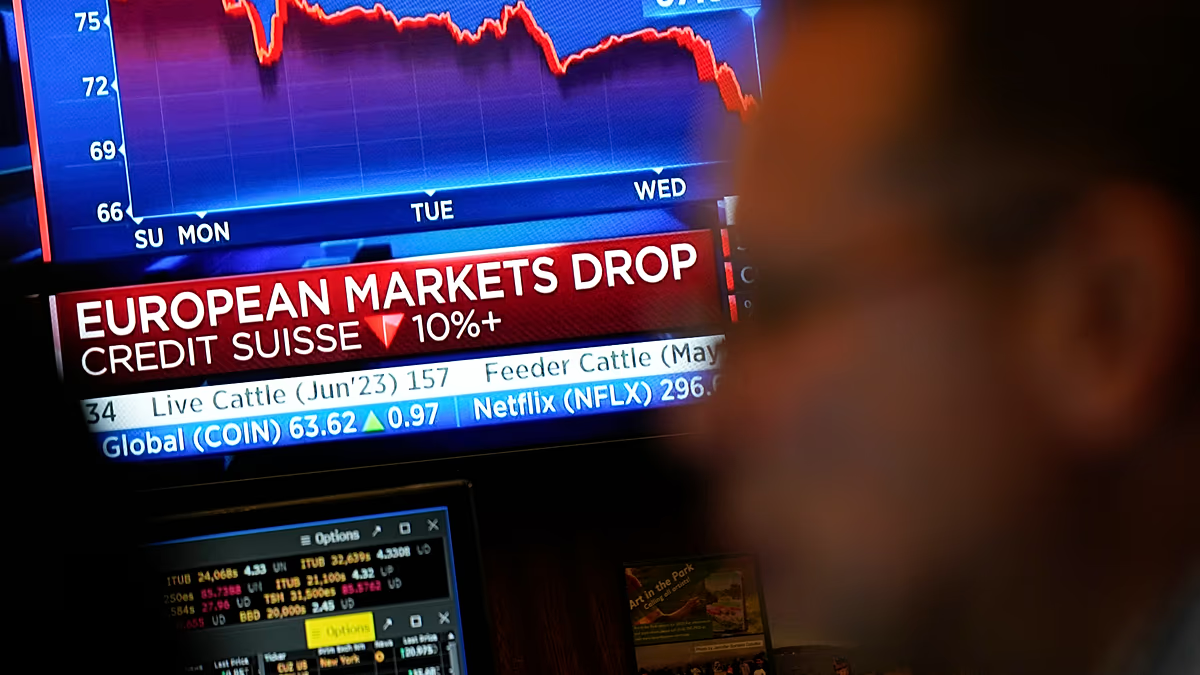
European markets are weathering their second day of heavy losses this week, with sell-offs persisting as EU-US trade tensions simmer.
At around 12pm CET, France’s CAC 40 was down 1.28%, Germany’s DAX slid 1.52%, Italy’s FTSE MIB dropped 1.49%, while Spain’s IBEX 35 fell 1.66%. The UK’s FTSE 100 was down 1.11%, while the broader STOXX 600 dipped 1.23%.
Investors are watching nervously as world leaders gather in Davos for the World Economic Forum’s annual summit, and US President Donald Trump doubles down on his intention to conquer Greenland — threatening extra tariffs on eight European countries that stand in his way.
While the targeted nations are mulling their retaliatory options, Trump added extra fuel to the fire on Monday evening. Following reports that French President Emmanuel Macron had rejected an invitation to sit on Trump’s so-called “Board of Peace”, the US leader commented: “I’ll put a 200% tariff on his wines and champagnes and he’ll join.”
The Board of Peace was an idea initially proposed by President Trump as part of his plan to end the war in Gaza, although the initiative now seems to be aimed at mediating global conflict more broadly.
President of the European Commission Ursula von der Leyen has branded Trump’s tariff threats “a mistake”. “The European Union and the United States agreed to a trade deal last July. And in politics as in business — a deal is a deal,” she said during a Davos address on Tuesday.
In light of the recent threats on winemakers, major French beverage firms saw their stock suffer on Tuesday. LVMH, which owns Moët & Chandon, Dom Pérignon, and Veuve Clicquot, dropped 2.57% in Paris, while Rémy Cointreau fell 2.83%.
The losses came after a rocky day of trading for European firms on Monday, with the luxury goods and automobile sectors taking a significant hit.
On Tuesday, the STOXX Europe Luxury 10 was trading 1.88% lower, and the STOXX Europe 600 Automobiles & Parts Index fell 0.89% by just after midday.
Is ‘Sell America’ back?
Ahead of Tuesday market opening in the US, S&P 500 futures were down 1.53%, while Dow Jones futures slipped 1.38%. Nasdaq futures tumbled 1.91%.
Against the euro, the dollar fell 0.71% to 0.8523. The Dollar Index, which tracks the greenback against six other currencies, traded 0.9% lower at 98.340. Such movements have once again raised fears of a ‘Sell America’ trade, meaning a major investor retreat from US assets, repeating a narrative that emerged last year in the wake of Trump’s ‘Liberation Day’ tariffs.
US Treasury Secretary Scott Bessent nonetheless sought to ease jitters at Davos on Tuesday. “I am confident that the leaders will not escalate, and that this will work out in a manner that ends up in a very good place,” he said.
“This is the same kind of hysteria that we heard on April 2,” he said. “There was a panic. And what I’m urging everyone here to do is sit back, take a deep breath, and let things play out.”
Yields on US bonds jumped on Tuesday, with the 10-year Treasury yield trading around six basis points higher at 4.291%. 20- and 30-year Treasurys also increased — making it more expensive for the government to service its debts.
Meanwhile, heightened demand for safe-haven assets gave a boost to precious metals, with gold and silver rising 3.04% and 7.97% respectively.
Only a select number of European stocks managed to escape the wider downturn on Tuesday. One standout performer was British fintech Wise, which rose around 14% after a strong earnings report. The firm said it was looking to move its primary listing to the US in the first half of this year as it seeks partnerships with American banks.