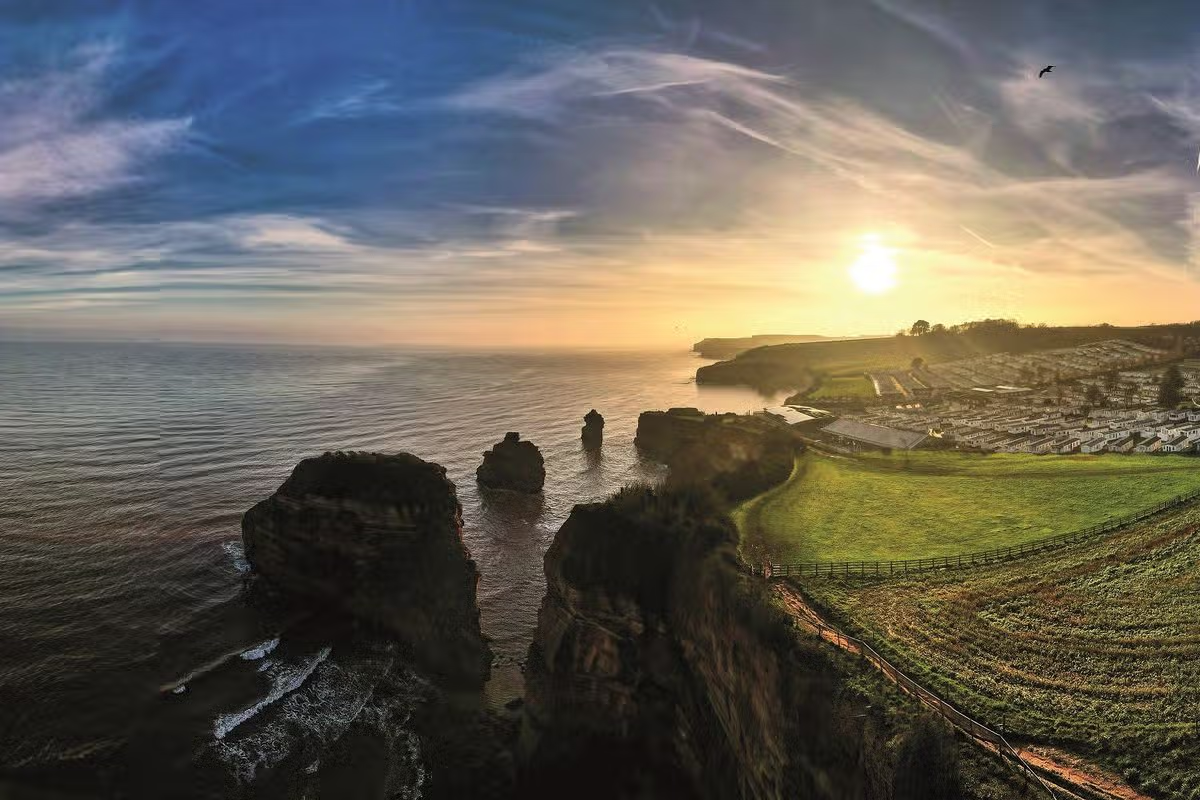
coastline

Canary Islands ‘on brink of disaster’ as 2.5 miles of coastline lost every year

The Canary Islands are experiencing a tourism crisis, with activists warning the coastline is unsustainable as locals say the ‘land is being destroyed and speculated on’

The Canary Islands have witnessed mounting demonstrations in recent years. Frustration has been building amongst residents, who argue the surge in tourism to the sun-soaked Spanish archipelago is unmanageable. They point to outdated regulations that allow property speculators to purchase land for hotels and holiday flats, while paying only minimal tax.

Consequently, Canarians claim they receive the lowest average salaries in Spain and face difficulties securing affordable accommodation. Yet now they have a further complaint against holidaymakers. The islands are suffering coastal erosion at an alarming pace. Campaigners say the Canary Islands’ coastline is on the brink of disaster.

Each year, based on a report from SOS Costas Canarias, approximately 21⁄2 miles of coastline disappears. Anne Striewe, the foundation’s director, states that hotels, apartment blocks, housing estates and marinas, amongst other structures, are being constructed on this “lost” territory.

The organisation cautions that throughout the eight islands, roughly 18% of the territory within the first 500 metres from the sea has already been developed. Beyond protected natural areas (PNAs), this figure skyrockets: it surpasses 40% on multiple islands and coastal sections, reaching 43% in Lanzarote and Gran Canaria.

Nearly 20% of the living space on the Canary Islands is dedicated to tourism – in comparison to around 4% on the Spanish mainland. Five municipalities on the Canaries possess more tourist beds than permanent inhabitants: Yaiza (Lanzarote), Pájara (Fuerteventura), Mogán (Gran Canaria), San Bartolomé de Tirajana (Gran Canaria) and Adeje (Tenerife).

Ms Striewe highlights that, beyond holiday accommodation, there is a vast array of tourist-related infrastructure including access roads, golf courses and desalination plants, which fail to show up in hotel occupancy figures yet remain part of the same problem.

Sharon Backhouse, director of GeoTenerife, told Sky News that the Canary Islands are a “biodiversity jewel in the Atlantic,” yet local authorities provide minimal protection for the islands’ natural habitats.

She warned that each year more “beautiful landscapes are cemented over” to make way for new tourist resorts.

She added: “The problem with these resorts is that we just don’t have enough resources in terms of water, what happens to all the rubbish, how is it all recycled.”

Carmelo Javier León, director of the UNESCO Chair in Tourism and Sustainable Economic Development at the University of Las Palmas de Gran Canaria (ULPCG), describes a conflict between those who wish to protect the islands’ natural beauty and “the development of ever more accommodation options.”

The authors of the SOS Costas Canarias report are demanding an immediate halt and the scrapping of planning permissions for undeveloped coastal land.

They argue that the seemingly relentless construction not only obliterates irreplaceable natural habitats and undermines the very scenic beauty that attracted tourists to the islands in the first place, but also dramatically heightens the risk of localised flooding. Approximately 80,000 inhabitants are already vulnerable to coastal flooding risk, yet almost half of flood-susceptible territory has already been designated for housing.

Irma Ferrer, a lawyer for Urban Planning Transparency and Civic Action Against Corruption, highlights that this demonstrates the institutions are failing to operate properly. “In urban planning and environmental matters, legislation is not enacted to defend the public interest,” she complains.

She added that the islands now possess an economy which is essentially “based on the destruction of the land and on speculation.”

Source link

The European coastline Brits always forget about with Disney-like castle and seafront resorts

THE sun tickles my face as I gaze across the North Sea on a bright April day. 

And I can safely say that this amazing spot on Sweden’s west coast radiates a stillness that could relax even the busiest soul. 

The 240-mile Kattegattleden cycle route runs parallel to the coast, weaving past idyllic farm shops, guesthouses, fishing villages and sandy beaches from Helsingborg Credit: Getty
Varberg and its surrounding towns are a haven for seafood lovers, with Spiseriet — ‘the place to eat’ — living up to its name Credit: Supplied

Varberg, a 40-minute train ride from Gothenburg, is emerging as a proper wellness spot. 

One where holidaymakers come to escape life’s rigours and experience authentic Sweden, without the modern-day malls and restaurant chains that have taken over many major cities across Europe

Here, old-fashioned practices and a fuss-free way of life are still very much the norm — and I couldn’t wait to try them out. 

Throwing myself straight into the action, I head to the town’s Kallbadhuset — which translates as “cold bathhouse” — perched on the sea and reminiscent of a Disney castle.  

BEACH BREAK

The tiny Spanish islands that are a ‘Caribbean-like break on a budget’


GREEK GEM

I went to the pretty Greek island with kumquat limoncello & unique British icon

Plunging into the water, I brace myself for the rush of cold — and the brief dip certainly wakes me up.  

Luckily, I can follow it up with a visit to the spectacular sauna, warming my limbs while I soak up the stunning view of the town’s pier. 

Of course, cold plunges are not the only perk of being by the sea.  

Varberg and its surrounding towns in Halland County are a haven for seafood lovers. One of the best places to sample it is Spiseriet.

This sauna with a spectacular view really is hot stuff Credit: Supplied
If you think Ikea’s meatballs are good then these will knock your socks off Credit: Supplied

Translated, it means “the place to eat” — and it certainly does its name justice.

Having worked at a string of Michelin-star restaurants throughout Gothenburg, charismatic host Peter Hallden and chef Martin Anneflod decided to open their own place in the picturesque Johnssons Gard. 

Diners sit in a renovated former stable and choose from a ridiculously fresh menu of classic Swedish grub.  

My Norwegian langoustines, Peter informs me, were in the sea four hours earlier, having been collected from nearby fishing village Traslovslage.

Make sure to try the falafel, too, made from local fava beans and pesto rustled up from local nettles. It is Michelin-star quality, but with a home-cooking feel to it and without the extortionate price tag. 

If you do want to push the boat out, however, then Restaurant Ang by the Astad Vineyard is a great spot to sample Michelin-star dining.  

At just over £100pp, its eight-course tasting breakfast is less eye-watering in price than its dinner and will keep you full for hours.  

Star dishes include waffle with a side of caviar, thick hash brown with fava beans and a breakfast cheesecake. 

Attention to detail is the name of the game here and doses of morning caffeine are served with a difference. Kenyan coffee beans are soaked in local lingonberries for 18 hours before being served as what looks like juice, but tastes like a refreshingly fruity iced coffee. 

After gorging on several hearty courses, I’m properly fuelled for my hiking trip in Steninge, 45 minutes south of Varberg. This area is filled with glorious trails, although Steninge, home to the Steningedalens nature reserve, has some of the best. 

An excellent path winds along the Hallandsleden coast, enabling ramblers to take in sensational views of the sea. Or if you prefer to cycle, stretching parallel to the coastal path is bike trail Kattegattleden.  

The 240-mile route begins in Helsingborg and weaves past idyllic farm shops, guesthouses and fishing villages as well as sandy beaches. 

Along the way is Steninge Kuststation, where I stop for vegetarian Swedish meatballs, mash and local lingonberries. If you think Ikea’s meatballs are good then these will knock your socks off. 

Co-owned by Frida Fernbrant and Martina Gustafsson, the guesthouse is a perfect overnight stop for cyclists — with tastefully decorated old-fashioned rooms, sea views, homely food and an outdoor stage for live music. 

Back at my base, the Varbergs Kusthotell resort helps me properly unwind and rest my weary legs.  

The modern facility sits just 52 steps from the sea, with spa facilities open late so that guests can enjoy an after-dinner swim. 

Three outdoor pools arc around the main spa building, which houses an indoor swimming facility in addition to two luxurious hot tubs. 

As I watch steam from the heated pool rise into the still night air, I can’t help but feel totally at ease. 

Wellness breaks don’t get much better than this.

GO: HALLAND, SWEDEN

GETTING THERE: Ryanair flies from Manchester and London Stansted from £30 return. See ryanair.com

STAYING THERE: Double rooms at Varbergs Kusthotell cost from £119 per night, based on two people sharing. See varbergskusthotell.se/en

Source link