This road has some truly stunning views – but if you’re behind the wheel, it’s safer not to look at them.
This terrifying road is one of the most dangerous in Europe(Image: Getty)
Road trips can be a fabulous way to see the world – but hidden in a back corner of Europe is a road trip unlike any other. This mountain pass is infamous as one of the most dangerous in the world, travelling over the ranges with 70 foot drops, no guard rails and waterfalls crashing over your path.
Known as Europe’s ‘death road ’ the Abano Pass in the Caucasus Mountains of Georgia is widely known as the most dangerous road in Europe. It is the only vehicle route connecting the lowlands of the Kakheti region to the isolated mountain region of Tusheti.
It is approximately 70 kilometres long, but due to the extreme conditions it can take an experienced driver anything between four to six hours.
According to dangerousroads.org, between 10 and 12 people die in crashes every year on this isolated stretch of road.
It is a steep, winding road that is only open to 4×4 vehicles due to its rough and unpredictable surface, tight turns and precipitous climbs.
It is only open during the summer months from around May to October (depending on weather conditions).
Frequent rainfall and melting snow can trigger rockfalls or landslides which can wipe the road out entirely, and several waterfalls mean the road is often wet and slippery.
There are several waterfalls which crash across the road, and these can hide deep potholes beneath the water. If the water is heavier than usual, it also runs the risk of sweeping vehicles sideways off the road and down the sheer cliff face with little warning.
The road is also incredibly slim, making it terrifying if you meet another car coming the other way.
While some people may think there is room to pass by squeezing the two cars in close, this would be a mistake.
According to IsleofNomads, the road can quickly give way and send the car on the outside hurtling into the deep ravine below.
Instead, it is safer to very carefully reverse until you find a spot where you can tuck the car in off the road and allow the other vehicle to pass.
For those brave enough to traverse it, the Abano Pass does boast some truly jaw-dropping views – just make sure your driver is focused on the road, not the scenery.
Canterbury for Evensong. Is there a more delightful cluster of syllables in the English language? Old English, I should say, as æfensang comes from that tongue, an update on the Latin-derived “vespers”. But whatever you call the service, Canterbury Cathedral does it in style. How beautiful the singing from the choristers in their white and purple. How beautiful the light as it honeys the stone of the quire. I had been in the city only an hour or so, and considered this early evening worship a sort of overture for my stay.
What a relief to get inside the great stone building. The lovely old city was horrible with heat. A statue of Chaucer on High Street appeared overdressed in robe, cloak and hat. He held out a page inscribed with the opening lines of The Canterbury Tales: “When in April the sweet showers fall … Then people long to go on pilgrimages.” The bronze had been hot to the touch and I began to suspect that I’d made a mistake starting my own pilgrimage at midsummer.
Walking to the cathedral, I had passed the former site of the Royal Fountain, where the travel writer HV Morton stayed in 1939. Morton chose the inn because it was quiet, Canterbury being very noisy in his experience, forever busy with tourist traffic. “And who can deny,” he wrote, “that the mobility given to masses of people by the cheap motor-car and the motor-bus has revived a wave of secular pilgrimage in Protestant England within the past 20 years and multiplied relics in a way unparalleled since the heyday of the Middle Ages?”
‘Medieval air’ … the nave of Canterbury Cathedral Photograph: Alamy
One could voice similar sentiments now. Pilgrimage is having a moment and has been for a while. According to YouGov research for the British Pilgrimage Trust in 2025, 3.7 million British adults have already made a pilgrimage, and almost one in five are considering making one. What is going on?
Torin Brown is the man to ask. The pilgrim officer at the cathedral meets many arriving in the city on foot and others for whom it is the start of a long, challenging walk. “We’ve seen a resurgence in pilgrimage in the last 10 years, especially since Covid. People are looking back to the old ways in their search for meaning. Even those who declare themselves atheists are engaging in this ancient religious ritual of walking to sacred spaces.”
Canterbury’s popularity as a pilgrimage site was accelerated by the murder in the cathedral of archbishop Thomas Becket in 1170 and his speedy elevation to sainthood. His shrine was among the most popular in Europe.
There are a number of historic routes to Canterbury, among them the Pilgrims’ Way from Winchester, the Old Way from Southampton, and the Augustine Camino from Rochester. Sarah Mullally, the new archbishop, spent six days walking from St Paul’s Cathedral ahead of her installation in March this year. My plan was to walk the English leg of the Via Francigena, which links Canterbury with Rome. This would mean reaching Dover in a day – about 20 miles. I had an OS map, the Via Francigena app, and a pilgrim passport, which Torin stamped before my departure. “You are now part of this wonderful history and tradition of pilgrimage,” he said.
I wouldn’t be leaving until the following day, so there was time for a proper look around the cathedral. They were tuning the organ, the building echoing with eerie drones and groans, which somehow gave a medieval air. I sat in the nave, beneath a vault built during the reign of Henry IV, and watched as a woman with a silver bob worked her way down the south aisle, cleaning memorials and tombs. She had a feather duster in one hand, a yellow cloth in the other and carried a pale blue handbag in the crook of her left arm. Her name, she told me, was Cilla.
The Geoffrey Chaucer statue in Canterbury. Photograph: Slawek Staszczuk /Alamy
“I’m one of the Holy Dusters! We’re the lowest of the low!” In the cathedral hierarchy, she said, the volunteer cleaners were below the florists and the welcomers. “And the older I get, the more that suits me.”
Cilla didn’t seem the sort of lady whose age one asks, so I contented myself with observing that the building was beautiful. “Isn’t it! I grew up in Salisbury, so I’m used to a more modern cathedral, but this is growing on me. Well, it would after 47 years.”
And she went on her way up the north aisle, dusting recumbent effigies of archbishops and deans, not neglecting to wipe beneath the ruff of Sir John Boys, who died in 1612. Forget memento mori, here was the true equality of the grave, every great man coming to the same humble pass – his stone face tickled by the feathers of the Holy Duster.
Next morning, I was out at first light. The heatwave was intensifying and I wanted to get ahead of the sun. A gull sat high on the cathedral gate, looking down as I touched the scallop shell, symbol of pilgrimage, carved into the wooden door.
The route is waymarked with the logo of the Via Francigena: a pilgrim carrying a staff. It follows the North Downs Way, so you can also look for the acorn sign.
Mist lay in the fields, working its alchemy. Copses became floating islands. Pylons were robot ramblers; I envied the length of their stride. Still, despite my shorter pace, I reached Shepherdswell by 8am and refilled my water bottle from a tap set into the church wall.
I had thought of stopping at this village and catching the train to Dover. To press on meant another 10 miles. But I was too much in love with the idea of walking to the coast – until the land, not my legs, gave out.
The Via Francigena walk follows the route of the North Downs Way. Photograph: Kay Roxby/Alamy
Over the next hours, I had cause to regret that decision. The sun, so gentle at rising, turned vicious. Nine felt like noon. What would noon feel like? The earth in field paths was hard and cracked. Nodules of flint lay around like bones. I considered lying down and adding my own. Pilgrimage? More like an act of atonement. Henry II, in penance for Becket’s murder, walked barefoot into Canterbury and was whipped by the monks. That was my whole vibe now.
Once in a while, I’d pass a garden and someone would look up from watering their roses and say good morning. I said it back, but wondered: “How can it still be morning?” Worst of all was a man floating in his pool, happy as a hippo in a mudhole. I was too Scottish and reserved to ask if I could join him.
Arriving in Dover at midday, I went to the museum to get my pilgrim passport stamped. If continuing the Via Francigena, I’d catch a ferry to Calais. But I had another destination in mind. I passed a sign saying Welcome to England and another for Dame Vera Lynn Way and then there they were – the White Cliffs. So bright, so beautiful. The Channel was a blue haze; France a shadow.
I hope one day, before long, to be on the other side of that water, exploring the cathedrals of Europe. But, for now, this footsore pilgrim was on a more humdrum quest: ice-cream and a pack of blister plasters.
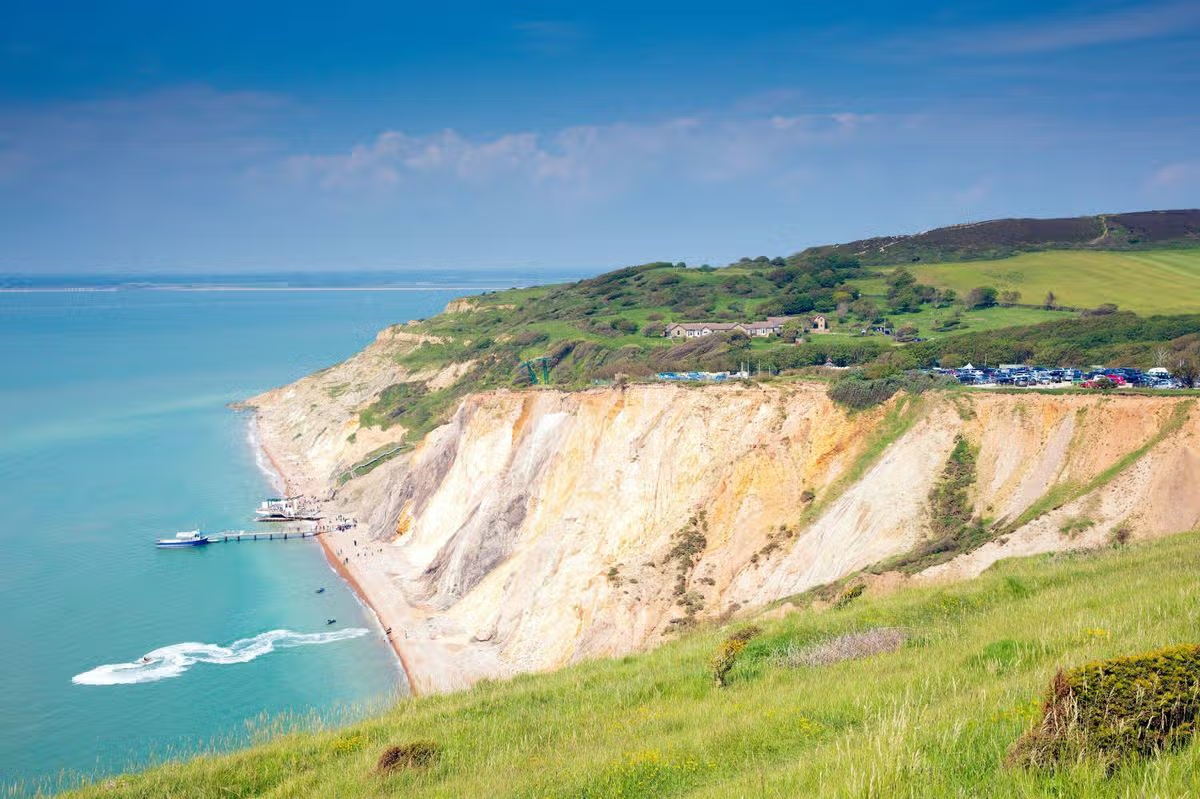
This location is the perfect day trip from London as you can enjoy the colourful coastline, admire the turquoise waters and hop on board a chairlift with the most breathtaking views
You’ll want to visit this gorgeous pier(Image: Getty Images)
But now if you’re tempted to head down south, there’s the “most breathtaking” ride in England that promises absolutely spectacular scenery. This destination truly has everything – from turquoise waters to a vibrant coastline which feels completely “unreal”. One content creator recently documented his day trip to the Isle of Wight, which is surprisingly straightforward to reach from London.
Samual told his TikTok followers: “I think I’ve found the most breathtaking ride in England.”
In his caption, he continued: “The chair lift at The Needles on the Isle of Wight is honestly one of the most breathtaking rides I’ve experienced.
“Gliding down the cliffs at Alum Bay with views of the famous Needles cliffs, turquoise water and colourful coastline feels unreal. This is the perfect day trip from London.”
Content cannot be displayed without consent
How to get to the Isle of Wight:
If you’re travelling from London, you’ll have to take a South Western Railway train to Portsmouth Harbour, which takes around 2 hours. Next you’ll need to hop on board the ferry to Ryde Pier Head, a journey of roughly 22 minutes.
Any other areas of the UK will require you to drive down to Portsmouth before you can take the ferry. Meanwhile, a journey in the car might take a little longer, in some cases around 3-4 hours depending on what area you’re leaving from.
What to do in the Isle of Wight:
The island boasts a wealth of attractions, including iconic landmarks such as Alum Bay and The Needles. You can also travel back in time at Carlsbrooke Castle, where King Charles I was held prisoner, or hop aboard the Isle of Wight Steam Railway.
For family entertainment, marvel at 300,000 specimens at the Dinosaur Isle Museum in Sandown, or let the kids run wild at the UK’s oldest theme park at Blackgang Chine.
Round off your visit by tackling the breathtaking coastal trails, wandering through the lush surroundings of Ventnor Botanic Garden, or simply soaking up the sun at Compton Beach.