We tested Europe’s luxurious new ‘business-class’ sleeper bus between Amsterdam and Zurich | City breaks
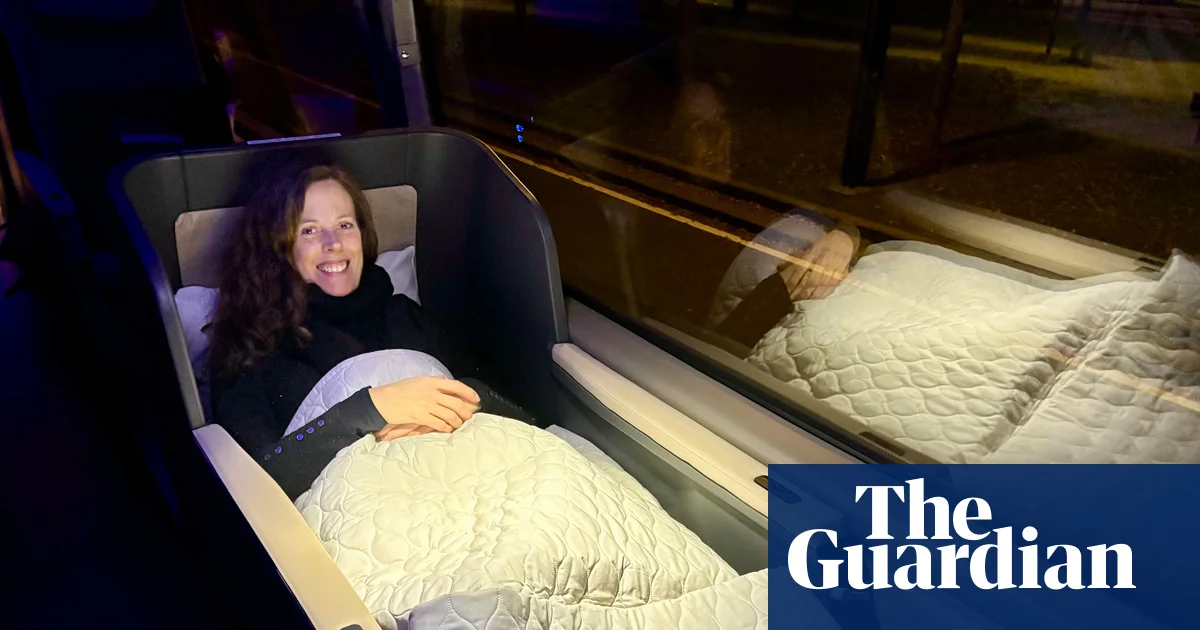
I feel my travel-scrunched spine start to straighten as I stretch out on the plump mattress, a quilted blanket wrapped around me and a pillow beneath my head. As bedtime routines go, however, this one involves a novel step – placing my lower legs in a mesh bag and clipping it into seatbelt-style buckles on either side; the bed will be travelling at around 50mph for the next 12 hours and there are safety regulations to consider.
Last month Swiss startup Twiliner launched a fleet of futuristic sleeper buses, and I’ve come to Amsterdam to try them out. Running three times a week between Amsterdam and Zurich (a 12-hour journey via Rotterdam, Brussels, Luxembourg and Basel), with a Zurich to Barcelona service (via Berne and Girona) launching on 4 December, the company’s flat-bed overnight sleeper buses are the first such service in Europe.
“Flying is one of the main drivers of climate change. We wanted to design an alternative that people would actually want to use,” the company’s co-founder and CEO, Luca Bortolani, told me before Twiliner’s launch. Their solution is a seat that turns into a genuinely comfortable bed. Manufactured by Greater Manchester-based Airline Services Interiors, it’s similar to a business class plane seat.
Hoping for more shut-eye than red-eye, I lean into that luxury. While I could shorten my journey by taking a Eurostar from London to Brussels and catching the Twiliner there, I’m going London to Amsterdam, and trialling the full Zurich route. With Eurostar adding a fifth direct weekday service to Amsterdam this month, it’s a good alternative connecting hub for UK travellers venturing further into Europe.
As viewers of Race Across the World will know, flatbed buses are common in Asia and South America, but they have been less successful in Europe. Twiliner hopes to change this by offering a service that’s both comfortable and sustainable. Run mostly on hydrotreated vegetable oil fuel (HVO, also called renewable diesel), the company claims its buses produce less than 10% of the CO2 emissions of a comparable flight. Even when running on normal diesel, which sometimes the buses have to, a Twiliner bus is as sustainable as a sleeper train per passenger kilometre, it says.
Currently operating three buses – one for each launch route plus a third for private charters – Twiliner hopes to offer 25 routes by 2028, possibly even adding a UK service. Though not exclusively targeting routes without sleeper trains, “our niche will be routes where lots of people travel and you don’t have a night train, or good connections,” said Bortolani.
A generous luggage allowance and the efficiency of being able to travel while asleep are pluses. These benefits (plus the novelty factor) aside, the biggest selling point is likely to be the comfort factor.
The blip on this journey is boarding at Amsterdam’s outdoor bus station in Sloterdijk, a five-minute train ride from Amsterdam Centraal station. Standing in the dark, a chill wind chasing through the open space, I’m not entirely sure I’m in the right place. But then I spot a flash of violet and the bus arrives, navigating its huge bulk like a cruise liner inching into a small fishing harbour. The doors open and the lights on the Twiliner’s steps glow a soft, spaceship purple as I climb aboard.
Downstairs are three seats, a spacious toilet, a changing room and self-service shelves selling eye masks, toothbrushes and snacks; ear plugs, coffee and wifi are free. I’m on the upper deck, in one of 18 seats with lofty views as well as USB ports. As we leave Amsterdam lights flicker in high-rise windows around me like colonies of square glow worms, and I click on the QR code by my seat to find instructions for my bed.
Around me there is much excitement but the chatter soon dies down. A no-children-under-five policy and strict guidelines on food, drink and noise make for calm travelling. By 10pm I’m fast asleep only waking at 5.30am in high heat (a teething issue Twiliner is ironing out) and lie back, dozing like a very overgrown baby being wheeled along in a cushioned pram, until the sun rises and the temperature drops.
after newsletter promotion
There’s a magic to falling asleep in one country and waking in another. Rolling into Zurich on a frosty weekday morning, the city is streaked with silver and gold as it begins to stir. By the bus’s Nespresso machine I chat to Adrien, a student from St Gallen university. “It’s not quicker. It’s not cheaper. But it’s another option, and it’s a good one,” he says. “I slept. I feel rested.”
Just over 25 hours after leaving my home in Somerset, a good chunk of which I’ve slept through, I arrive at Zurich’s Sihlquai bus station. Soaking up sunshine, I walk the 10 minutes to my hotel via the Christmas market on Europaallee, stopping for a hot, cinnamon-dusted Öpfuchüechli (apple doughnut) at one of its wooden booths.
Along the river, the art-lined Helvetia hotel extols the virtues of its hand-stitched Hästens mattresses, designed to ensure its guests a restful night’s sleep. There’s one thing their beds can’t promise, though: to transport me, magic carpet-style, to a new destination the following morning.
The trip was provided by Twiliner and Eurostar. Twiliner tickets between Amsterdam and Zurich cost from 150 Swiss francs (£141). Eurostar tickets from London to Amsterdam from £229 each way in Premier – which includes fast-track check-in and lounge at St Pancras, with breakfast and wifi – or from £39 in standard class. Hotel Helvetia in Zurich has double rooms from 169 Swiss francs (£160) B&B