‘My silence ends here’: The heartbreaking burden of Dolores Huerta
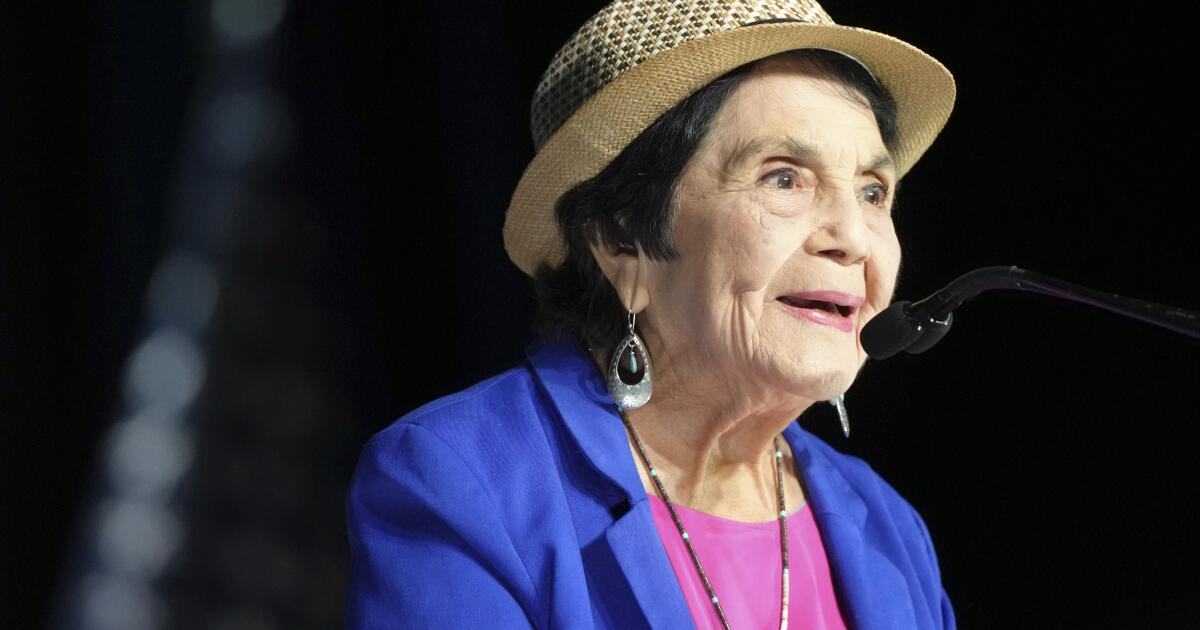
At 95, labor icon Dolores Huerta made a shocking and heartbreaking revelation Wednesday, in the wake of a New York Times investigation into sexual abuse allegations against her fellow icon, Cesar Chavez.
She was raped by Chavez, she said. Twice — both times resulting in pregnancies.
“I have never identified myself as a victim, but I now understand that I am a survivor — of violence, of sexual abuse, of domineering men who saw me, and other women, as property, or things to control,” Huerta wrote in a statement Wednesday. “I have kept this secret long enough. My silence ends here.”
Like so many women who have carried the burden of their own attacks behind an iron curtain of guilt and shame, Huerta now finds herself in the difficult, painful position of having not only to relive this trauma as it becomes public, but explain it to the rest of us.
Like the brave women of the Epstein files; like our First Partner Jennifer Siebel Newsom and the courageous women who spoke out against Harvey Weinstein; like Cassie Ventura; like E. Jean Carroll; like Christine Blasey Ford, Huerta joins the ranks of women forced to justify their response to abuse by powerful men.
Huerta shouldn’t have to engage in this rite of self-flagellation, of course, but she and Chavez are linked by their legacies as two of the greatest civil rights fighters in our history. Now, this hidden truth rewrites not just his story, not just hers — but the entire legend of a workers’ movement that grew from the grape fields of California into a defining story of Golden State fortitude and hope.
If Chavez was a predator, where do we even go from here? What do we believe in when even our heroes are ghosts, as Pink Floyd long ago warned?
“It’s just a very heavy day,” said Huerta’s spokesperson, Erik Olvera. “It is incredibly overwhelming for her.”
And for all of us, really.
Reports of abuse
The New York Times investigation detailed the molestation and abuse by Chavez of two women who were teens at the time the events took place. Huerta, the sharpest 95-year-old I’ve even seen, also told the reporters that Chavez had forced sex on her when she was in her 30s, once by manipulation and once by force.
“The first time I was manipulated and pressured into having sex with him, and I didn’t feel I could say no because he was someone that I admired, my boss and the leader of the movement I had already devoted years of my life to,” she wrote in her statement. “The second time I was forced, against my will, and in an environment where I felt trapped.”
Huerta had two daughters from these encounters and gave them to other families to be raised, though she is close to both of them, Olvera, the spokesman, said.
Olvera said that Huerta was unaware of the allegations of the two other women interviewed by the New York Times until the reporters contacted her several weeks ago.
“She literally thought she was the only one,” Olvera said. “The guilt is really heavy for her.”
As the news broke this week, shock — but not disbelief — rippled through the political and union worlds where Chavez remains revered (he died in 1993) and Huerta remains active. Despite her age, she speaks at multiple events each week and is a fixture at the state Capitol advocating for workers’ rights.
While Huerta has never spoken before about Chavez’s attacks on her, his infidelities and autocratic leadership style — and rumors of misconduct — have been documented for years. In her 2014 biography, journalist Miriam Pawel detailed some of these complaints as well as Chavez’s troubled relationship with his wife.
In a statement, the United Farm Workers union called the allegations “profoundly shocking.”
It canceled all events celebrating the upcoming Cesar Chavez Day — a state holiday — and is working on a survivor-centered response with outside experts to help ensure a fair and inclusive pathway for other people to tell their stories.
Sen. Alex Padilla, who has worked for years with Huerta but who was a child when Chavez was organizing, called for “zero tolerance for abuse, exploitation, and the silencing of victims, no matter who is involved.”
“Confronting painful truths and ensuring accountability is essential to honoring the very values the greater farmworker movement stands for — values rooted in dignity and justice for all,” Padilla said.
Changing times
If there is the slightest bit of solace to be found in this tragedy, it is in the response. So far, we have been spared the usual attacks on victims — though almost certainly they are happening outside the public eye.
Though Huerta may carry guilt, as all survivors so unfairly do, coming forward now has quickly and forcefully changed the narrative. I suspect there are few people who would dare call Huerta a liar, or challenge her motives. I suspect without her revelations, the other women coming forward would be treated differently.
I imagine that had she spoken out back then, as a young mother in the 1970s, a Latina woman in the male-dominated culture of the Central Valley, she would likely have found little relief.
What must it have been like for her all these years to know the man we idolized had this monstrous side?
But after 60 years of hard work, Huerta is now powerful in her own right. And after 60 years of silence, Huerta wanted to use that power to support the other women speaking out. Olvera said Huerta came to that decision reading the New York Times piece, and for the first time understanding that these other survivors were children when their abuse happened.
“When she learned that, that’s when she was like, I need to come out and tell my story,” he said. “She didn’t want them to stand alone.”
In the end, every survivor stands alone because what needs to heal is a soul shattered by the trivial evil of carnal greed, a pain so personal and unique even another survivor can’t fully understand it. It is daring and noble in the crucible of that personal destruction, which lasts years if not decades, to demand accountability. Not all of our heroes are ghosts.
“Your courage and your voices matter,” Siebel Newsom said. “They open the door for so many others to follow suit and tell their stories so that one day soon, we will break this horrific cycle of repetitive abuse by powerful men.”
These women have now made it clear: Chavez was a predator — a powerful man who used his authority to manipulate and force women and girls into sexual encounters.
In the end, all the good Chavez did, the strength and dignity he brought not just to farmworkers but to immigrants across the country, will forever be bound up with this ugly truth — though the movement is far more than one man.
Chavez earned this ending. Hopefully, for Huerta and the other survivors, speaking out is the beginning of healing.
What else you should be reading
The must-read: Cesar Chavez, a Civil Rights Icon, Is Accused of Abusing Girls for Years
The deep dive: ‘Profoundly shocking’ allegations against Cesar Chavez spark soul-searching in movement
The L.A. Times Special: Democrats face the possibility of a historic upset in California governor’s race, poll finds
Stay Golden,
Anita Chabria
—
Was this newsletter forwarded to you? Sign up here to get it in your inbox.