Brent Crude

Senate Republicans block Democrat’s war powers resolution

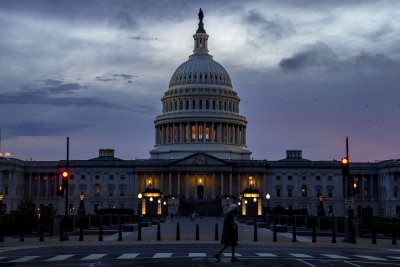
March 19 (UPI) — Senate Republicans have blocked a Democrat-led effort to curb President Donald Trump‘s powers to wage war against Iran, as the nearly three-week-old conflict escalates and rattles global energy markets.

The Senate voted 53-47 mostly along party lines Wednesday night to reject a resolution that would withdraw U.S. armed forces from conflict with Iran absent congressional approval.

Sen. Rand Paul of Kentucky was the only Republican to join his Democratic colleagues and vote in favor of the motion, while Democratic Sen. John Fetterman of Pennsylvania was the only member of his caucus to vote against it.

“We do not have a king. We are a democratic republic with a constitution and no one is above the law,” Sen. Cory Booker, D-N.Y., said Wednesday from the Senate floor before the vote.

“This president cannot take us to war without coming through this body. He is not able to do that unless this body supplicates itself before that man and surrenders its responsibilities.”

Senate Democrats forced the vote on the resolution that Booker sponsored as the conflict escalated on Wednesday, with Iran attacking Persian Gulf energy facilities in retaliation for Israel striking its South Pars gas field.

Thirteen American service members have been killed, and another 200 have been wounded so far in the conflict, which is threatening to become a regional war as Iran has retaliated by attacking U.S. bases and its allies in the Middle East.

Democrats of both chambers of Congress have been attempting to rein in Trump’s war powers through resolutions since the war with Iran began late last month. They argue the United States’ ongoing war with Iran violates the Constitution, which mandates that only Congress has the power to declare war.

The conflict has also seen the cost of oil surge. On Thursday, Brent crude reached nearly $110 a barrel, up from an average $71 before the war began on Feb. 28.

Wednesday’s vote is the third time — and the second by the Senate — that the majority Republicans have blocked war powers motions.

From the floor, Senate Minority Leader Chuck Schumer said, “Enough is enough.”

“To my Republican colleagues: The American people are watching. They oppose this war. They expect us to do our jobs,” he said.

“No more senseless wars in the Middle East. No more gas prices shooting through the roof. No more U.S. service members fighting and dying for in endless wars.”

Though the war has exposed fissures in the Republican Party, its members still mostly stand behind the president, who campaigned on ending conflicts and warning Americans that the Democrats would wage war with Iran if they won the White House.

Sen. Lindsey Graham, a staunch Trump ally, argued on the Senate floor that the war is intended to prevent Iran from securing a nuclear weapon.

He said during the prior negotiations the United States offered Iran what he called “a lifetime fuel supply for free” if the Islamic regime agreed to hand over its cache of highly enriched uranium. It is believed that Iran had enriched uranium to 60%, according to a recent International Atomic Energy Agency report, which is below weapons grade enrichment at 90%.

Graham compared the Islamic regime of Iran to Nazi Germany.

“If you do not see this as an imminent threat, then you’re blind from your hatred of Trump,” he said.

“There are people on the left and people in my own party that are more afraid of Trump being successful than the Ayatollah having a nuclear weapon. That’s sick.”

Source link

Seoul stocks jump over 5 pct on chip rally

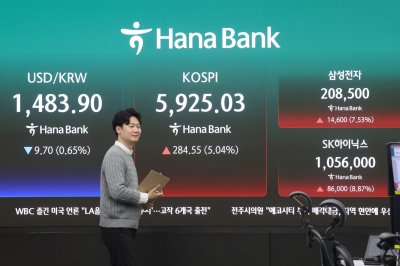
This photo, taken Wednesday, shows the trading room of Hana Bank in central Seoul as South Korean stocks surged more than 5 percent on a semiconductor rally. Photo by Yonhap

South Korean stocks surged more than 5 percent Wednesday, on a semiconductor rally boosted by the ongoing U.S. chip giant Nvidia’s global artificial intelligence (AI) conference. The Korean won strengthened against the U.S. dollar.

The benchmark Korea Composite Stock Price Index (KOSPI) closed up 284.55 points, or 5.04 percent, to 5,925.03.

The index came under strong buying pressure from foreigners and institutional investors, triggering the Korea Exchange (KRX), the country’s main bourse operator, to issue a buy-side sidecar near the closing bell.

Program trading for the KOSPI was suspended for five minutes at 2:34 p.m., according to the KRX.

Offshore and institutional investors snapped up a combined net 4 trillion won (US$2.7 billion) worth of equities. Retail investors, on the other hand, offloaded 3.9 trillion won.

Trade volume was heavy at 1.1 billion shares worth 26.1 trillion won, with winners far outnumbering losers 614 to 278.

Investors’ appetite for semiconductors increased, following remarks from Nvidia’s Chief Executive Officer (CEO) Jensen Huang on Samsung Electronics, Lee Kyoung-min, an analyst at Daishin Securities, said.

During the ongoing four-day event in California, Huang said on Monday he wants to “thank Samsung, who manufactures the Groq LP30 chip” for the company, adding that the chips are in production and would be shipped in the second half of this year.

“The stock market’s sensitivity to geopolitical issues in the Middle East is markedly declining,” Lee added.

Most large cap shares ended bullish.

Top-cap Samsung Electronics jumped 7.53 percent to 208,500 won, while its chipmaking rival SK hynix climbed 8.87 percent to 1,056,000 won.

Nuclear power plant builder Doosan Enerbility rose 2.78 percent to 107,300 won, on anticipations alternative energy sources would benefit from the recent spike in oil prices.

Brent crude, the international oil benchmark, has remained at the US$100 per barrel level for the past five sessions.

In contrast, defense shares lost ground as investors went to lock in profits. Hanwha Aerospace inched down 0.43 percent to 1,390,000 won, and LIG Nex1 retreated 2.27 percent to 689,000 won.

The Korean won was quoted at 1,483.1 won against the U.S. dollar as of 3:30 p.m., up 10.5 won from the previous session.

Bond prices, which move inversely to yields, closed higher. The yield on three-year Treasurys fell 6.3 basis points to 3.261 percent, and the return on the benchmark five-year government bonds retreated 6.7 basis points to 3.511 percent.

Copyright (c) Yonhap News Agency prohibits its content from being redistributed or reprinted without consent, and forbids the content from being learned and used by artificial intelligence systems.

Source link

U.S. gas prices up 27% since start of Iran attacks

March 17 (UPI) — U.S. gasoline prices have surged by 27% and diesel by 34% since the start of U.S. attacks on Iran last month, fuel costs reported Tuesday indicate.

AAA reported that the national average cost for a gallon of gas in the United States was $3.79 Tuesday morning. Diesel was $5.044 per gallon, topping the $5 threshold for the first time in three years, CNBC reported.

A year ago, those prices were $3.078 and $3.592, respectively. A month ago, they were $2.917 and $3.651.

Fuel prices have been on the rise globally since the United States and Israel launched attacks on Iran on Feb. 28 amid negotiations over Iran’s nuclear program. The attacks, which killed Iran’s supreme leader, Ayatollah Ali Khamenei, prompted Tehran to effectively close down the Strait of Hormuz by banning ships linked to the United States or Israel. About 20% of the world’s oil runs through the waterway that separates Iran and Oman.

Brent Crude, the benchmark price for oil worldwide, rose about 2% to $102 a barrel Tuesday, The New York Times reported. The West Texas Intermediate, the U.S. benchmark, rose to $95 a barrel.

Diesel prices are particularly tied to the U.S. economy, which depends on it for the transportation of goods via trucks, trains and barges. Recent surges in prices could have a cascading effect.

Andy Lipow, president of Lipow Oil Associates, said Tuesday that trucking and rail companies have begun increasing their fuel surcharges in response to the fuel hikes.

“One should really be worried about higher diesel prices,” he said in a note published by CNBC.

President Donald Trump this week put pressure on other nations that rely on oil shipped through the Strait of Hormuz to join a coalition to police the transit route and reopen traffic.

Speaking aboard Air Force One on Sunday, Trump said the United States doesn’t need to be involved in reopening the Strait of Hormuz because little of its oil passes through the waterway. About 7% of the United States’ crude oil and condensate imports passed through the strait in the first half of last year, the U.S. Energy Information Administration said.

He said the United States was protecting it “almost like we do it for habit” and to help “some very good allies that we have in the Middle East.”

Patrick De Haan, head of petroleum analysis at GasBuddy, said Monday, “until we see a meaningful resumption of oil flows through the Strait of Hormuz, upward pressure on fuel prices is likely to persist.”

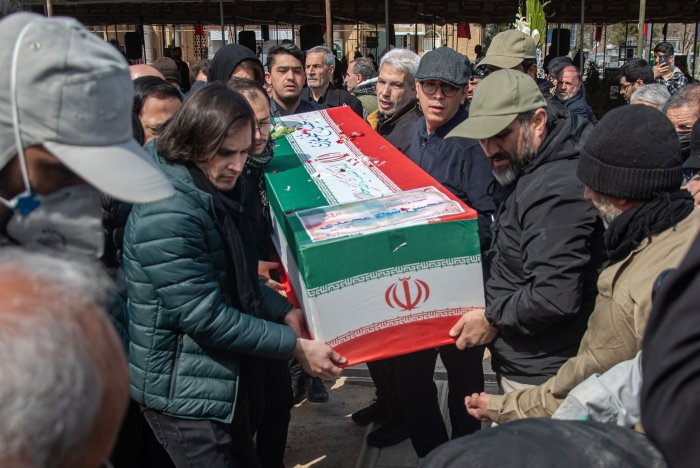
Iranians attend a funeral for a person killed in recent U.S.-Israel airstrikes at Behesht-e Zahra cemetery on the southern outskirts of Tehran in Iran on March 9, 2026. Photo by Hossein Esmaeili/UPI | License Photo

Source link

Iranian drone strike sets stategically key UAE oil trading hub on fire

Iran stepped up its targeting of Gulf neighbors, attacking and setting on fire a fuel tank close to Dubai International Airport, forcing flights to be suspended, and the key Fujairah oil export hub on the UAE’s east coast, on the supposed “safe” side of the Strait of Hormuz. Photo by Stringer/EPA

March 16 (UPI) — Emergency services in the United Arab Emirates were battling a major blaze at the country’s strategically key Fujairah oil export hub on Monday morning after the second drone strike on the facility in two days.

Emirate of Fujairah authorities said in a post on X that no one had been hurt in the attack on the Fujairah Industrial Petroleum Zone and that efforts were ongoing to bring the fire under control. They appealed to people to refrain from spreading misinformation.

“Civil defense teams in the Emirate immediately responded to the incident and are continuing their efforts to control it. The competent authorities call on the public not to circulate rumours and to obtain information only from official sources,” wrote the Fujairah Media Office.

The facility is strategically important because it is the only oil export terminal on the UAE’s eastern coast, located on the Gulf of Oman, the “good” end of the Strait of Hormuz.

Critically, it means oil tankers servicing the port do not need to run the gauntlet of the 21-mile-wide sea lane that Iran has effectively closed.

An approximately 250-mile-long cross-country oil pipeline from Habshan, a key onshore field 80 miles southwest of Abu Dhabi, feeds as much as 1.8 million barrels per day of crude into Fujairah.

However, Iran’s Islamic Revolutionary Guard Corps threatened ports, docks, military facilities and other “legitimate” U.S. targets in the UAE while the state media uged workers and residents in and around Fujairah, Jebel Ali and Khalifa ports to evacuate due to the presence of U.S. military forces.

Monday’s incident, following on from a separate strike and fire on Saturday, highlighted how exposed Fujairah — one of the world’s key crude oil and fuel storage hubs — was to Iranian threats.

The UAE has been repeatedly targeted by Iranian drones and missiles since the United States launched its airborne offensive against Iran on Feb. 28.

A drone attack earlier Monday that forced the temporary grounding of all flights at Dubai International Airport after a fire erupted in a fuel tank close by and an announcement by Israel that it was nowhere near done with hitting Iran indicated the war was likely headed into a third week.

Israel also announced plans for an expansion of its ground offensive in Lebanon against Hezbollah operatives and strongholds after the Iranian proxy group attacked Israel with rockets and missiles on March 2, two days into the war.

An Israeli bombing campaign and targeted actions by ground forces has already forced hundreds of thousands of civilians in the country to flee their homes and killed more than 850, more than 170 of them women and children, according to the Lebanon Health Ministry.

European Union foreign ministers were set to meet on Monday in Brussels to discuss the situation in the region as oil prices continued their upward trajectory with the benchmark Brent crude futures briefly hitting $106 per barrel during trade on Monday.

Shipping of oil, gas and all cargo through the Strait of Hormuz remains stalled despite calls by U.S. President Donald Trump at the weekend for countries that get their oil from Gulf producers to step up and help restart movement of ships in and out of the Persian Gulf.

Iranians attend a funeral for a person killed in recent U.S.-Israel airstrikes at Behesht-e Zahra cemetery on the southern outskirts of Tehran in Iran on March 9, 2026. Photo by Hossein Esmaeili/UPI | License Photo

Source link

G7 finance ministers meet to discuss releasing emergency oil reserves

March 9 (UPI) — G7 finance ministers were set to hold an emergency meeting first thing Monday to discuss oil prices after Brent crude surged above $100 per barrel, with an option to release strategic reserves to calm the market on the table.

The virtual meeting, due to get underway at 8.30 EST, comes amid fears that disruption to oil and gas shipments from the Gulf via the Strait of Hormuz, which Iran has closed, could continue for some time, sending energy prices soaring and rattling financial markets.

The joint release of “emergency reserves,” if agreed, would be coordinated by the International Energy Agency, according to the Financial Times.

If G7 nations do release oil reserves, it would be the first time in four years since a crisis triggered by Russia’s full scale invasion of Ukraine triggered similar price shocks, although gas was hit the worst.

Exacerbated by escalating attacks on Gulf countries’ oil fields, refineries and storage plants — impacting their ability to produce and store product, as well as export it — Bent crude jumped more than 25% in Asian trade Monday, hitting a $119.50 per barrel high, before falling back with the price of West Texas Intermediate making similar moves.

Investors also reacted to fears that the crisis will push inflation and borrowing costs higher, with negative impacts for the global economy.

The key Nikkei 225 index in Japan slumped by more than 5% to end Monday down 2,892 points lower, with the jitters spilling over into Europe when the markets there opened.

At lunchtime Monday, the FTSE 100 in London was down 1.4%, Germany’s DAX was down 1.6% and the CAC 40 in Paris was off by more than 2.2%.

Former IEA head Neil Atkinson warned that unless there was a resolution to the situation in the Gulf and flows of oil resumed “very soon” the world faced a “potentially game-changing and unprecedented energy crisis,” even if the reserves were made available.

“Though there are oil stocks around the world, the point is that if this closure of the Strait persists, those oil stocks if they are deployed will be depleted and we are going to be in a situation where, with the oil production actually shut in, in Iraq and possibly in Kuwait and maybe even in time in Saudi Arabia, that we are going to be in a crisis the likes of which we have never seen before,” Atkinson told CNBC.

Source link

Iran conflict: Global oil, gas prices surge on supply disruption fears

A tanker anchored in the Persian Gulf off coast of Dubai, one of scores halted on either side of Strait of Hormuz after it was effectively closed due to threats against shipping made by the regime in Tehran that have sent global energy prices soaring. Photo by Stringer/EPA

March 3 (UPI) — The price of Brent crude oil rose to $80 a barrel and the price of natural gas jumped 30% to $1.97 per therm on Tuesday after Iran effectively shut the key Strait of Hormuz shipping lane, with an official threatening its forces would “set fire to anyone who tries to pass.”

Prices continued their upward trajectory from Monday when markets reopened following the military strikes over the weekend on Iran by the United States and Israel and Tehran’s strikes on its oil and gas producing neighbors across the Gulf.

Concerns over supply disruptions are growing as the conflict widens across the region with Iranian strikes going beyond military bases used to launch attacks on Iran to target oil and gas production facilities, as well as Amazon data centers in the United Arab Emirates and Bahrain.

On Monday, Qatar Energy, one of the world’s largest exporters of liquefied natural gas, shut down production following “military attacks” on its Ras Laffan plant and Saudi Arabia’s state-run Aramco shuttered its giant Ras Tanura refinery near the port city of Dammam after it was set ablaze in a drone strike.

Analysts warned the oil price could surpass $100 a barrel if the disruption continued for very long — translating to a 25-cent-a-gallon rise in U.S. petrol prices.

The risk to maritime traffic was also pushing up the cost of moving oil from the Gulf to Europe and Asia and around the world with the leasing cost of a tanker to ship Middle East to China doubling to $400,000 a day on Monday.

The president of logistics technology platform Flexport, Sanne Manders, told the BBC that while Iran had not physically blockaded the strait, through which 20% of the world’s oil and gas transits, it was closed as far as global shipping was concerned.

Manders said it was partly that shipping lines were simply unwilling to expose their vessels, cargo and crews to potential jeopardy and partly insurance companies “not being willing to insure this risk anymore.”

He warned that expectation of higher fuel costs would feed through to movement of all goods by sea with carriers hiking rates “for any shipping in the world.”

That all fed into investor fears over the consequences for inflation and interest rates, sending global stock markets tumbling overnight, led by Japan’s Nikkei 225 Index, which ended Tuesday down more than 3%.

In mid-morning trade London’s FTSE 100 was down 2.8 %, Germany’s blue-chip DAX was trading 4% lower, down more than a thousand points, and the CAC 40 in Paris was off by 3.2%.

The pan-European Stoxx 600 Index continued its retreat, with across-the-board falls in all sectors pulling it 2.9% lower, while the blue-chip Euro Stoxx 50 was even lower, down 3.1%.

However, hotels, airlines and utilities took the biggest hits while energy firms and defense contractors performed better.

Ahead of the opening of U.S. markets, S&P 500 futures fell by 1.8%, Nasdaq 100 futures were down 2.3% and Dow Jones Industrial Average-linked futures moved lower by around 1.7%, or 821 points.

Defense and energy stocks rose on Monday led by Northrop Grumman, up 6%, and Palantir, up 5.8%, which together with a surge in NVIDIA’s share price, helped the overall market erase big losses early on to end the day in the black.

U.S. President Donald Trump was due to discuss the economic and cost-of-living impacts with Treasury Secretary Scott Bessent and Energy Secretary Chris Wright on Tuesday while Secretary of State Marco Rubio trailed administration plans to cope with energy price spikes.

“We knew that going in would be a factor. Starting tomorrow you will see us rolling out those phases to try to mitigate against that,” said Rubio.

Former South African president Nelson Mandela speaks to reporters outside of the White House in Washington on October 21, 1999. Mandela was famously released from prison in South Africa on February 11, 1990. Photo by Joel Rennich/UPI | License Photo

Source link