STEPPING through the floo network into the Ministry Of Magic, I feel like I’ve been transported straight on to the Harry Potter film set.
The attention to detail is next-level, even down to the sheer size of the building I’m standing in.
Sign up for the Travel newsletter
Thank you!
Epic Universe’s Helios Grand Hotel at Universal Studios Orlando ResortCredit: Supplied by Universal Destinations & Experiences PRSuper Nintendo WorldCredit: KILBY_PHOTO
Surrounded by green subway tiles, ginormous gold ornate statues of magical creatures and hanging banners featuring some of Azkaban’s Most Wanted, the magic really has come alive.
So much so that, as a huge Potter fan, I find myself choking back tears.
Feeling Epic
Join Walt and Mickey at the Magic KingdomCredit: Matt Stroshane, PhotographerThe Dragon Racer’s Rally ride is epic!Credit: KILBY PHOTO
Later, in the How To Train Your Dragon zone, Hiccup’s Wing Gliders is a super-fun coaster I want to ride again and again.
However, nothing quite hits the adrenalin high of Stardust Racers – a mega coaster in the park’s centre that reaches speeds of 62mph and heights of up to 133 feet, with spins and turns aplenty.
All this excitement leaves us needing a tipple, and the best place to take in the view of the park at night with a glass of pale rosé, £13, in hand, is Bar Helios at the top of the Helios Grand Hotel.
We’re staying a five-minute shuttle ride away at Terra Luna Resort, which also opened last year.
Designed in the colours of the solar system, my room features a spaceship-style window looking out on to Epic Universe.
No trip would be complete without visiting Magic Kingdom, home to the Cinderella Castle, and we’re soon flying around on motorbike rollercoaster Tron Lightcycle.
The new night-time parade, Disney Starlight: Dream The Night Away, makes the already dazzling performance even more breathtaking, too (Disneyworld.co.uk).
Located on International Drive, these sleek, modern, self-catering pads can sleep up to 26, and all have private pools – many even have cinema rooms.
There’s a large resort swimming pool, too, with water slides and a lazy river, which I sit beside, sipping frozen margaritas, £12.60, as I dive into a good book.
The crib at Villatel ResortCredit: Supplied by PRCocktails and bites at Palm Tree Club OrlandoCredit: DAVY JONES
One evening, we visit nearby entertainment complex Activate Orlando at Pointe Orlando, where teams face physical and mental challenges using interactive technology.
My favourite is one which involves dipping and dodging a network of lasers.
Luckily, Palm Tree Club Orlando close by offers a party atmosphere alongside delicious Lavender Hugo Spritzes, £12, rigatoni smothered in a vodka sauce, £14.80, and sides of charred broccolini, £9.60, which are a fitting reward for our energetic endeavours (@Palmtreecluborlando).
Orlando’s huge shopping malls are almost as famous as the theme parks, and as Fabulous’ Fashion Editor, it would be remiss of me not to visit one.
I pick The Mall At Millenia, home to designer boutiques and US faves Pottery Barn, Macy’s and Bloomingdale’s (Mallatmillenia.com).
Yet I still end up buying a pair of boots from H&M for £35!
The real souvenir of my trip, however, is the magic feeling this city gave me, theme parks and all.
We are living in an era of dissent, but what does that mean in 2026? According to writer Gal Beckerman, to be a dissident is as much a way of being as it is an act of resistance. In his new book “How to Be a Dissident,” Beckerman, a staff writer for the Atlantic, unpacks dissent as a kind of rough art. His book is both an instruction guide and a primer.
In nine short, potent chapters, Beckerman lays out the essential traits of an effective dissident — loyalty, recklessness and watchfulness, among them — to illustrate how communities of resistance are built from the ground up. I recently chatted with Beckerman about playwright and former president of the Czech Republic Václav Havel, President Trump and AI.
You’re reading Book Club
An exclusive look at what we’re reading, book club events and our latest author interviews.
By continuing, you agree to our Terms of Service, which include arbitration and a class action waiver. You agree that we and our third-party vendors may collect and use your information, including through cookies, pixels and similar technologies, for the purposes set forth in our Privacy Policy such as personalizing your experience and ads.
✍️ Author Chat
You have written three books that deal with dissent — political, cultural and societal. It’s clearly a big issue with you.
I don’t think of myself as an activist; I don’t approach these topics with an activist’s fervor. I’m genuinely curious about how change happens in society. All four of my grandparents survived the Holocaust, and I think the notion of a society that can change that quickly and turn on you was always very shocking and interesting to me.
In reading your book, it’s really inspiring and extraordinary to read about individuals putting their lives on the line to make change happen.
They genuinely fascinate me as these bizarre human beings who are able to act in ways that I find really mysterious. There’s a mystery as to how people’s minds actually change, and how society can change.
You write about making moral choices, and doing something bold because of some strongly held belief. This is not the same thing as joining the crowd, which can be the path of least resistance.
I had this feeling during the first few months of the current Trump term (and I share this sentiment with a lot of people) that we were just bowled over by the degree to which people in elite places were acquiescing to the exercise of executive power and being willing to bend the knee in ways that felt shocking to me. This prompted me to wonder, what would I do in that situation? Would I say “no” and not succumb to the will of executive power? Would any of us do so? It’s a question we all have to ask ourselves.
You cite Iris Murdoch’s notion of “radical humanism” as a key trait of effective dissent.
Radical humanists are attuned to the messy and wonderful ways that beings just are. They are defending those conditions for human beings to have a normal life, whether that means being able to listen to whatever music you like, or to wear your hair in a certain way, or to take care of a neighbor that is being ill-treated. Václav Havel called it the “pre-political” way of thinking and acting. And we saw this recently in Minnesota, with people standing up to ICE, regardless of what their political affiliations might be. Something pre-political was going on.
Another important factor you cite is civic mindedness, which feels like a difficult goal given how our communities have been dissolved by our screen addictions.
The communication tools that we use are dehumanizing in many ways because they don’t allow us to really see each other. Instead we preconceive each other and just scream a lot. And we know this at a gut level even as we continue to use them. That’s why I do think it takes an almost dissident sort of energy to insist on thinking in a different way and scrambling the assumptions that our modes of communication have foisted upon us.
What about AI? It feels as if there is a lot of resistance to accepting AI into our lives just because technology companies are investing billions of dollars to make it so. You are seeing communities protesting against the construction of data farms in their neighborhoods, for example.
The money behind the ideology pushing AI is about letting us feel that the only way to have an efficient life is through AI. And I feel like the 20th century taught us that there are lots of ideologies that come around to promise this sort of thing. And so we need to learn from that. I think there are a lot of overwhelming powers that try to flatten us. But we have to take that wonderful human element, that radical humanism, to say no, maybe there’s a way to do it better.
📰 The Week(s) in Books
Monica Lewinsky as a saint offering solace to the lovelorn and abandoned? Julia Langbein’s wild conceit works beautifully in her novel “Dear Monica Lewinsky,” according to Julia M. Klein, who calls the book “smart, poignant and involving.”
Among the casualties of the Vietnam War were the Appalachian communities whose male populations were decimated on the frontlines. This is the subject of Pamela Steele’s “taut, lyrical” novel “In the Fields of Fatherless Children,” a book that delves into the “poverty, racism, environmental degradation and despair suffered in the Appalachian ‘holler’ during the Vietnam era,” writes Meredith Maran.
The Times’ Deputy Entertainment and Arts Editor Nate Jackson sat down with the rapper, actor and K-Town native Jonnie Park to discuss his memoir, “Spit: A Life in Battles.”
Finally, Maddie Connors answers the question, “why are novels getting shorter?” Welcome to the age of the Adderall novel.
📖 Bookstore Faves
The inside of Mystery Pier Books
(Mystery Pier Books)
Established in 1998, Mystery Pier Books is L.A.’s prime destination for rare books and signed editions across a wide range of genres and forms, including Shakespeare folios and vintage sci-fi paperbacks. Located right alongside its Sunset Strip neighbor Book Soup, Mystery Pier was established by character actor Harvey Jason and his son Louis, who continue to run the store together. I chatted with Harvey about the treasures to be found in his store.
What is the market like for rare books right now?
Very strong, in fact. We just sold a beautiful edition of J.R.R. Tolkien’s “Lord of the Rings” trilogy to a private collector for $55,000. And that is actually a reasonable price for those books. We have a long list of serious collectors all over the world that contact us for books, customers that have been coming to us for years. We also sold a first edition of “The Adventures of Huckleberry Finn” for $17,500.
Why should one own a rare book?
It’s a good investment. People who collect rare books are book lovers, first and foremost. And they are smart enough to know that the books they love can increase in value year by year. First editions never depreciate. They always become more valuable over time.
I’m interested in journalism books. Do you have any Tom Wolfe or Hunter Thompson in your store?
Hunter Thompson came in here years ago and signed all of his books, so, yes, we have his books signed by him.
Do you see young people looking to get into collecting books?
Yes. A lot of recent college graduates are building collections. It’s very heartening to see that. You can come into our store and find nice editions for $100. The front room of our store contains the first editions but our other rooms will have landmark titles for far less money. This is really a pursuit for everybody, not just wealthy collectors.
The Lady Grace Mysteries is a collection of children’s detective fiction novels, originally penned by English author Patricia Finney, before Sara Volger and Jan Burchett later came aboard as co-authors.
Written in diary format, the story centres on Lady Grace Cavendish, a maid of honour to Queen Elizabeth I, who sets out to unravel a series of mysteries within the royal court.
The series comprises 12 books in total, with the earliest releases regarded as the most beloved titles. These include Assassin, Betrayal, and Conspiracy – published in 2004 and 2005. The final instalment, Loot, hit shelves in 2010.
Now, audiences can immerse themselves in the 16th-century royal court as the beloved books have been brought to life in a new BBC adaptation. The “vibrant” new drama breathes excitement, humour and intrigue into Queen Elizabeth I’s court, appealing to younger viewers, as well as older fans who grew up devouring the books, reports the Liverpool Echo.
“The series introduces 14-year-old Grace Cavendish, a spirited lady-in-waiting with a sharp mind, a strong sense of justice and one enormous secret: she is the Queen’s top secret teenage spy,” reads the official synopsis for the series.
“Moving through the glittering but treacherous world of the Tudor court, Grace must juggle her official duties with undercover missions as she tackles everything from stolen crowns and mysterious hauntings to political plots and deadly traitors hiding in plain sight (Claudia Winkleman not included).
“With picture perfect palaces, sweeping gardens, secret passageways and lavish royal celebrations, The Lady Grace Mysteries brings the Elizabethan Golden Age to the screen in a way that feels both authentic and fresh. Alongside her best friends, Ellie, a fearless scullery maid, and Masou, an ambitious young actor, Grace’s world is packed with daring escapades, heartfelt friendships and relatable teenage drama, just with more ruffs, royal balls and assassination attempts.”
Sarah Muller, Head of Commissioning 7+ at the BBC, commented: “The Lady Grace Mysteries is everything we love in co-viewing a series: it’s warm, funny and full of adventure, with a brilliant young heroine at its heart.
“It blends mystery, history and big emotional stories in a way that feels fresh and exciting for today’s audience, while giving parents and grandparents something richly nostalgic and visually spectacular to enjoy too. We’re so proud of this show and can’t wait for families to discover Grace’s world together.”
Evie Coles takes on the role of Grace, with Rebecca Scott portraying Queen Elizabeth I. The cast further features Carys John, Twinkle Jaiswal, Rafael Alessandro, Georgia Farrow, and Fintan Buckard. All ten episodes of The Lady Grace Mysteries dropped on BBC iPlayer earlier this month (April 20), with viewers already devouring the entire series in one sitting.
Numerous fans have taken to social media to express their enthusiasm, with one user posting on X (formerly Twitter): “The Lady Grace Mysteries are heaps of fun.”
Another chimed in: “It’s actually a kids show but I’m liking the teenage spy at the Elizabethan court. Great fun with FAB costumes. Each character has their own colour scheme, Lady Grace in greens, the Queen in orange/gold, another in purple, one in blue. NICE!”
The official CBBC Instagram account also enthused: “If you like and miss Malory Towers… we’ve got you! Brand new series, with familiar faces… #TheLadyGraceMysteries is available right now.”
The Lady Grace Mysteries is available to stream on BBC iPlayer
THE beloved “Hogwarts Express” steam train could be heading for the buffers thanks to a bitter health and safety row.
The iconic service, made famous by the Harry Potterfilm series, is under threat after rules forced a major overhaul.
Sign up for the Travel newsletter
Thank you!
The future of The Jacobite steam train is under threatCredit: Alamy Stock Photo
The iconic train, known as The Jacobite steam train, runs through Scotland’s stunning countryside between Fort William and Mallaig, crossing the famous Glenfinnan Viaduct.
But now the popularlocomotive– which is enjoyed by around 70,000 passengers a year – is at a crossroads due to a long-running dispute over safety regulations and the resulting financial strain.
Old-style carriages used in the films have effectively been banned because their doors don’t have central locking.
Operator West Coast Railways says being forced to swap them out has caused huge problems.
Newer coaches are unpopular with tourists and far more expensive to run. They even require a diesel engine at the back just to power air conditioning.
The train, which should have started running this month, has yet to begin its 2026 season.
Bosses are now begging regulators at the Office of Rail and Road to allow the return of the original carriages.
James Shuttleworth of West Coast told The Telegraph: “I don’t know what we would do. We were losing money working like that and you don’t go into business to lose money.”
Local businesses are already feeling the pain, with trade slumping as visitors stay away.
Fears are now growing that unless a solution is found soon, the world-famous Hogwarts Express could run out of track for good.
The train typically hosts over 70,000 passengers per yearCredit: Getty Images
Chinguetti, Mauritania – Bookkeeper Muhammad Gholam el-Habot gently pulled a pair of white gloves onto his slender hands and set about his routine in his high-ceilinged, cool library lined with steel bookshelves.
He opened a thick manuscript printed in Arabic. After leafing through its brown and frail pages, looking for damage, el-Habot closed the book with a satisfied thud, rubbed his fingers over the wrinkled leather cover, and carefully placed it in a white cardboard box.
Recommended Stories
list of 3 itemsend of list
“These books are very important to my family and me,” the librarian said, as the midday sunlight spilled in through open wooden doors. He spoke in Hassaniya Arabic, the dialect spoken in Mauritania, his voice low, his sentences halting and poetic. Fat flies buzzed around his long oval face as he worked.
“My relationship with them is like that of a father and his son,” he continued. “We must protect them until God takes the land and all the people who are on the land.”
The el-Habot family library is only one of a handful of its kind still operating in Chinguetti, a medieval fortress town or ksar in Mauritania’s northern Adrar region. Once a centre of commerce and Islamic learning between the 13th and 17th centuries, it is now largely abandoned as, over the decades, locals have sought opportunities in bigger cities.
A view of the old town of Chinguetti, which follows typical Moorish structures with a mosque at the centre [Shola Lawal/Al Jazeera]
Chinguetti is also at the mercy of a changing climate.
Mauritania, in northwest Africa, is 90 percent Sahara desert and has faced desertification for centuries. Now, human-induced climate change is an accelerant. Sand and flash storms occur more frequently, while extreme hot or cold seasons last longer than usual.
Those pressures are a “big deal” for precious books, said Andrew Bishop, a researcher at the University of Wyoming studying climate impacts on Saharan cultures.
“Extreme heat and less predictable rainfall patterns means that texts are increasingly damaged by water or heat, making many manuscripts beyond repair. More than that, the mud libraries themselves are not built for sudden rain and longer summer of over 40 degrees (Celsius, or 104 degrees Fahrenheit),” he told Al Jazeera.
Many of Chinguetti’s 4,500 residents now live in cement buildings outside the original confines of the abandoned ksar, built out of dry stone and red mudbrick. There are fears that the entire area, which is about 500 square kilometres (200 square miles) – about the size of Prague – is at risk of being buried by surrounding sand dunes in the long run, although there is not a clear timeline yet.
Rare manuscripts shown in one of Chinguetti’s last libraries [Logan Stayton/University of Wyoming]
Islam’s ‘seventh holiest city’
El-Habot did not always want to be a bookkeeper.
But when his father grew sick in 2002, he took over the approximately 1,400 manuscripts out of obligation. It was an honour in his culture to be selected, he said.
It would be out of the question now, the 50-year-old librarian said. He imagines that his two sons would reject the duty, as many of their peers have left to explore economic opportunities in the capital city, Nouakchott, or elsewhere.
“This is something that we have to do; it is a family obligation,” el-Habot said, with a bewildered expression. “This is not even a question to be asked.”
The family manuscripts are sacred because they are rare. The bookkeeper’s ancestor, Sidi Mohamed Ould Habot, was one of about two dozen Chinguetti scholars who travelled around the Muslim world between the 18th and 19th centuries, from Egypt to Andalusia, in search of knowledge.
Between them, the scholars amassed a vast fortune of about 6,000 scripts. They covered almost every topic: Islamic jurisprudence, the hadith or teachings of the Prophet Muhammad, mathematics, medicine, and poetry. Some of the works came from the scholars themselves, including the older el-Habot, who wrote about the science of poems.
The books were stored in about 30 libraries in Chinguetti, open to people from all over the world.
At the time, the town was famous because of its location at the crossroads of trans-Saharan trade routes linking the Sahel and the Maghreb. Camel caravans guided by nomadic Berber traders transporting goods – mostly salt and gold – between northern Africa and the southern empires used the city as a way station, transforming it into a commercial hub.
Muslim pilgrims on their way to Mecca on foot or camel would gather in Chinguetti and prepare themselves spiritually and mentally for their long, difficult journey before heading on to Cairo. Islamic and scientific texts were exchanged, bought and sold in the town.
In West African lore, Chinguetti was referred to as Islam’s seventh holiest city. Others nicknamed it the “Sorbonne of the Sahara”, according to UNESCO.
Some of the old texts stored in the el-Habot family library. The family has a total of about 1,400 books in its care [Logan Stayton/University of Wyoming]
Generation after generation managed the libraries. Over time, as the caravan trade declined due to new European sea routes, the old town emptied and several libraries closed.
“Chinguetti was the mother of all people,” el-Habot said, referring to the town’s old status as the main capital of the region. Indeed, the area now known as Mauritania was called “Bilad Shinqit” or Land of Chinguetti. In the local Soninke language, it translates to “spring of horses”.
“People had to go because they wanted to feed themselves, get education for their kids, and get better opportunities for themselves too,” el-Habot said, adding that there were no universities close by, and only a handful of primary and middle schools.
Some within his family have moved on, as well, the bookkeeper said. Those, like him, who stayed back, wanted to respect their ancestor’s three wishes.
“His wishes were that the library stay in Chinguetti, that it should be open to all seekers of knowledge, and that a male descendant of his who is religious and morally upright be the bookkeeper,” el-Habot explained. Not following those instructions, he said, could invite God’s anger.
Chinguetti’s decline is largely due to the lack of support for its traditional lifestyle, Bishop said. Annual rainfall in Mauritania has decreased by 35 percent since 1970, making it harder for herders to graze or for date palms to produce fruit.
In 1996, UNESCO granted Chinguetti and three other Mauritanian ksour World Heritage Status, cementing their rich legacy. The few people still living in the old town are allowed to renovate but only minimally, to keep its original stone architecture and the typical Moorish structuring where houses are lined up along narrow alleys that lead to a mosque with a square minaret.
Just outside Chinguetti are the excavated ruins of Abweir, a town of 25,000 believed to have been founded in 777 AD, and believed to be the “original” Chinguetti. Its residents moved from the settlement, locals believe, in 1264 – likely after a conflict. Over time, the area was completely swallowed by sand.
Bookkeeper el-Habot stands inside the family library on a recent weekday [Shola Lawal]
Saving the manuscripts
El-Habot’s job, while enjoyable much of the time, is also taxing, he admitted.
Preserving old books by reprinting or digitising the most worn-out manuscripts before they become unreadable is a costly process. He often needs chemicals to keep away book-eating insects and has to fund more suitable storage.
Then, there is the weather, which is out of his control. Mauritania swelters in the dry season between April and December, and is bitingly cold in the winter months that follow. Old pages are sensitive to both extremes and can become brittle, el-Habot said. Sometimes, when it is really hot, he places buckets of water around the library hall to spur humidity.
Flash floods, meanwhile, threaten water damage.
An excavated mosque of Abweir, just outside Chinguetti, stands next to a sand dune. The settlement was believed to be the ‘original’ Chinguetti before residents moved for unclear reasons [Shola Lawal/Al Jazeera]
Visitors to the library usually pay a small fee, but tourist numbers dropped drastically across Mauritania in the mid-2000s, when armed groups attacked foreigners. The COVID-19 pandemic also reduced the flow of travellers.
Mauritania has since clamped down on violence. Tourists are slowly coming back, el-Habot said, and some of the locals who left have also returned.
In 2024, a $100,000 UNESCO restoration project provided air-conditioning units, computers and printers, as well as shelving units and storage boxes to 13 family libraries to stimulate the sector. But most libraries remain closed, their texts scattered among members. The lack of capacity of young people who are not as interested in preserving Chinguetti’s culture will continue to pose a challenge, Bishop said.
A section of old Chinguetti shows the stone masonry used at the time [Shola Lawal/Al Jazeera]
Back in the library, el-Habot continued working, his thin frame bent over his manuscripts. He opened one book and pointed excitedly at its pages: They depicted the moon in its luteal phases, and an eclipse. A third page showed the holy cities of Mecca and Madina.
“I have to protect this heritage,” el-Habot said in his low voice. “As mine, and also for all of humanity.”
WHAT do a former Tory councillor from Kent and a Wimbledon-supporting socialist have in common?
They are both sharing a beer with me on my “solos” group tour of Portugal.
Sign up for the Travel newsletter
Thank you!
The pretty city of Porto rises up above the River DouroCredit: GettyThirty minutes drive from the capital lies Sintra, another Unesco World Heritage SiteCredit: Getty
And the three of us are talking over the day’s activities with a Trump fan from the east coast of America.
Luckily, politics is off the menu.
Very much on the menu, however, is sardines, salted cod and the country’s speciality egg yolk pastries. But more on them later.
We are part of a 26-strong group on a dash around the southwestern-most territory of Europe, which is packed with old-world charm.
Our adventure, organised by solo tour specialist Just You, starts in Porto, where the steep hills that rise up from the River Douro are dotted higgledy-piggledy with colourful houses.
Author JK Rowling lived among the granite streets here before she was famous — and it is said the city’s gothic architecture, along with the traditional robes of its university students, inspired her world of Harry Potter.
At least one establishment, bookshop Livraria Lello, cashes in on the fact, charging entrance fees to see its elaborate interior and upstairs cafe where Rowling would drink her coffee.
Talking of elaborate, it doesn’t get much more so than the “Gold Church”, real name the Church of St Francis.
Designated a Unesco World Heritage site, its interior is dripping with carved wood covered in gold leaf, with the precious metal having been shipped over from Portugal’s former colony of Brazil.
It’s certainly dazzling, as is a trip down the Douro River to the vineyards, which supply grapes for that most Porto of products . . . port.
Can you get more Portuguese? Well, actually, my guide informs me that, historically, it was mostly grown here by the British.
The two countries have long been allies, with many Englishmen living in Portugal in the 1600s.
Back home in those days, the English liked wine but were always at war with the pesky French, meaning booze cruises across the Channel were often a no-no.
Instead, they turned to north Portugal and the Douro Valley to grow their own.
It will come as no surprise then that many of the port brands bear English names.
These include Taylor’s, Cockburn’s and Sandeman, and you can see lots of them emblazoned on the wine cellars that fill the hills of the city of Gaia, which is just across the narrow river from Porto.
The walled city of Obidos is perched on a hilltop and is completely enclosed by its fortificationsCredit: Refer to sourceAveiro is marketed as the ‘Venice of Portugal’Credit: Getty
By the way, white port (yes, that’s a thing) is tipped to be the next big thing in the cocktail market.
After time in Porto, Gaia and the Douro Valley, day four of my eight-day trip sees the group begin to wind south to capital Lisbon, but not before stops at Aveiro, Coimbra and Obidos.
Let’s take them one by one. Aveiro is marketed as the “Venice of Portugal”. OK, it has some canals, but a trip on a large, electric gondola just doesn’t feel as romantic.
A fellow traveller did remark on its Art Deco beauty, though.
Coimbra could maybe be the Oxford of Portugal, boasting the country’s oldest university, which dates back to 1290. Bats live in its library to eat book-destroying bugs.
A guided tour of the city, which was once the capital, will take you into the grand university building, which sits among former church schools in a street that was the widest in Europe until the 1800s.
You will also likely hear the story of Don Pedro and Donna Ines. I heard it twice and am still a little hazy on the details.
Based on truth, it is Portugal’s Romeo And Juliet tale, which involves the 14th-century prince Pedro digging up the five-year-dead corpse of his mistress Ines.
He then crowned her queen and made his courtiers kiss her hand. The things we do for love.
The walled city of Obidos continues with the historic buildings. Perched on a hilltop, the medieval settlement is completely enclosed by its fortifications. And its small size makes its stunning streets very manageable to navigate.
While there, it’s worth trying its cherry liqueur, called ginjinha, which is served in chocolate cups that you can eat afterwards.
The final days of the tour were spent in Lisbon, a city built on seven hills.
Chris Michael in the Portuguese city of CoimbraCredit: SuppliedTuck into the tasty pastry pastel de nataCredit: Getty
This may make exploring its small streets a challenge, but you can always hop on and off the quaint yellow trams.
The downtown area and main squares are flat enough and filled with impressive buildings despite the earthquake that devastated the area in 1755. A couple of miles out from the centre lies the Belem district.
Its Belem Tower is a small, picturesque fort which marks the transition from tall forts (for shooting arrows) to horizontal ones (for hosting canons).
And it does this by combining both aspects of those designs as it juts prettily into the Tagus river.
Thirty minutes drive from the capital lies Sintra, another Unesco World Heritage Site. With its microclimate making it cooler and wetter than Lisbon, it stays green all year round.
It also plays host to colourful palaces where past royalty would spend their summers hunting.
I’m sure they feasted well, too. And I didn’t do badly on that front, either. The Portuguese say they have 365 different recipes for cod (one for each day of the year).
It is often dried and salted, which they call bacalhau. I had bacalhau covered with onions and accompanied by wafer-thin fried potatoes.
Another national delicacy is pastel de nata, an egg custard tart pastry, often dusted with cinnamon.
Grabbing one with a coffee will only set you back a couple of euros for both the treat and the drink.
It’s the sort of thing you can do to while away the hours with new-found friends from the group of initial strangers on the tour.
Which, arguably, is the key factor of the holiday’s success. Do you like your travel companions? Are you cut out for solo travel?
Cards on the table, this was my first solos tour. I met people I liked and no one I disliked. Ages ranged from 40 to 95, though 85 per cent were retired.
Lots I spoke to had been using solo tour companies for many, many years.
For some it was their first time.
If you haven’t tried it before, all I can say is: You might like it, you might love it.
But you only live once (unless you’re Donna Ines) . . . and Portugal is well worth a visit.
GO: PORTUGAL
GETTING/STAYING THERE: Just You’s eight-day Picturesque Portugal escorted tour for solo travellers includes flights from London, overseas transfers, B&B in 3* and 4* hotels with a guaranteed twin or double room of your own, four dinners and welcome and farewell drinks, accompanied by a Just You holiday director and specialist local guide.
Multiple departure dates available, with prices starting from £2,169pp.
Jane Fallon has given her fans a health update after having her second surgery following her cancer diagnosisCredit: InstagramThe author who is the partner of Ricky Gervais, told fans earlier this month that she was suffering with breast cancerCredit: Getty
Posting a sweet pic alongside her cat Pickles on Instagram, Jane wrote: “Little update. So, my 2nd surgery went well.
“They got the clear margin they need on the original excision, which is great.
“They did hit a new little patch of precancerous cells on the other side of the new bit they took out but, thankfully, everyone agrees more surgery would be overkill.
“A huge % of pre cancer doesn’t develop into cancer.
“I saw the oncologist today & we’ve agreed the risks of radiation outweigh the benefits in my case.
“Which leaves Tamoxifen (or similar) or wait and see (my preferred option).
“I’m very nervous about going the drug route, because I know the side effects can be hideous, but I’m taking all the info on board & luckily there’s no pressure to make a quick decision.
“So, all good & I’m just looking forward to getting back to normal.”
Jane’s followers flocked to support her, including author Jojo Moyes who wrote: “Well done for getting through another surgery.
“Wishing you some reassuring news very soon x”
A fan added: “Happy to hear the update and it sounds very positive … yes take your time to decide , & so all the research … as of course you will x”
Another said: “That’s such uplifting news , so pleased your doing well. onwards and upwards x And cats will always upstage.”
This comes just days after Jane slammed a fake obituary that was published online after she was revealed she had cancer.
She said: “I’ve taken the post about the obituary down, because I don’t want people to think I’m upset by it. I’m not. P***ed off yes.
Breast Cancer Screening
Most women will have been told to check their own breasts for signs of lumps and bumps, but after a certain age you’ll be invited for a free NHS breast cancer screening.
You’ll automatically get your first invite for up to three years after you hit 50, as long as you’re registered to a GP surgery.
After that, you’ll be invited every three years until you turn 71.
If you’re a trans man, trans woman or are non-binary, you may be invited automatically, or you may need to talk to your GP surgery or call the local breast screening service to ask for an appointment.
If you have not been invited for breast screening by the time you are 53 and think you should have been, contact your local breast screening service.
But if you’re experiencing symptoms of breast cancer before you reach screening age, don’t wait to be invited – see a GP.
Do this even if you’ve recently had a breast screening.
“But more, I just want people to know that any photos you see of me in hospital, looking sad or with tubes sticking out of me are 100% fake – AI generated.”
Following her recent procedure, Jane told her followers she was feeling “remarkably fine” and in good spirits.
She assured people she wold update them once she had the medical all clear.
“Then 8-10 days wait for confirmation that they’ve got it all & the margins are clear (small % chance of more surgery if not),” Jane wrote.
She has been resting up at home with the support of cat Pickles.
Jane has been with comedian Ricky for more than 40 years after meeting back in 1982Credit: X/JaneFallonWhen Jane announced her diagnosis, Jane asked fans not to “panic” and said her prognosis was “excellent”Credit: InstagramJane is the author of 14 bestselling books such as Getting Rid of Matthew and Queen BeeCredit: Instagram/janefallon2
THEY were once ‘like brothers’, touring the world together and dealing with global superstardom after being propelled into the spotlight aged just 16.
But now in their early 30s, Niall Horan and Harry Styles are “worlds apart” and living “vastly different lives”. Here, an insider tells us why the relationship has soured between the pair, and how the rest of One Direction are keeping their distance.
Niall and his girlfriend Amelia are often spotted walking their dog in LondonCredit: MJ-Pictures.comHarry tends to wear disguises and use fake namesCredit: BackGrid
Fans first noticed cracks between the pair last month when Niall, 32, made barbed remarks about the cost of fame on an American podcast just days after Harry, also 32, said he found his superstardom “deeply isolating”.
Speaking on the Zach Sang show earlier this month, Niall cheerfully revealed how delighted he is to be living a “completely normal life” in London, travelling on the tube, walking his dog and going for beers with his mates in local boozers.
When asked if he minds being stopped by fans, the Irish singer remarked: “You cannot have your f***ing cake and eat it”.
Fans were quick to point out that the comment came shortly after Harry spoke about the cost of superstardom – and wondered if it was a dig in his direction.
Speaking to Runners’ World magazine for their May cover, Harry said that he found fame ‘deeply isolating’ and felt the need to withdraw from public life to protect himself.
As part of this, he moved to Italy, because it allows him to ‘live a quiet life’ and ‘reset’.
But the differing attitudes toward fame are part of reason why the pair are no longer close.
A source tells us: “The boys used to be like brothers, they were the best of friends and used to joke about what life would be like when they were old men and still hanging out together.
“Now they are about a million miles from that. They have gone their separate ways and are all living such different lives.
“Niall is a real homebody; he loves being at their place in London with Mia and the dog, or with his family in Ireland. He’s not a kid anymore; he feels settled now, while Harry still jets all over the world and never seems to stay in one place for long.
“The pair of them hardly have anything in common now, and while Niall would never come straight out and criticise Harry, some things he says definitely make Niall’s eyes roll.”
While the Irish singer songwriter, who is worth £52 million, is completely at ease with being recognised when he’s out and about, scared Styles recently admitted all the unwanted attention left him wanting to become a recluse.
Speaking to US media, Niall claims he can live carefree in London. He says his life with long-term girlfriend Amelia Woolley – known as Mia – is not built around his work schedule and fame.
He added that he’s never minded being mobbed by One Direction’s devoted army of fans: “I don’t ever want it to be like, poor me. That was just the way it was – there were a lot of people around.
“I just get out and do it, and people are going to come up to you and say hello. And that’s fine.
“I used to be nearly afraid of that. I love it now. I basically live a completely normal life, really, apart from the fact that if I walk in somewhere, someone’s going to come up and say hello, that’s fine.
“I walk the dog every day and go on the tube and go into town and go for beers. There’s nothing special.
“It’s a great thing. It’s something that when you were younger, you yearned for.
“We all want that normalcy in effect. You cannot have your f****ing cake and eat it, though, either.
“I want to be out there doing my thing and getting up on stage. It’s the best f***ing thing in the world.”
The former pals’ bruising clash came as they filmed a three-part road trip for a nostalgic Netflix documentary about the band, which has since been scrapped.
Our front page splash on Saturday revealed details of the fightCredit: Not known, clear with picture deskHarry goes out of his way to avoid being recognisedCredit: BackGridBack in 2011 the boys said they were as close as brothersCredit: Getty
Despite the frenzy of worldwide adulation, Niall says that down-to-earth fashion buyer Mia, 28, from Birmingham, keeps his feet firmly planted on the ground.
He went on: “You can sit at home and go like, it’s hard for me to do these things.
“But at times, it being uncomfortable or something can be a reason why you don’t do them. Or you can choose for that to not be a reason and you can do them anyway.
“When you shut out a lot of the things that are assumed can be negative, you also just unconsciously shut out a ton of positive things.
“We live a completely normal life outside of this.
“It’s like someone’s pressed pause on a stopwatch, and then when it clicked back in, I was just this different person. It’s really cool. It happened gradually, but when I think about it in hindsight, it felt like just night and day.
I basically live a completely normal life, if someone’s going to come up and say hello, that’s fine
Niall Horan
“My life just went from being all encompassing to having this good divide.
“I love it. I like having the balance. It’s pretty cool.
“I’ve gotten very good at. When I’m at home, I’m completely at home. I’m not doing anything. I just want to be at home.
“But I like going to work now and then being at home, I like it that way.
“Hopefully, I can keep doing that because it’s a nice little balance I’ve got going on. And it takes time to get to that.
“Amelia’s got her own life. She’s been doing her thing, and everything can’t be just surrounding me.
“It’s already weird enough that she used to fly to Amsterdam to come in on a five o’clock flight on a Friday. It can’t be like that all the time.
Niall’s new album Dinner Party is about the night he met fashionista AmeliaCredit: GoffAmelia and Niall at Wimbledon last summerCredit: Getty
“Bringing her into that is a really cool thing. And she feels that sense of pride and looks at the fans and sees the way they’re thinking and things like that.
“It’s such a cool thing for her if I play her a song; she’s never had that before. It’s not like people were coming home in the evening from work and going, ‘Hey, I wrote you a song today.’
“That’s a new thing for her, too. The whole thing is a shock to the system, but our life is just not all about that.”
Niall previously dated Hailee Steinfeld and Ellie Goulding –resulting inEd Sheeranwriting the hit track Don’t about an apparent love triangle between the trio.
He explained recently: “A large part of the last couple of years has just been about, honestly, learning to like myself away from having so much of my value baked into whether other people are enjoying me or not.
“Learning that fears and feelings aren’t facts, and you can have a feeling about yourself and taking the time to be able to see what that is and see where that comes from.”
Louis was cut on the head and left concussed while filming in AmericaCredit: London News PicturesAfter receiving medical treatment, Louis left for the UK, while Zayn returned to his farm in PennsylvaniaCredit: Getty – Contributor
Deep in a medieval hunting forest, amid 6,500 acres of heathland, a wooden bridge spans a tributary of the River Medway. Every single day, no matter the weather, people flock to stand on its slats and cheer on sticks as they float downstream.
I know this because on a frosty but sunny morning, (“a very long time ago now, about last Friday”, as children’s author AA Milne might have said), I stood with two such adults jumping up and down with delight as my little piece of oak stormed ahead and won the race.
The game is Pooh Sticks, originally described by Milne in Winnie-the-Pooh, which was published in 1926. It was inspired by the game he and his son, Christopher (Robin), would play on Posingford Bridge in Ashdown Forest (AKA the Hundred Acre Wood) in East Sussex. Just 30 miles south of London, this sprawling open heathland lies within the High Weald Area of Outstanding Natural Beauty.
To mark the 100th anniversary of the book, a programme of free cultural events is planned for this summer in the forest and throughout the county. Highlights include a series of interactive performances by “the Curious Adventurer”, a puppet brought to life by 10 puppeteers. Five new walks themed around different species are launching too, encouraging people to visit more of the forest.
Winnie the Pooh’s House. Photograph: Mark Phillips/Alamy
I joined ranger Beth Morgan to explore the real places inextricably linked to the make-believe world where Christopher Robin once played. The bridge is a short walk from the 16th-century farmhouse known as Cotchford Farm where Milne once lived (now an Airbnb), and easily accessed from the public car park off Chuck Hatch Road. “That,” Beth said as we passed a small red wooden door, tucked into the lower roots of a tall, moss-covered birch tree, “is Piglet’s house; Pooh-lovers have added them along the path.” I felt as if I was walking into a storybook.
For fans of the book – and later Disney cartoons – the easy-to-follow 2.5-mile (4km) stroll to Pooh Sticks Bridge is the most popular. Just beside the bridge is Pooh’s postbox, which usually contains offerings of honey that visitors leave for the sweet-toothed bear.
The way Milne captured the magic of this place has been key to helping preserve it. “The low heath habitat we have here is rarer than tropical rainforest,” said Beth. “And people’s interest in it – thanks to the Pooh connection – is what has brought in funding to help conserve it.”
Until Brexit, the forest received about £500,000 a year from EU grants; now it is constantly short of funds. But the hope is that the anniversary plans and new walking trails will help bring more people and donations to the area.
One surprising thing about the forest is that back in Milne’s day just 10% of this open heathland would have been woodland. Now it’s 40%, meaning that trees and gorse are actually encroaching on the ancient landscape, which presents the biggest challenge and cost.
A 20-strong herd of free-roaming ponies, along with Galloway cattle and Hebridean sheep, help manage it. As I watched them meandering slowly through the bracken munching on gorse and saplings, I couldn’t help but picture Eeyore, the grumpy donkey from Winnie-the-Pooh.
AA Milne with his son, Christopher Robin. Photograph: Bettmann Archive
Suitably, my next stop, Pooh Corner, a former post office in the village of Hartfield to the north of the forest, was actually visited by the real Eeyore (Christopher’s real-life donkey Jessica). It’s now a cafe, gift shop and museum. “So many people have either grown up watching the movies or reading the books,” said owner Neil Reed as I tucked into a pile of honey-laden treats, “but really the fascinating story is the one where we learn what happened beyond the pages – who the father and son really were.”
His small museum tells that story, through school photos of Milne, newspaper cuttings (including the first Pooh story, which was published in London’s Evening News on Christmas Eve 1925) and even a note from Milne’s former science teacher HG Wells. Also on display are the understated illustrations of EH Shepard and the more gaudy souvenirs made by Disney, who acquired the rights to Pooh back in 1961.
After my deep dive into Pooh history, I checked into Helix, a new cabin from Unplugged and Healf, on the Buckhurst Estate close to the forest. With its own wood-fired sauna and ice bath, and huge picture windows making the surrounding trees part of the bedroom walls, the emphasis is on bringing the outdoors indoors.
The following day I discovered perhaps the most enchanting thing about Ashdown Forest – that the place hasn’t been Disneyfied. The only real mention of Pooh is on the official Long Pooh Walk from Gills Lap, a 2-mile circular (a route map is available from the Ashdown Forest Centre or online for 50p). And even on that route there are no cutesy bear faces, just a sweeping sandy plateau, punctuated by clumps of trees, AKA the Enchanted Place, and clusters of heather.
Helix cabin has its own wood-fired sauna and ice bath. Photograph: Phillip Scott
Over the next couple of hours I took my time, wandering with map in hand, visiting the Gloomy Place – where Eeyore lost his house (and Christopher Milne’s donkey was put out to pasture), the Heffalump Trap (a striking lone pine with views over the Weald), Roo’s Sandy Pit (a white sand quarry) and ending with a pause at the Milne and Shepard Memorial.
Later that afternoon, I walked from my doorstep to Birchden Vineyards a few miles away. I sampled some of the white and sparkling wine varieties the family-run winery is known for, as well as apple juice and raw, unfiltered honey made by bees who feed on the flora of Ashdown Forest. Pooh would have approved.
On my final day, I decided to take a lesson from the bear I’d been following and do nothing at all. I spent the day at my cabin – where you are encouraged to lock up your mobile phone to be properly off-grid. I sat outside and listened to the call of a warbler, the tap-tap-tapping of a woodpecker and, as night fell, the hoot of an owl. I lay in the sauna and watched a family of fallow deer wander by as though I was invisible, and later I shrieked like Tigger as I plunged into an ice bath under a sky filled with stars.
Winnie-the-Pooh once said: “We didn’t realise we were making memories. We just knew we were having fun.” Perhaps, I mused, as the last of the light faded, he wasn’t such a silly bear after all.
The trip was provided by Visit England and Explore Wealden, with accommodation inHelix: The Wellbeing Cabin with Healf provided byUnplugged. Three nights from £660. For more information about Ashdown Forest and the Winnie-the-Pooh celebrations, see ashdownforest.org.
April 20 (UPI) — The American Library Association released its list of the “Top 11 Most Challenged Books List of 2025,” including titles by John Green and Sarah J. Maas.
The list, part of the 2026 State of America’s Libraries Report, is based on data from the ALA’s Office for Intellectual Freedom, which tracked 4,235 unique titles challenged across 2025. The number was the second-highest ever documented by the ALA, after 4,240 books were challenged in 2023.
The 2025 challenges included 713 attempts to censor library materials and services through access restrictions, including 487 books.
The most challenged book of 2025 was Sold by Patricia McCormick, followed by The Perks of Being a Wallflower by Stephen Chbosky, Gender Queer: A Memoir by Maia Kobabe, and Empire of Storms by Sarah J. Maas.
There was a tie for fifth place between Last Night at the Telegraph Club by Malinda Lo and Tricks by Ellen Hopkins.
The seventh book on the list was A Court of Thorns and Roses by Sarah J. Maas, followed by a four-way tie between A Clockwork Orange by Anthony Burgess, Identical by Ellen Hopkins, Looking for Alaska by John Green and Storm and Fury by Jennifer L. Armentrout.
The challenged titles of 2025 included 1,671 representing the lived experience of LGBTQ people and people of color — about 40% of the total challenges.
The report was released to coincide with National Library Week
“Libraries exist to make space for every story and every lived experience,” ALA President Sam Helmick said in a news release. “As we celebrate National Library Week, we reaffirm that libraries are places for knowledge, for access, and for all.”
The ALA said less than 3% of the challenges came from individual parents, with 92 percent of the challenges coming from government officials and political pressure groups.
“In 2025, book bans were not sparked by concerned parents, and they were not the result of local grassroots efforts,” said Sarah Lamdan, executive director of ALA’s Office for Intellectual Freedom. “They were part of a well-funded, politically-driven campaign to suppress the stories and lived experiences of LGBTQIA+ and BIPOC individuals and communities.”
A total 5,668 books were banned from American libraries in 2025, and 920 others were censored through access restrictions.
Children race to push colored eggs across the grass during the annual Easter Egg Roll event on the South Lawn of the White House in Washington on April 21, 2025. Easter this year takes place on April 5. Photo by Samuel Corum/UPI | License Photo
The “Coachella of books” has arrived. The biggest literary event in the country, the L.A. Times Festival of Books, kicked off at USC this weekend. The 31st annual event features more than 500 authors, including Lionel Richie, Tina Knowles, Larry David, Pat Benatar, Amy Tan, Anne Lamott and more. Several of these talented individuals stopped by the L.A. Times photo studio to have their portraits taken between spirited panel discussions and book signings.
Here are some portrait highlights from the 2026 Festival of Books:
Lisa Rinna author of “You Better Believe I’m Gonna Talk About It.”
Morgan Hutchinson and Brett Hutchinson.
Daniel Humme and Roda Ahmed.
Rachel Renee Russell, Presli Noelle James, Kim James, Nikki Russell and Cori James.
Chet’la Sebree 2026 finalist for the LA Times Book Prize in Poetry for her collection “Blue Opening.”
Tens of thousands of readers of all ages, from toddlers clutching picture books to longtime fans carrying armfuls of paperbacks, fanned out across the USC campus Saturday for the opening day of the 31st Los Angeles Times Festival of Books, packing panels and lining up to see favorite authors and celebrity guests.
It was too early to know how many people attended the first day of the event, billed as the country’s largest literary festival, though organizers said they expect between 150,000 and 155,000 attendees over the weekend. By late morning, the campus was already bustling, with strong turnout expected for appearances by author T.C. Boyle and actors Sarah Jessica Parker and David Duchovny, among others.
Founded in 1996 and spread across eight outdoor stages and 12 indoor venues, the festival has become a fixture on Los Angeles’ cultural calendar, bringing together more than 550 storytellers for panels, author interviews, book signings, performances and screenings spanning a wide range of genres, from children’s story times to cooking demonstrations.
This year’s lineup features a broad mix of writers, performers and public figures, including comedian Larry David, musician Lionel Richie, multihyphenate businesswoman (and Beyoncé’s mother) Tina Knowles, author and social critic Roxane Gay and scholar Reza Aslan.
Under sunny skies, actor and reality TV personality Lisa Rinna brought humor and a bit of bite to a 10:30 a.m. conversation on the festival’s main stage. The “Real Housewives of Beverly Hills” alum released her second memoir, “You Better Believe I’m Gonna Talk About It,” in February, chronicling her time on the show and her recent turn on Season 4 of Peacock’s reality competition series “The Traitors.”
Reflecting on her approach to “Traitors,” Rinna said she wanted to strip away the conflict-driven persona she had cultivated on “Real Housewives” and present a more unfiltered version of herself. “I was like, ‘Self, listen. You’re gonna go in there and just be you. No housewife s—, none of that reactionary stuff.’ ”
In conversation with Times senior television writer Yvonne Villarreal, Rinna also spoke candidly about the loss of her mother, Lois Rinna, in 2021 and how her grief manifested in a feeling of rage while she was filming Season 12 of “Real Housewives.”
“It really took me by surprise,” she said. “And you have to give space for it because you can’t make it go away. … They always say time heals, but time makes everything just a little less intense.”
At a noon panel titled “Fire Escape: Wildfires and the Changing Geography of Southern California,” moderated by Times climate and energy reporter Blanca Begert, author and former wildland firefighter Jordan Thomas said the scale and frequency of California wildfires have shifted dramatically in recent decades.
“The vast majority of the largest wildfires in California’s recorded history have happened just in the past 20 years,” said Thomas, author of last year’s National Book Award finalist “When It All Burns: Fighting Fire in a Transformed World.” “While I was a hotshot, there were three of those fires burning simultaneously, including a million-acre fire — more than used to burn across the entire American West over the course of a decade.”
In the early afternoon, former Georgia Rep. Stacey Abrams spoke with moderator Leigh Haber about artificial intelligence and voter suppression in front of an enthusiastic, packed crowd at USC’s Bovard Auditorium.
Abrams’ latest Avery Keene novel, “Coded Justice,” came out last year and explores the role of artificial intelligence in the healthcare industry. AI has already become enmeshed in everyday life, she said, asking audience members to raise their hands if they had used TSA PreCheck or a streaming service.
“AI is a tool … but it is created by someone, it is programmed by someone, it is controlled by someone,” she said. “Regulation is not about slowing down progress. It is about asking questions and saying that in the absence of answers, we’re going to put on reasonable restraints that we can revisit.”
Abrams also revealed that her next book, the fourth in her Avery Keene thriller series, will focus on prediction markets.
“I write Avery Keene novels to tell stories about social justice, but I put it in a form that’s accessible to people who don’t think that they are social justice people,” Abrams said. “I want to meet people where they are, not where I want them to be.”
She also encouraged audience members to push back against voter suppression and defend democracy by volunteering at polling places — even in reliably blue districts — warning that she believes masked paramilitary groups will be allowed to patrol voting locations and target people of color in the upcoming midterm elections.
The festival kicked off Friday evening with the 46th Los Angeles Times Book Prizes ceremony at Bovard Auditorium, emceed by Times columnist LZ Granderson, recognizing both emerging voices and established writers.
Winners were announced in 13 categories for works published last year. Find a full list of winners here.
Oakland-born novelist Amy Tan, whose work often explores identity and the Chinese American immigrant experience, received the Robert Kirsch Award for lifetime achievement, and the literary nonprofit We Need Diverse Books received the Innovator’s Award for its work promoting diversity in publishing.
Accepting her award, Tan, author of the 1989 bestseller “The Joy Luck Club,” said that as a birthright citizen, she had never questioned her place in the country until recent debates over citizenship and belonging led her to reconsider whether she is, in fact, a “political writer.”
“My birthright and that of millions of others is now being argued before the Supreme Court, and no matter what the outcome is, it’s been a kick in the gut to know that those in the highest echelons of government and those who support them believe that we don’t belong.”
Tan said that as an author, “I imagine the lives of the people I write about,” and that act of compassion “reflects our politics and our beliefs. And so yes, I am a political writer.”
Addressing the attendees, Times Executive Editor Terry Tang pointed to the breadth of the weekend’s programming as an opportunity for connection and discovery. “If you take in just a fraction of these events, it will expand your mind,” she said. “This weekend gives all of us a chance to celebrate a sense of unity, purpose and support.”
The festival runs through Sunday. More information, including a schedule of events, can be found on the festival’s website.
This year’s festival will take place Saturday and Sunday at the USC campus, and it’s packed with a mind-boggling array of great participants and exhibitors. You can peruse the complete schedule, download the book festival app, and book your parking and panel reservations here.
I have warm fuzzy feelings about the festival, attending as a budding writer in the early aughts. As someone who aspired to “go long” but had no clue how to go about doing it, the event was an inspiration: all these hot-shot authors talking about their craft, and free admission no less.
Of course the event wasn’t the sprawling, magnificent behemoth it is now, with cooking demonstrations from the world’s greatest chefs, and bestselling children’s authors reading to tiny budding bibliophiles. The first festival in 1996 drew 75,000 book fans; last year, more than twice as many people showed up.
As the festival grew, so did the excitement. In 2007, I waited in line along with hundreds of other fans for the privilege of hearing Gore Vidal talk about his craft in UCLA’s Royce Hall. Gay Talese, one of my journalism heroes and a veteran of some of the very first festivals in the late ’90s, was always a pleasure. His stories about breaking into the New York Times conjured up a lost world that seems positively antediluvian now. “If you show up in a three-piece suit and a hat, and you look like you might have taken a bath recently, they don’t kick you out as fast,” Talese told a packed crowd in 2008.
By that time, much to my astonishment, I knew Talese personally. In 2004, I was working on a book about the New Journalism movement that he spearheaded. That year, he asked me to join him at the book festival as a guest. It was my first time in the “green room,” the backstage area where authors socialize over food and drinks. After ogling all the A-list talent in the room, I was asked by Talese to join him for lunch at a table along with novelists Jane Smiley and John Kaye, historian Doug Brinkley and social critic Naomi Wolf, all of whom were appearing at the festival. Reader, my mind was suitably blown. I just kept my mouth shut and listened.
I will be moderating a panel Sunday at 1:30 p.m. at the Ray Stark Family Theatre (plug) and I can’t wait. There is nothing like this festival; it is The Times’ annual gift to the Southland, and we should all be grateful we get to enjoy it.
Here are some of this weekend‘s festival highlights. All panels are an hour in duration.
You’re reading Book Club
An exclusive look at what we’re reading, book club events and our latest author interviews.
By continuing, you agree to our Terms of Service, which include arbitration and a class action waiver. You agree that we and our third-party vendors may collect and use your information, including through cookies, pixels and similar technologies, for the purposes set forth in our Privacy Policy such as personalizing your experience and ads.
Graphic novelists Henry Barajas, Eagle Valiant Brosi, Anders Brekhus Nilsen, Mimi Pond and Angie Wang discuss their latest graphic novels, each of which is based on true events or popular myths.
Where: Albert and Dana Broccoli Theatre When: 10:30 a.m.
Acclaimed author Amy Tan is the recipient of the 2025 Robert Kirsch Award for lifetime achievement, which recognizes a writer with a substantial connection to the American West. Tan’s expansive body of work, including essays, memoirs and bestselling novels “The Joy Luck Club,” “The Kitchen God’s Wife” and “The Bonesetter’s Daughter,” is widely celebrated for its profound exploration of the immigrant experience, family bonds and the quest for individual identity. Join us for a conversation with Amy Tan and award-winning former Los Angeles Times writer Thomas Curwen.
Novelists Jade Chang, Kevin Wilson and Sarah Levin discuss their new novels, which are fresh examinations of family in contemporary life: the ones we’re born with, the ones we make, and the ways we reach out for connection in an increasingly isolated, chaotic, and lonely world.
Lana Lin, Melissa Febos, Susan Orlean and Amanda Uhle have produced literary and artistic work that has shaped conversations, influenced culture and established them as leaders in their fields. Now, they turn the pen inward and become the story. Exploring their careers, relationships, sexuality and more, these writers offer a rare and intimate look at the vulnerability, creativity and humanity behind their work
Join California Atty. Gen. Rob Bonta, Steven J. Ross, Omer Aziz, Erwin Chemerinsky and Los Angeles Times reporter Seema Mehta for a conversation about the state of our freedoms today and what our current political atmosphere could mean for the future of our democracy.
Where: Hancock Foundation, Newman Recital Hall When: 1:30 p.m.
How do we raise children in an age of rapid technological change, political polarization and global uncertainty? Drawing from their new books and their experience as parents, Reza Aslan and Jessica Jackley will explore how to have honest, age-appropriate conversations with kids about complex and challenging topics, while psychologist Darby Saxbe shares groundbreaking research on the science of fatherhood.
Join Austin Channing Brown, Tre Johnson, Tamika D. Mallory and Carvell Wallace as they reflect on the moments that shaped their lives, work and perspectives. Through individual stories of resilience, love, purpose and self-discovery, their experiences weave together like a mosaic to form a deeper collective portrait of Black life and identity in America today.
Where: Hancock Foundation, Newman Recital Hall When: 10:30 a.m.
Panelists Matthew Cuban Hernandez, Karla Cordero, Sonia Guiñansaca and Yesika Salgado will dive into what it means to be autonomous, to be your own supreme authority, to belong to yourself, the land(s) and people you choose.
Christine Bollow, Karen Tei Yamashita and Naomi Hirahara dive deep into the myriad Asian American experiences at turning points in American history, shedding light on untold stories and essential characters in our shared history.
IF HOGWARTS was a real place, it would be rammed with selfie-stick-wielding tourists – but one quiet spot in a Devonshire city is the ultimate hidden gem for Potterheads.
It’s no secret that J.K. Rowling studied at Exeter University, but for years Harry Potter fans have been convinced that part of the city actually inspired a major feature of the movies (though she did debunk this herself).
Sign up for the Travel newsletter
Thank you!
In the city of Exeter there is a hidden gem for PotterheadsCredit: The Sun – Cyann FieldingGandy Street is just off of Exeter high streetCredit: The Sun – Cyann FieldingAnd many people believe it is the inspiration for Diagon Alley as J.K. Rowling attended Exeter UniversityCredit: Alamy
Follow The Sun’s award-winning travel team onInstagramandTiktokfor top holiday tips and inspiration@thesuntravel.
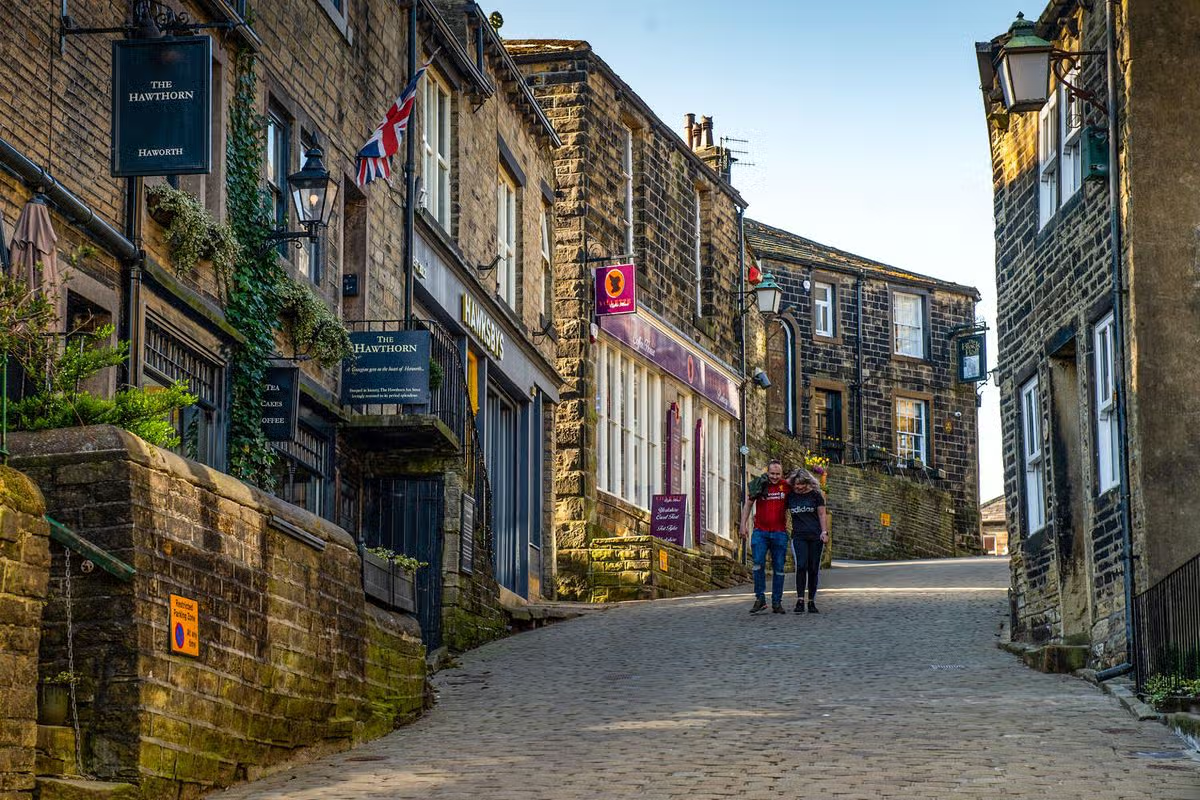
Tucked away at a right angle off the bustling high street, you’ll find Gandy Street – a crooked, cobbled lane that looks remarkably like Diagon Alley.
To find it, you’ll have to venture down an opening between Urban Outfitters and Costa – and many visiting the city actually miss this.
The lane then opens up into a magical world of bunting, twinkling lights and higgidy-piggidy shops.
While the film‘s Diagon Alley is actually a film set, the resemblance is clear.
According to Warner Brothers Studio Tour, the design of Diagon Alley was inspired by Charles Dickens’ descriptions of London.
However, director Chris Columbus realised that not many places look like 19th century London anymore, so a set for Diagon Alley was built specifically for filming.
Misshapen buildings tower over the lane and there is a flea market vibe similar to that of the bird cages and antique-style signs hanging from Diagon Alley’s shopfronts.
The entire street has dark-stone architecture, just like the gloominess of Diagon Alley.
Though the colourful shopfronts brighten the street in the same way Weasleys’ Wizard Wheezes does for Diagon Alley.
While Diagon Alley boasts Flourish and Blotts, Mr Mulpepper’s Apothecary, Gringotts Wizard Bank and OIlivanders wand shop, Gandy Street has its own destinations worth visiting.
You might not be able to gobble a Chocolate Frog, but you can dive into Chococo for a hot chocolate.
At the Makers Market, you will find magical trinkets created by local sellers such as handmade handbags and quirky prints.
For pretty and unique jewellery head to Silver Lion and for gifts drop by Moko.
The Vaults nightclub is even compared to Gringotts BankCredit: Alamy
Even The Vaults nightclub looks a bit like Gringotts Bank, though don’t expect to find a dragon – just good cocktails.
If you are hungry there are a couple of spots on the street to grab a bite to eat including Red Panda, where you can grab a bao bun and salad for under a tenner.
For another interesting spot nearby, venture to Parliament Street which is thought to be the narrowest street in the UK and one of the narrowest in Europe.
It dates back to the 14th century and at its narrowest point measures only 63.5cm.
And your adventure around the city doesn’t have to end there…
Make sure to head to the Cathedral Quarter, where – in my opinion – you’ll find one of the most breathtaking cathedrals in the UK.
The 12th century Gothic cathedral has the “longest unbroken stretch of Gothic vaulting” remaining in the world, according to Visit Exeter, measuring 91metres – about the same as the height of Big Ben.
Whilst in the city, make sure to also head to the CathedralCredit: The Sun – Cyann Fielding
Our favourite UK hotels
*If you click on a link in this box, we will earn affiliate revenue.
Margate House, Kent
This stylish boutique hotel is in a seaside townhouse, a short walk from Margate’s coolest bars and restaurants. Decked out with plush velvet sofas, candles flickering and striking independent art, inside feels like a warm welcome home. Rooms are stunning, especially the ones that give you a glimpse of the sea.
The Alan looks extremely grand, being built into a beautiful Grade II listed building. Spread across six floors, with 137 rooms, each one looks like a fancy design magazine. From the concrete coffee tables to the pink plastered walls, the industrial-inspired designs perfectly replicate the history of the city.
This historic hotel has welcomed the likes of Charles Dickens and Lillie Langtry through its doors. Rooms have richly-patterned carpets with super soft bed linen and premium toiletries in the bathroom. Go for a superior room for extra goodies including bathrobes and snack boxes.
This Cambridge hotel is in the ideal spot, within walking distance to bars, shops and hotspots like the university colleges and Parker’s Piece. The inside couldn’t be prettier, with huge stained glass windows, grand chandeliers, and rooms with enormous clawfoot bath tubs.
One of my favourite things to do here is enjoy the cathedral green and look at the 50-plus statues carved into the Salcombe and volcanic stone the cathedral is built out of.
Make sure to explore the lower part of the high street as well, just a short walk from the cathedral.
Here you’ll find most of the independent businesses in the city including cosy cafes and McCoys Arcade, which is home to a number of shops including a book store and record store.
If you do want to head to some of the bigger brand names, walk to the very top of the high street where you will find the likes of Lush, John Lewis, Next and Waterstones.
The best part to visiting the city? Unlike Harry, you won’t need to tap your wand on the wall to get in… You just need a train ticket to Devon.
A ‘NOVEL coat’ has been launched which holds 48 books in 12 compartments
How’s this for a book jacket – a ‘novel coat’ has been launched to help travellers who want to take their beach reads on holiday.
Sign up for the Travel newsletter
Thank you!
Modelled by Sunday Times Best Seller and TV personality, Charlotte Crosby, the unusual outerwear has a total of 12 compartments on the front and the backCredit: SWNS
Modelled by Sunday Times Best Seller and TV personality, Charlotte Crosby, the unusual outerwear has a total of 12 compartments on the front and the back.
The coat has enough space to carry 48 books at once, in a cheeky nod to getting around suitcases full of holiday clothes, many of which will come home unworn anyway.
It was released by loveholidays to encourage people to pick up a book on their travels, after the National Literacy Trust reported reading rates are at a 20-year low.
The tongue-in-cheek coat comes after a poll of 2,000 UK holidaymakers found 27 per cent of items packed for a trip are never actually worn.
Meanwhile 57 per cent overpack by filling their bag up to the brim with clothes every single time – and more than a quarter (26 per cent) take too many pairs of shoes on holiday.
Charlotte Crosby said: “I’m absolutely made up with this coat, I love it. I can carry all my holiday reads and all the outfits I’ve planned for my trip.
“Reading is a key part of my holiday, but I am also a serial over-packer and have to sit on my suitcase to zip it up every time as I take too many clothes with me.
“With this coat I’ll never have to worry about leaving enough space for my books ever again.”
Al Murray, a spokesperson for online travel agent, loveholidays, which also commissioned the research, said: “It’s easy to stuff your suitcase with too many clothes – leaving less room for the things that matter, like that bestselling thriller you’ve been dreaming of reading by the pool.
“For many, a good book is the perfect way to truly switch off, so making space for a few great reads can make all the difference to a relaxing escape.”
The study went on to find the reasons for overpacking include those ‘just in case outfits’ that never get worn (62 per cent) and unexpected weather (52 per cent).
Two in 10 of those polled by OnePoll reckon they never seem to leave enough room in their luggage for books.
Of those who don’t prioritise books when packing, 23 per cent said they didn’t think they were as essential as other items, and the same number didn’t think they will have enough time to read while away.
Despite this, among those who enjoy reading on their travels, 61 per cent said it relaxes them deeply, and 49 per cent credit having no time pressure and it being a screen-free joy.
Exactly one in 10 of those that take books on holidays don’t read as much as they’d like while they’re away.
Since 31 per cent of them struggle to find quiet time or space to read, 30 per cent end up spending time with family or friends instead and 28 per cent get distracted by their phone or social media.
bPlus 18 per cent of all travellers admitted they would take more novels abroad if they had more space in their suitcase.
Al Murray added: “So many holidaymakers love to read but just don’t end up getting to read as many books as they’d like while on their travels.
“And with people admitting they stuff too many things in their cases that they don’t even need while they’re away, it’s a fun reminder to pack smarter and make space for the stories that help turn a good holiday into a great one.”
TOP 25 HOLIDAY READS:
1. The Thursday Murder Club 2. The Time Traveller’s Wife 3. Where the Crawdads Sing 4. The Housemaid 5. The Couple Next Door 6. It Ends With Us 7. The Holiday 8. The Alchemist 9. Me Before You 10. One Day 11. The Seven Husbands of Evelyn Hugo 12. Normal People 13. The Midnight Library 14. The Road Trip 15. Eleanor Oliphant is Completely Fine 16. Big Little Lies 17. The Island 18. The Secret Life of Bees 19. Lessons in Chemistry 20. It Starts With Us 21. Daisy Jones and The Six 22. The Satsuma Complex 23. Crazy Rich Asians 24. My Brilliant Friend 25. Rachel’s Holiday
Al Murray added: “So many holidaymakers love to read but just don’t end up getting to read as many books as they’d like while on their travels”Credit: SWNS
LENA Dunham has made claims that a ‘feral’ Adam Driver screamed and ‘hurled a chair’ on the set of Girls after she missed her lines.
In the show created and starring Lena, 39, her character Hannah Horvath was in an on-off relationship with Adam’s character Adam Sackler.
Sign up for the Showbiz newsletter
Thank you!
Lena Dunham and Adam Driver starred opposite each other in GirlsCredit: AlamyLena has made a slew of accusations against AdamCredit: AlamyLena’s new book, Famesick, was released this weekCredit: GettyAdam played Lena’s character’s on-off partner in the showCredit: Getty
In Lena’s brand new memoir Famesick, the actress alleges that her Girls co-star, 42, exhibited “violent” and “feral” behavior on the set of the popular HBO series.
She even described him as “spectacularly rude” and recounted instances of him allegedly screaming and throwing furniture.
Lena described Adam as “half-man, half-beast” as she claimed how Adam was “occasionally violent”.
In one part of the book, Lena alleged Adam threw a chair at the wall next to her when they were running lines.
Lena claimed she was unable to get her words out but says this was due to her dissociating because of her then-undiagnosed endometriosis.
In her book, Lena recalled: “I remember doing a fight scene with Adam and how scary it was to meet someone so totally present with such absence.
“Late one night, as we practiced lines in my trailer, I found that mine were suddenly gone. I knew I’d written them. I’d known them only minutes before.
“But when I opened my mouth, all that came out was a stammer—until finally, Adam screamed, ‘F**KING SAY SOMETHING’ and hurled a chair at the wall next to me.”
Most read in Entertainment
She then alleged he said: “WAKE THE F**K UP,” adding how he allegedly fumed: “I’M SICK OF WATCHING YOU JUST STARE.”
The U.S. Sun reached out to Adam’s representative for comment.
Lena went on to say that she said her lines correctly after the incident.
She later noted: “Adam hated his new haircut and had punched a hole in his trailer wall.”
Lena also opened up about sex scenes in Girls and how intimacy coordinators were used far less frequently at the time of the show being in production.
But Lena wanted to cultivate a “safe” environment on set when it came to sex scenes.
She claimed in her book how the “careful blocking went out of the window” when filming intimate scenes, because Adam would allegedly “hurl me this way and that”.
Lena alleged: “Part of me was afraid that when I turned around, I would find I was suddenly in a full-penetration 1970s porno.
“But after a few mimed thrusts, I called cut,” she wrote.
According to Lena, when Adam wrapped his final scene for Girls, at the end of season six in 2016, he told her: “I hope you know I’ll always love you.”
She then revealed how she “never heard from him again” after that.