Democrats bury 2024 autopsy report, angering some in the party
Democrats are starting the new year on a high.
A series of 2025 victories, in red and blue states alike, was marked by a striking improvement over the party’s 2024 showing. That over-performance, to use the political term of art, means candidates — including even some who lost — received a significantly higher percentage of the vote than presidential candidate Kamala Harris managed.
That’s a strong signal ahead of the midterm election, suggesting Democratic partisans are energized, a key ingredient in any successful campaign, and the party is winning support among independents and perhaps even a few disaffected Republicans.
If history is a guide and the uneven economy a portent, Democrats will very likely seize control of the House in November, picking up at least the three seats needed to erase the GOP’s bare majority. The Senate looks to be a longer — though not impossible — reach, given the Republican lean of the states being contested.
In short, Democrats are in much better shape than all the black crepe and existential ideations suggested a year ago.
Yes, the party suffered a soul-crushing defeat in the presidential race. But 2024 was never the disaster some made it out to be. Democrats gained two House seats and held their own in most contests apart from the fight for the Senate, where several Republican states reverted to form and ousted the chamber’s few remaining Democratic holdouts.
Still, Democrats being Democrats, all is not happiness and light in the party of Jefferson, Jackson, Clinton and Obama.
Campaigning to become the party’s chairman, Ken Martin last winter promised to conduct a thorough review of the 2024 election and to make its findings public, as a step toward redressing Democrats’ mistakes and bolstering the party going forward.
”What we need to do right now is really start to get a handle around what happened,” he told reporters before his election.
Now Martin has decided to bury that autopsy report.
“Here’s our North Star: Does this help us win?” he said in a mid-December statement announcing his turnabout and the study’s unceremonious interment. “If the answer is no, it’s a distraction from the core mission.”
There is certainly no shortage of 2024 election analyses for the asking. The sifting of rubble, pointing of fingers and laying of blame began an eye blink after Donald Trump was declared the winner.
There are prescriptions from the moderate and progressive wings of the party — suggesting, naturally, that Democrats absolutely must move their direction to stand any chance of ever winning again. There are diagnoses from a welter of 2028 presidential hopefuls, declared and undeclared, offering themselves as both seer and Democratic savior.
The report Martin commissioned was, however, supposed to be the definitive word from the party, offering both a clear-eyed look back and a clarion way forward.
“We know that we lost ground with Latino voters,” he said in those searching days before he became party chairman. “We know we lost ground with women and younger voters and, of course, working-class voters. We don’t know the how and why yet.”
As part of the investigation, more than 300 Democrats were interviewed in each of the 50 states. But there was good reason to doubt the integrity of the report, even before Martin pulled out his shovel and started digging.
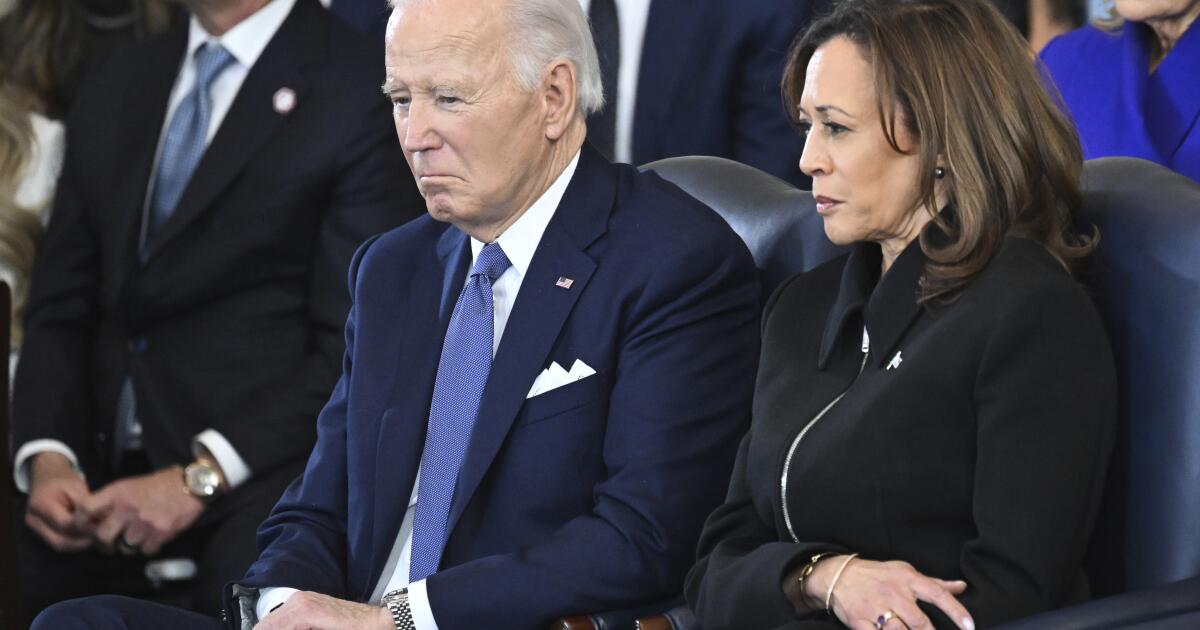
According to the New York Times and others, there was no plan to examine President Biden’s headstrong decision to seek reelection despite his advanced age and no intention to second-guess any of the strategic decisions Harris made in her hurry-up campaign.
Which is like setting out to solve a murder by ignoring the weapon used and skipping past the cause of death.
Curious, indeed.
Still, there was predictable outrage when Martin went back on his promise.
“This is a very bad decision that reeks of the caution and complacency that brought us to this moment,” Dan Pfeiffer, an alumnus of the Obama White House, posted on social media.
“The people who volunteered, donated and voted deserve to know what went wrong,” Jamal Simmons, a former Harris vice presidential advisor, told the Hill newspaper. “The DNC should tell them.”
In 2013, Republicans commissioned a similar after-action assessment following Mitt Romney’s loss to President Obama. It was scathing in its blunt-force commentary.
The 98-page report said a smug, uncaring, ideologically rigid party was turning off voters with stale policies that had changed little in decades and was unhelpfully projecting an image that alienated minorities and young voters.
Among its recommendation, the postmortem called on the party to develop “a more welcoming brand of conservatism” and suggested an extensive set of “inclusion” proposals for minority groups, including Latinos, Asians and African Americans. (DEI, anyone?)
“Unless changes are made,” the report concluded, “it will be increasingly difficult for Republicans to win another presidential election in the near future.”
Trump, of course, won the White House three years later doing precisely none of what the report recommended.
Which suggests the Democratic autopsy, buried or otherwise, is not likely to matter a whole lot when voters go to the polls. (It’s the affordability, stupid.)
That said, Martin should have released the appraisal and not just because of the time and effort invested. There was already Democratic hostility toward the chairman, particularly among donors unhappy with his leadership and performance, and his entombing of the autopsy report won’t help.
Martin gave his word, and breaking it is a needless distraction and blemish on the party.
Besides, a bit of thoughtful self-reflection is never a bad thing. It’s hard to look forward when you’ve got your head stuck in the sand.