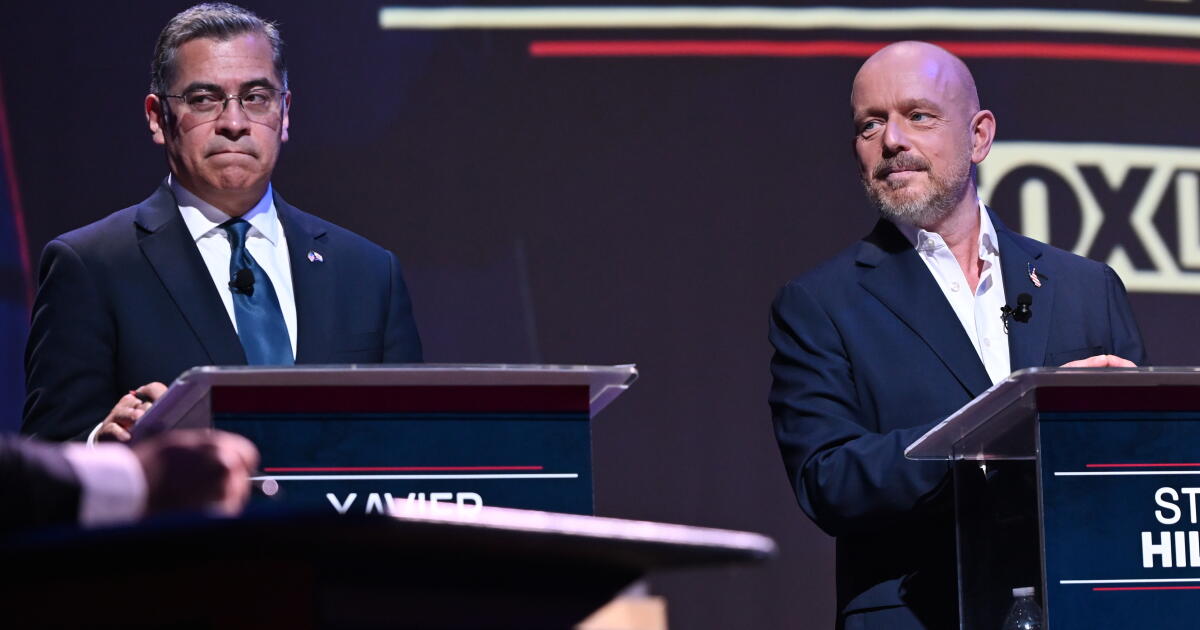
Live chat: Times columnists analyze the CNN Hilton-Becerra debate
Xavier Becerra has made a campaign out of saying nothing. Steve Hilton will seemingly say anything to anyone as long as there’s a microphone.
Neither dynamic is promising for voters tuning into Wednesday night’s televised debate on CNN with the two candidates vying to replace Gavin Newsom as California’s new governor.
But don’t worry, Golden State voters — Times columnists Gustavo Arellano, Mark Z. Barabak and Anita Chabria are watching every minute, every second, really, to bring you the zingers, gaffes and hopefully maybe even some insights.
*
Chabria: Let me start things off by saying my hope is that Hilton will push Becerra into specifics around issues including affordability, what we’re going to do about the coming Medicaid cliff, housing and education. California has been focused on raising up our most vulnerable and struggling residents for years — which is important.
But the middle class is suffering now, too, in all those areas. Hilton is right that the status quo isn’t working. That’s going to be a challenge for Becerra when he gets into office (and honestly, he could vacation in Hawaii until November and still get elected), so I’ll be looking for answers on how he plans to lift all boats.
Barabak: There will be much critiquing to come, so let me start by paying both gentleman a compliment.
Hilton has been campaigning hard, as though he has more than the merest speck of a chance of pulling an epic upset and somehow prevailing. Good for him!
And Becerra, who’s made himself exceedingly scarce, is stepping up and debating, as he should. And he’s not being cute about it, insisting on, say, a midnight appearance on local cable TV in Alturas. So props for that.
Arellano: I’m hoping that Becerra will once again channel his inner cholo, as I urged him to during the primary.
The Tío Xavier persona that Becerra supporters have trotted out — a kind, chuckling sage — isn’t what California needs right now. Becerra knows that the most loved uncles in Latino households aren’t the safe, boring ones but the ones who risked it all: the ones who came into this country without papers, who pulled themselves up by their bootstraps so that their kids could drive hybrids, and who proudly warble “El Rey” during the mariachi portion of the latest family wedding instead of sit quietly at the table.
We need the loco uncle, Xavier, not the fresa — uppity — one.
And I’m hoping Hilton will rebuke Donald Trump. I know, I know: there’s a better chance of England winning the FIFA World Cup than that ever happening.
But if there’s an iota of hope for the British expat to beat Becerra, it can only happen by him showing Californians that he’s willing to stand up to the loathed president instead of cozying up to him.
Otherwise, as a famous Brit once sang backed by sinuous xylophones, “Baby, baby, baby, you’re out of time.”
Insights
L.A. Times Insights delivers AI-generated analysis on Voices content to offer all points of view. Insights does not appear on any news articles.
Viewpoint
Perspectives
The following AI-generated content is powered by Perplexity. The Los Angeles Times editorial staff does not create or edit the content.
Ideas expressed in the piece
- Chabria argues that the debate should press Becerra for concrete plans on affordability, the coming Medicaid funding cliff, housing and education. In particular, the piece says California’s middle class is struggling and that the status quo is not working, leaving Becerra with a challenge if elected.
- Barabak welcomes both candidates’ participation: Hilton, for campaigning energetically despite his long odds, and Becerra, for agreeing to a televised debate rather than avoiding the encounter.
- Arellano contends that Becerra should project a more forceful, less cautious persona, drawing on the immigrant and working-class experience of Latino families. The column also argues that Hilton would need to show independence from President Trump to make a stronger case to California voters.
Different views on the topic
- A contrasting case for Hilton’s candidacy is that California needs a sharp break from current policies. Hilton has proposed eliminating state income taxes on the first $150,000 of earnings and says he would offset the lost revenue with budget cuts; he has also blamed climate policies and regulations for high fuel costs.[3][1]
- Becerra’s record of public proposals complicates the article’s portrayal of a candidate who has made a campaign out of saying little: his platform calls for expanding housing construction, streamlining approvals and addressing utility and insurance costs. At the same time, his healthcare proposals have been described as broad rather than detailed, lending weight to calls for greater specificity.[4][2][3]
- The candidates also offer different approaches to affordability. Hilton has promised to unwind policies he blames for high costs, while Becerra says the state should maintain environmental standards as it works to lower costs and stabilize fuel supply.[3][1]