Alau

Conflicting Warnings Issued as Overfilled Alau Dam Releases Water, Sparks Panic 
Residents of Maiduguri, capital of Borno State, North East Nigeria, who live near the Alau Dam and its downstream channel, are in a state of confusion, grappling with conflicting government directives on the dam’s water release. The mixed messages are sparking widespread concern over potential flood risks.

The conflicting messages from these two key government bodies have left residents uncertain about the immediate danger and the appropriate course of action. While the Chad Basin Development Authority (CBDA) suggests a controlled release of the dam that shouldn’t cause panic, the State Emergency Management Agency (SEMA) is demanding immediate evacuation, indicating a potentially serious flood threat.

“We really don’t know which warning or advisory to follow now,” said Yunus Isa, a resident whose house was submerged in the devastating September flood last year. “I hope we will not be left in the darkness about reality until it is too late.”

The September flood resulted from the breakdown of the Alau Dam after years of neglect and warnings that the flood would happen. It swept through several local government areas of Borno State and affected about one million residents, according to the emergency management agency. HumAngle investigations found money trails that were allocated to the repair of the dam over the years, yet the repairs never happened.

This Wednesday, the CBDA announced the opening of the Alau Dam’s spillway gates to release water downstream. In a special announcement, they tried to calm fears, stating, “The general public should note that the spillway gates of the Alau Dam have been opened for water in the reservoir to spill downstream steadily… people, especially those living within the River Ngadda and Gwange area, should not panic by seeing the water passing through its normal way.” 

CBDA’s Executive Director for Engineering, Engr. Mohammed Shettima, who signed the statement, added that the authority would keep monitoring the dam’s activities until water levels recede.

However, SEMA has issued an urgent public notice concerning the dam’s water release with a stern directive: “Evacuate Immediately: All communities and individuals living or working near the Gadabul River and its tributaries must relocate to higher ground without delay.” SEMA further cautioned against approaching riverbanks, citing “strong currents and sudden surges” as “life-threatening hazards,” and advised residents to secure property and stay informed through local media.

When contacted for clarity, Borno State Permanent Secretary for Information and Internal Security, Aminu Chamalwa, stated that his ministry has reviewed both press statements and will address the matter on Friday to prevent any miscommunication.

The current confusion over the Alau Dam’s water release comes nearly a year after its catastrophic collapse and months after the Federal Government inaugurated a significant reconstruction project. The Federal Ministry of Water Resources and Sanitation held a groundbreaking ceremony in March this year for a crucial ₦80 billion project to reconstruct, dredge, and upgrade the vital infrastructure. However, despite that formal flag-off, nearly 120 days later, no significant work has reportedly been done on the dam.

Residents of Maiduguri are confused by conflicting government directives about the Alau Dam’s water release, causing concern over potential flood risks. The Chad Basin Development Authority suggests a controlled release with no need for panic, while the State Emergency Management Agency advises immediate evacuation, citing serious flood threats.

Last year, the Alau Dam’s breakdown led to a devastating flood affecting nearly one million residents following years of neglect despite allocated funds for repairs. Although the spillway gates have been opened for a steady water release downstream, residents are advised by SEMA to evacuate immediately due to life-threatening conditions.

The confusion comes nearly a year after the collapse and months after the Federal Government launched a reconstruction project for the dam. However, despite the formal launch of an N80 billion reconstruction plan in March, no significant repairs have been made to date.
Source link

Borno Communities Fear Repeat Floods as Alau Dam Remains Unrepaired

Every weekday, 38-year-old Fatima Musa grips her son’s hand as they step onto a makeshift bridge in Fori, a community in Jere Local Government Area (LGA) of Borno State, northeastern Nigeria. Together, they cross the poorly constructed structure to reach the primary school he attends, and later make the same journey home.

The original Fori Bridge collapsed during the devastating floods of September 2024, which inundated Maiduguri and its environs, leaving dozens dead and thousands displaced. The destruction severed vital connections between Bama Park and Market, the University of Maiduguri, and several neighbourhoods.

With no official intervention, local youths erected a makeshift crossing far from Fatima’s home. Constructed from wooden planks, logs, and sand-filled sacks, the narrow bridge hovers precariously over the Ngadda River, the same river that swept away homes, businesses, and livelihoods just months ago.

The disruption forced residents like Fatima to undertake perilous detours or depend on the makeshift bridge, which is far away from her home. 

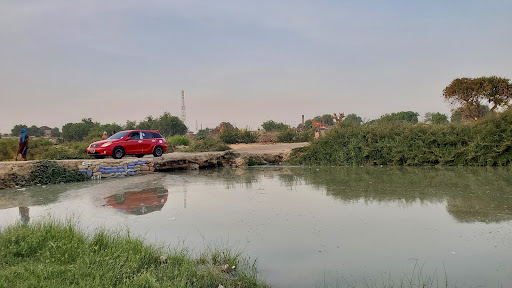
A red car is parked on a narrow bridge over a calm river with greenery and a person nearby under a clear sky.
A car crossing the Fori makeshift bridge. Photo: Abubakar Muktar Abba/HumAngle

The community’s improvised fix has restored a semblance of connectivity, but it is fragile. In less than two months, seasonal rains will return, swelling the Ngadda once again. Residents told HumAngle they fear the structure will be destroyed, cutting them off from schools, hospitals, and markets, and deepening the isolation they already face.

The original Fori Bridge, a vital link for residents across several communities in Jere, was the first structure to collapse when the floods ravaged the area. 

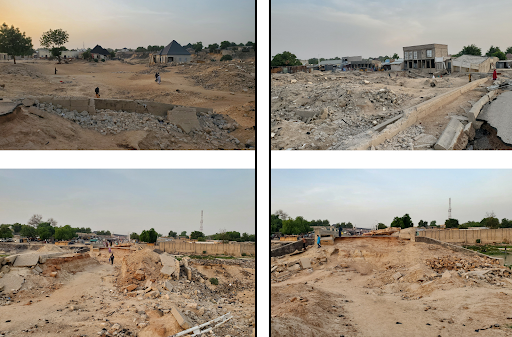
Construction site with debris and a partially built structure, surrounded by trees and a fence under a clear sky. People walking through.
A photo collage of the Fori Bridge showing different angles of the destroyed bridge, damaged nearby structures, and large gaping holes that pedestrians carefully manoeuvre around in their daily routines. Photo: Abubakar Muktar Abba/HumAngle

A student’s dread

For 27-year-old Zainab Yahaya, a student at the University of Maiduguri, the broken bridge is more than a daily inconvenience, it threatens her future. She crosses the makeshift bridge every day to attend classes. As the rainy season looms, her anxiety increases.

“I use the makeshift bridge now, but when the water returns, the bridge won’t survive it,” she said. “And then, everything becomes more difficult, more expensive, more dangerous and more exhausting.”

Last year’s flood destroyed her neighbourhood. This year, she fears her education may be next. Without the bridge, Zainab would be forced to take longer detours that significantly increase both cost and travel time.

“What used to cost ₦100 will now jump to ₦400,” she explained. “And the hours I lose taking detours, it’s hard to keep up with school. I will be exhausted before I reach class.”

Crossing by canoe is not an option she trusts. “It’s dangerous. The water is unpredictable, the canoes are unstable, and sometimes you don’t even know if the person paddling them is a professional or not,” Zainab added.

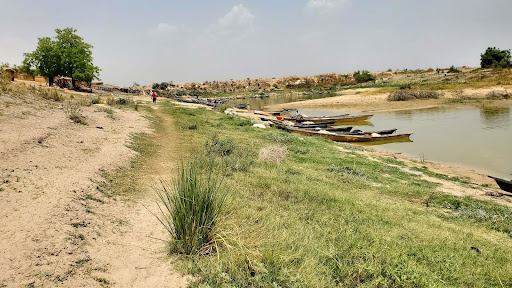
Riverbank with several wooden boats, a grassy path, and scattered trees under a clear sky.
Canoes are parked at the shallow river banks. Photo: Abubakar Muktar Abba/HumAngle 

Her frustration is echoed throughout the community. “The government hasn’t done anything tangible. No repairs, no support, not even a visit,” she says. “We’re left on our own.”

A cycle doomed to repeat

A HumAngle investigation published in 2024 traced the flood’s origins to a combination of infrastructural decay, poor planning, and delayed emergency response at the Alau Dam.

Originally designed in 1986 to hold 112 million cubic meters of water, the dam’s capacity has swelled to an estimated 279 to 296 million cubic meters, primarily because of unchecked sediment buildup. 

Every year, during the June-to-September monsoon, stormwater flows from the Mubi highlands into the Yedzeram River. This major tributary quickly swells and merges with the Gambole River, before entering the wetlands of the Sambisa Forest to form the headwaters of the Ngadda.

From there, the Ngadda empties into Lake Alau, held back by the Alau Dam, a large reservoir on the outskirts of Maiduguri. When rainfall is heavy upstream, the rivers surge downstream with little delay, raising water levels sharply in Lake Alau.

The dam is gate-controlled, designed to hold and release water in a regulated manner.

However, another dam downstream lacks this control. Without gates, it simply overflows once water reaches a certain level, releasing torrents into vulnerable communities with no warning. This unregulated spillway worsened last year’s catastrophe in Maiduguri.

In February, the federal government announced a ₦80 billion rehabilitation and expansion project for the Alau Dam to prevent any disaster in the future. On March 2, the Minister of Water Resources and Sanitation, Joseph Utsev, officially flagged off the project, stating it would be executed in two phases over 24 months.

Yet, a visit by HumAngle to the site in May painted a different picture.

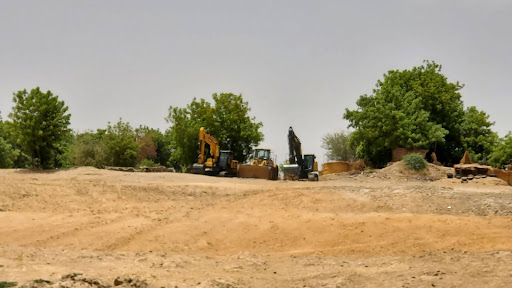
Three bulldozers sat idle in the sun. No workers were present. The dam, still visibly broken, lay open like an unhealed wound. A makeshift sand barrier was the only sign of intervention, containing stagnant water where a flowing river once ran.

Construction equipment on a dirt clearing surrounded by trees under a cloudy sky.
Three bulldozers were parked near the dam. Photo: Abubakar Muktar Abba/HumAngle

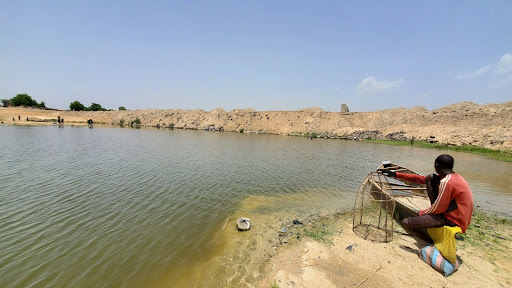
Nearby, fishermen cast their nets into the shallow puddles, making do with what remains of their vanishing livelihood. 

“They [referring to government contractors] brought those bulldozers months ago,” said Musa, a wiry young man watching the water. “All they did was pile sand to block the flow. Since then, nothing.”

Adamu, another resident and a fisherman, leaned against a tree and shook his head. “This sand is like candy floss,” he muttered. “It will melt when the floods come. Then we’ll flood again.”

Person sitting near a pond with fishing gear, looking at the water under a clear sky.
A fisherman gazes at the pond, waiting patiently for a sign from his fish trap. Photo: Abubakar Muktar Abba/HumAngle

At 53, Bulama Isa no longer moves with the vigour of his youth. Yet he frequently walks his farmland along the banks of the Ngadda River, inspecting what remains of his farmland. 

“This place used to feed my whole family,” he says, gesturing at the gaping holes where his garden once stood. “Now I don’t have a farm.” Isa has farmed near the Alau Dam since the early 2000s. He watched the flood swallow his fields last September and his year’s harvest. When the water receded, he was left with a gaping hole. 

Now, with no compensation and no clear plan from the government, he survives on support from relatives and the little his wife makes selling fried groundnuts.

Residents who spoke to HumAngle expressed frustration over the lack of progress and now fear that this year’s flood could be even worse than the last. 

As of May 2025, neither the Fori Bridge nor the Alau Dam has been repaired. 

The Nigerian Meteorological Agency (NiMet) has projected that the onset of the rainy season in Borno State will occur between early June and July 2025. In northern states, flooding will likely occur at the peak of rainfall between July and September, according to NiMet. Urban areas with poor drainage systems are particularly at risk of flooding during this period.

HumAngle reached out to the Ministry of Water Resources through the state commissioner, Tijjani Goni Alkali, to inquire about the project’s status and the concerns of nearby communities. As of press time, no response had been received.

With the forthcoming rains, many fear that their lives will be uprooted once again.

Source link