Venezuela: Rice Producers Denounce Agribusiness Pressure, Demand Gov’t Support for Fair Prices
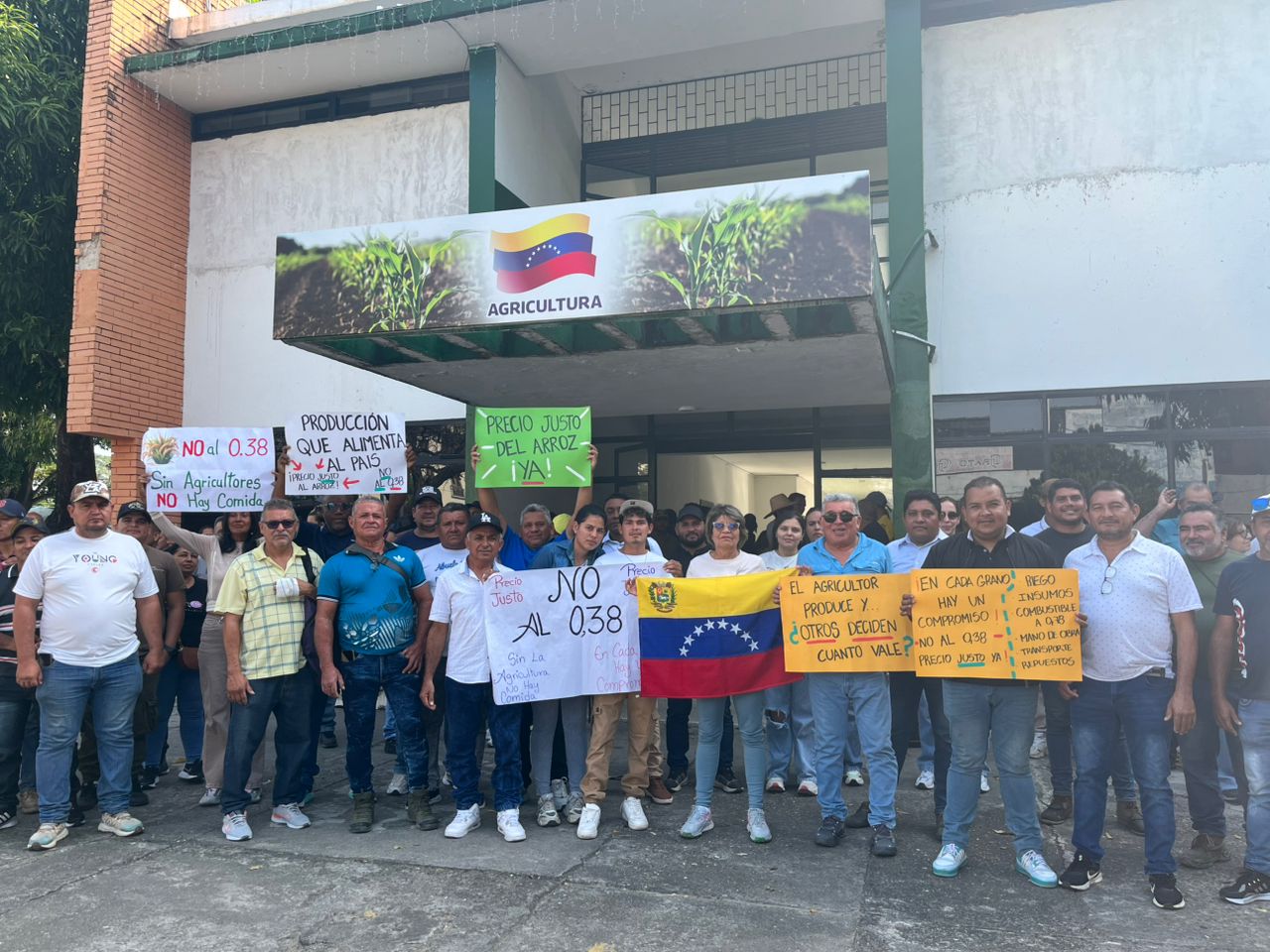
Demonstration outside the agriculture ministry’s office in Acarigua, Portuguesa state. (Archive)
Caracas, February 25, 2026 (venezuelanalysis.com) – Venezuelan rice producers have staged demonstrations in recent days, demanding responses from authorities to secure fair prices for their harvests.
Campesino organizations from Barinas, Cojedes, Guárico, and Portuguesa states have held meetings with their respective governors and local representatives of the Agriculture Ministry to denounce pressure from agribusiness conglomerates imposing lower prices for their crops.
Victor Martínez, a rice producer and representative from a rural association in Portuguesa state, told Venezuelanalysis that there is an urgent need to establish appropriate crop prices with harvesting set to begin in the coming days.
“We are calling on the Venezuelan government, from Acting President Delcy Rodríguez to Agriculture Minister Julio León Heredia, to intervene and help set fair prices for rice that take into account our production costs,” he explained. “We cannot have the agroindustrial conglomerates imposing prices unilaterally.”
According to Martínez, rural producers sold rice crops at $0.50-0.55 per kilogram last year, and presently the Iancarina group, the biggest agribusiness firm in Portuguesa state, is offering $0.32-0.38 per kilo. Iancarina holds significant market shares nationwide in corn flour and rice distribution with its “Mary” brand and has ties to the US-based transnational commodities marketer GSI Food.
“These prices would mean the extinction of rice production, jeopardizing thousands of jobs in the countryside,” Martínez continued. “We urge authorities to establish dialogue mechanisms that take our production costs into account.”
The rice growers additionally denounced that corporations have recently imported rice to drive down crop prices and that Venezuelan producers cannot compete with international prices due to “exorbitant production costs.” AgroPatria, a state-owned company that supplied agricultural inputs to campesinos, was turned over to private group AgroLlano in 2020.
Martínez stated that $0.70 per kilo of rice is the price Portuguesa producers have set as a target in negotiations.
“There are too many hurdles to produce right now, from very expensive inputs to a lack of access to credit,” he went on to add. “The same agroindustry corporations offer financing but with draconian conditions and our profit margins vanish.”
According to Martínez, current financing agreements see companies supply inputs and then collect as much as 60 percent of the crop as payment.
“Agribusiness oligopolies say that they are better off just importing rice, which carries no risk for them. But no country can survive without agriculture.” He concluded with a call for halting imports and extending state support to campesino producers.
In recent days, rural collectives in different states have shared their production costs and come up with different proposals for Venezuelan authorities. They are likewise weighing the possibility of staging a rally in Caracas to demand the intervention of the Agriculture Ministry. Venezuelan government officials have yet to comment on the controversy.
In recent years, with the economy heavily constrained by US sanctions, the Nicolás Maduro government moved to liberalize agricultural policies, transferring former state competencies to the private sector, including provisioning of seed and fertilizer inputs and access to tractors. Fuel subsidies have likewise been phased out, with small-scale producers denouncing it as a major factor driving up production costs.
Campesino collectives have repeatedly drawn attention to a growing agribusiness influence both in the supply of inputs and the commercialization of harvests. Food conglomerates have used their control of silos and retail channels as well as imports during harvest season, to drive up profit margins by imposing lower prices on producers.
Apart from rice, farmers have condemned similar coercive practices with sugar and coffee. Standoffs have traditionally led to mediation from state authorities and a temporary agreement on prices. However, campesinos have repeatedly alerted that agribusiness firms stop honoring established prices or delay payments to take advantage of the Venezuelan currency devaluation.
Edited by Lucas Koerner in Fusagasugá, Colombia.