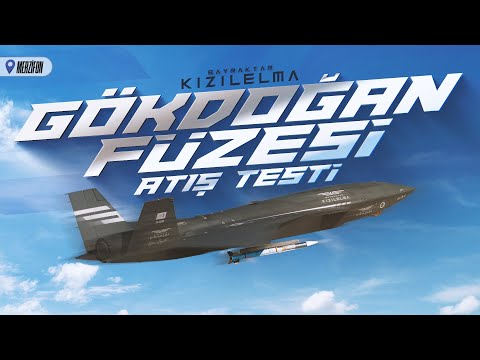
Turkish industry and media alike have heralded the recent live-fire test in which a Kizilelma uncrewed combat air vehicle (UCAV) used a Turkish-made air-to-air missile to destroy a target drone. Turkey claims the test marks the first occasion a UCAV has launched a radar-guided air-to-air missile. But, while undoubtedly impressive, there are unanswered questions about how the engagement actually played out, especially to what degree the UCAV was being controlled by crewed fighter jets.

Outside of radar-guided missiles, it’s worth noting that the idea of drones firing air-to-air missiles is far from new. For example, in 2002, an urgent development program put infrared-guided AIM-92 Stinger air-to-air missiles on a U.S. Air Force MQ-1 Predator drone. A Stinger-armed Predator even fired at an Iraqi MiG-25 Foxbat, before the fighter downed the drone. The United States has also long explored the idea of employing MQ-9 Reapers in the air-to-air role, at least for self-defense. In a test in 2017, a Reaper successfully downed a target drone using an AIM-9X Sidewinder air-to-air missile. Earlier this year, it emerged that an MQ-9 was used to try and intercept an unidentified object in the air off the coast of Yemen in 2024. As you can read about here, this would appear to be the first known instance of a Reaper engaging an aerial target of any kind in an operational setting.
Returning to the Turkish test, this was conducted on November 28 and announced yesterday. A video released by Baykar, manufacturer of the Kizilelma, shows the UCAV — specifically aircraft PT-5 — taking off, together with four Turkish Air Force F-16s. In all, five F-16s were involved in the live-fire test, including one that served as a safety chase plane. An Akinci high-altitude long-endurance UCAV also flew chase duties.

The Kizilelma was fitted with two Gökdoğan air-to-air missiles on external pylons. One of these was apparently inert, while the other, a powered missile (under the starboard wing), was fired at a target drone. It should be noted that external weapons carriage would degrade the radar signature reduction measures that the manufacturer says it has built into the UCAV. However, the drone is also planned to carry stores in an internal weapons bay, which would preserve such measures.
Developed by TÜBİTAK SAGE, the beyond-visual-range (BVR) Gökdoğan — which means peregrine — features radar guidance and reportedly has a range of around 40 miles. The Gökdoğan is slated to eventually replace the AIM-120 Advanced Medium-Range Air-to-Air Missile (AMRAAM) in the Turkish Air Force inventory, and you can read more about it here.

The video shows the Gökdoğan missile climbing after launch, putting it on a lofted trajectory, which improves its kinetic energy and allows it to hit targets at longer ranges. Footage captured from the target drone then records an almost-direct head-on impact with the incoming missile.
The Turkish Air Force commander, Gen. Ziya Cemal Kadıoğlu, announced the live-fire test with the following statement:
“Today, we have opened the doors to a new era in aviation history. For the first time in the world, an uncrewed combat aircraft fired an air-to-air missile with radar guidance and hit an aerial target with perfect accuracy. Our entirely indigenous and original Bayraktar Kizilelma successfully completed this historic mission with Aselsan’s Murad radar and the BVR active-radar-guided Gökdoğan missile … Turkey has become the first country in the world to achieve this. The Turkish Armed Forces have [made] history, and the doors to next-generation aerial warfare have been opened.”

Based on this statement, it’s not immediately clear if the Kizilelma UCAV acquired the target using the Murad active electronically scanned array (AESA) radar, or with its Toygun electro-optical sensor and targeting system, both of which were developed by Aselsan and have been previously tested on PT-5.
The possible use of the Toygun’s infrared search and track (IRST) system in the engagement is particularly interesting.
As we have discussed many times in the past, IRST sensors like this offer a very useful way of detecting and tracking aerial threats, especially stealthy aircraft and missiles, and can be used as an alternative and/or companion to radars. Unlike radars, IRSTs have the additional benefit of being immune to electronic warfare attacks. Since they operate passively, they don’t emit signals that could alert an opponent to the fact that they are being targeted.
Potentially, the firing solution as well as the in-flight updates for the Gökdoğan missile could have been provided by the Kizilelma’s onboard sensors, or from one or more of the accompanying F-16s, which would have then handed off the targeting information to the UCAV. In fact, the entire engagement could have relied on information datalinked from third-party assets, meaning the Kizilelma didn’t acquire the target itself.

There is also a question about whether the Kizilelma UCAV was controlled during the live-fire test by the F-16s, or from the ground, or a combination of both.
Having a UCAV controlled by a crewed tactical jet would be a very significant achievement for Turkey, with such capabilities currently limited to experimentation with higher-end U.S. and likely also certain Chinese drones. At the same time, it should be noted that we don’t currently know what might have been explored in the classified realm in either of these countries. Russia has reportedly flight-tested its S-70 Okhotnik UCAV with air-to-air missiles, but there is no evidence that they have been fired. Earlier this year, the U.S. Air Force carried out a notable mock mission in which an MQ-20 Avenger drone was controlled by a pilot in an F-22 Raptor, but the drone did not launch any weapons.
What is clear is that the Turkish test was very quick in the making.
Captive-carry trials of weapons on the Kizilelma were only started in September, beginning with homegrown air-to-ground munitions. The first launches of air-to-ground weapons, specifically inert examples of the Tolun glide bomb and the TEBER-82 guided bomb, were announced in October. Subsequently, the first flights with captive-carry Gökdoğan missiles took place 10 days before the live-fire test.
It may well be that Turkey was seeking to steal some of the thunder from Boeing, which in November announced that it was on track to conduct a first live-fire weapons shot from its MQ-28 Ghost Bat drone sometime this month. That test will involve an AIM-120 AMRAAM missile.

Boeing officials had said on various occasions earlier this year that the AMRAAM shot from an MQ-28 could come in late 2025 or early 2026.
Even before the live-fire test, the Kizilelma was an eye-catching program, as one of only a few fighter-type air combat drone projects to have resulted in hardware. The development of the Kizilelma began as long ago as 2013, although the project was only revealed to the public in July 2021, when conceptual studies were presented.
The UCAV is claimed to be supersonic (at least in later versions), have a degree of reduced-observable characteristics, and be tailored for the kinds of air combat missions typically undertaken by crewed fighter jets. In particular, it is eyed as being a drone companion to Turkey’s next-generation TF Kaan crewed fighter.

Powered by a single turbofan, the Kizilelma has a canard-delta configuration, of the kind seen on some other reduced-observable combat aircraft designs, and has canted vertical stabilizers.
The UCAV was flown first — albeit for a very short time — in December 2022, as you can read about here. That milestone came only weeks after the Kizilelma’s emergence for ground testing.

Overall, the design of the Kizilelma appears to be weighted more toward high performance than low observability.
With that in mind, the fact that it’s now taking part in air-to-air engagements, in a live-test environment, is especially relevant.
Taken together, it points toward the Kizilelma being envisioned for more fighter-like missions, including direct air combat with other platforms, rather than air-to-ground missions, although it is also being developed for these, and electronic warfare would be another likely role.
On the other hand, although the Kizilelma is being pitched for collaborative operations in support of crewed fighters, it remains unclear exactly how this concept will work.

It remains to be seen when the Kizilelma will become a true ‘loyal wingman’-type drone companion to crewed fighters, or if the drone will be controlled from a ground station until the capability to participate in collaborative operations proves out. In the past, it is thought that it will be used in both independent and collaborative operations, depending on the mission, but the level of onboard autonomy and networking needed to make the latter work remains a goal for the world’s most capable air arms.
Just as intriguing is whether the Kizilelma will, at some point, be expected to shoot down hostile aircraft with some degree of that aforementioned autonomy. The latter point is one that the U.S. Air Force, in particular, has been grappling with, as you can read about here.
Overall, however, the first live shot of a Gökdoğan air-to-air missile from the Kizilelma is another important step for the program, and for Turkey’s fast-expanding drone developments in general. While the details of the engagement may not be entirely clear, the high-profile test underscores the fact that the country has found a real niche here, especially when it comes to the development of armed drones.
Contact the author: thomas@thewarzone.com